'You can't keep everyone happy...': Rohit Sharma on India's squad for T20 World Cup
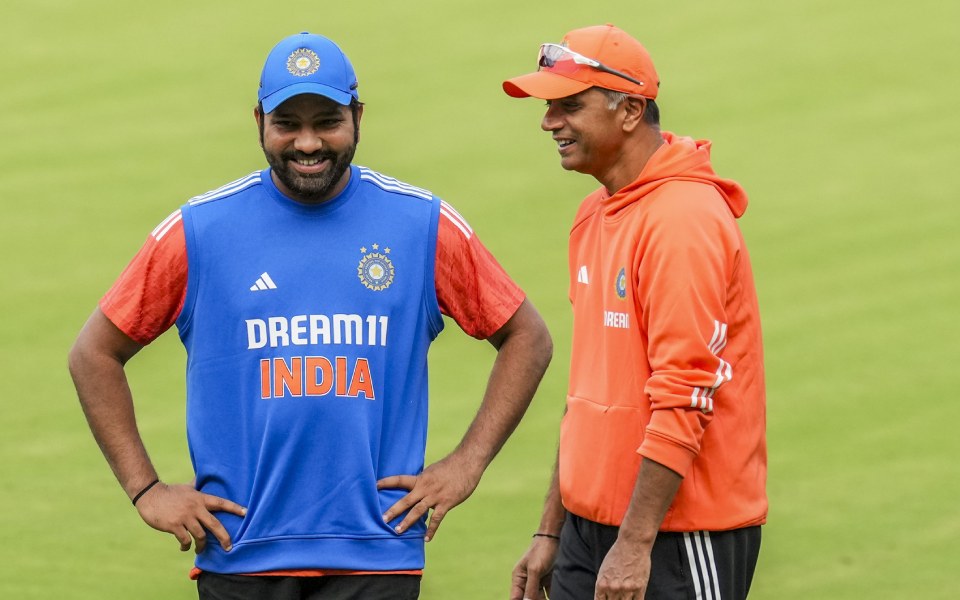
Bengaluru, Jan 18: The squad is not yet finalised but in his mind, India captain Rohit Sharma says he knows about 10 players who will be part of the side in the ICC T20 World Cup to be held this June in the Americas.
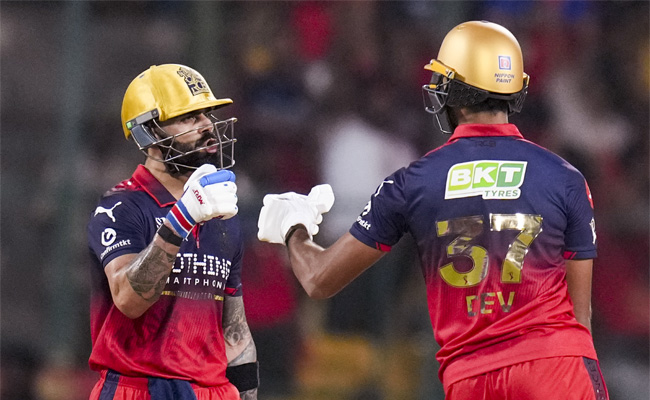
The series against Afghanistan was India's last T20 engagement before the World Cup. It also marked Rohit and Virat Kohli's comeback to the format after 14 months. Fringe players like Shivam Dube also got an opportunity to prove themselves in the series that India won 3-0.
Speaking to Jio Cinema, Rohit said some of the promising players will be left out for the event in Americas but that is the nature of professional sport.
"Like when we were playing the ODI World Cup, we tried out many boys in T20s. They perform but when the main squad is announced, some boys have to be left out. So, it is disappointing for them. But our job is to bring clarity to the team.
"So, in the pool of 25-30 players we have, they know what is expected of each player. We have still not finalised the squad for the T20 World Cup, but obviously in the mind you know the 8-10 players who are going to play," he said on Wednesday night after the third and final T20 here.
Majority of the games will be played in the Caribbean where the pitches are expected to be on the slower side.
"In the West Indies, the conditions are quite slow, so we have to pick the squad accordingly. Again I say, Rahul bhai and I have tried to maintain clarity in the team. The one thing I have learnt from captaincy is that you can't keep everyone happy. You have to focus on the needs of the team," said the skipper.
After a couple of ducks, Rohit got back among the runs with a record fifth T20 hundred. In his memorable effort, the skipper also attempted reverse hits multiple times with the surface playing out a few tricks in the powerplay.
"I have been practising it a lot in the nets. You have to play some shots in order to put the bowlers under pressure. When the ball is spinning and you can't hit straight, you have to try something new.
"I have been practising reverse sweeps and sweeps for the past two years. You would have seen me play them once or twice in Test matches. You have the options and it's up to you how you are using those options.
"The ball was spinning and gripping today so, I thought I'd play with the spin rather than step out and hit hard in front of the wicket," he said.
With the three games, Rohit also got up to speed with the team's plans for the World Cup.
"I had not played for one year, so I discussed ideas with Rahul bhai (Dravid). Although I was watching the games, I was not playing. I got an understanding of a few things, so we wanted to implement them and also do something different.
"We wanted our bowlers to bowl in a different way, someone wasn't comfortable bowling in the power play, so we had to use them there. Some were not comfortable bowling at the death, we asked them to bowl there," he added.
Let the Truth be known. If you read VB and like VB, please be a VB Supporter and Help us deliver the Truth to one and all.
T'gana RTC strike: Talks between govt, employees successful

Hyderabad (PTI): Talks between employees of Telangana State Road Transport Corporation (RTC) who were on strike and the state government concluded successfully on Friday as the government agreed to the key demands of the workmen.
Following a day-long marathon of talks between the leaders of the employees' Joint Action Committee (JAC) and the cabinet sub-committee, the government announced after midnight that it acceded to the demands, including a merger of RTC with the government, 11 per cent pay revision and elections to the employees' unions.
A committee comprising officials and employee leaders would be appointed over the merger of RTC with the government, it said.
The RTC management has also agreed to address the remaining issues as well, an official release said.
The employees would call off their strike and the RTC buses would hit the roads shortly, it said.
The employees had been on an indefinite strike since April 22 over a series of demands, including the merger of RTC with the government.
Earlier in the day, a driver of the RTC, who attempted suicide on April 23 during the strike, died at a hospital here in the early hours of Friday.
Shankar Goud, a 55-year-old driver, set himself ablaze by pouring petrol at Narsampet in Warangal district when the employees were staging a protest on Thursday in support of their demands.
Goud suffered serious burns, was initially admitted to a state-run hospital in Warangal, and later shifted to a super-speciality hospital in Hyderabad for advanced treatment.
"He succumbed (to injuries) at about 1.30 am on Friday," a senior official said.
The driver’s body was taken to his relative’s village, Muttojipet in Warangal district, for funeral rites.
Tension prevailed in Muttojipet as his family members and RTC employees attempted to take the body to the Narsampet bus station, where he worked, to enable his colleagues to pay their last respects. However, police did not permit this, citing law-and-order concerns.
This led to a deadlock before the funeral could proceed.
Union Minister Bandi Sanjay Kumar criticised the Telangana government for not allowing the body to be taken to the Narsampet bus station.
Kumar, Minister of State (Home), visited Muttojipet village in Warangal district, where the funeral was held, and paid homage to Goud.
“They (family members) want to take the body to the bus depot for five minutes. Is the RTC bus depot in Pakistan or Bangladesh? They are emotionally attached to taking the body there. The government is hurting sentiments and creating fear among RTC employees,” Kumar told reporters.
He also expressed anger at the police for not allowing the body to be taken to the bus station and staged a protest, according to a release from his office.
RTC employees and BJP workers attempted to take the mortal remains in an ambulance to Narsampet, but were stopped by the police.
Later, after discussions with the police, the family members and RTC employees agreed to conduct the funeral in the village.
Sanjay Kumar, stating he would abide by the family’s decision, left the village after the funeral was conducted there.
Transport Minister Ponnam Prabhakar said an ex gratia of Rs 10 lakh, a house, and a government job would be provided to the kin of Goud.
Chief Minister A Revanth Reddy expressed shock over the employee’s death and conveyed deep condolences to the grieving family, according to the release.
The RTC employees’ JAC had earlier announced an agitation programme from April 24 to 29, including silent marches and submission of memorandums to MLAs and other leaders.