Yuvraj Singh hints at mentoring role to prepare Team India for challenges ahead
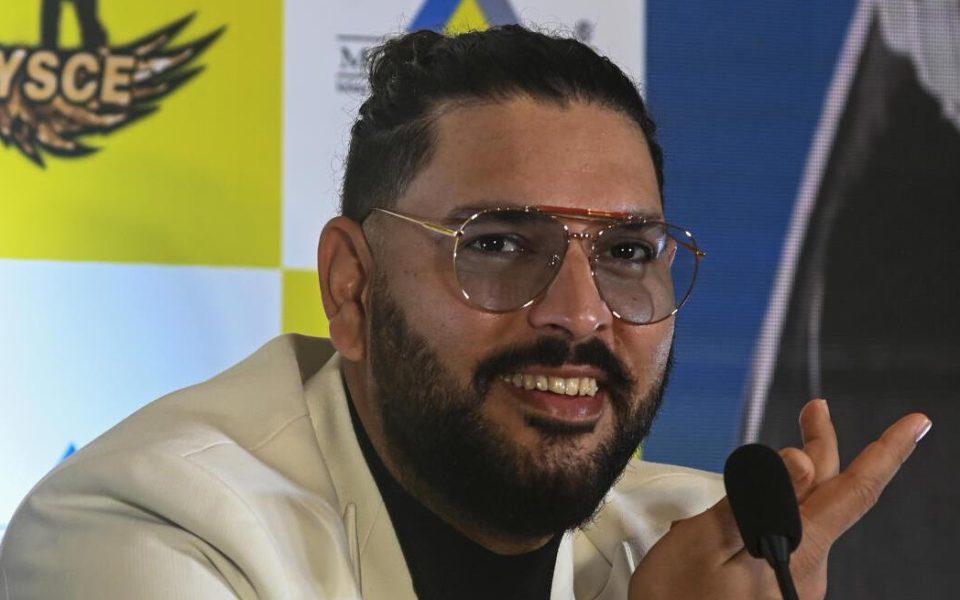
Kolkata, Jan 14: World Cup-winning hero, Yuvraj Singh on Saturday hinted at a potential mentorship role in the future to mentally prepare the Indian cricket team for the challenges ahead.
India has waited endlessly in their quest for an ICC trophy, with the team suffering another defeat in the 2023 World Cup final against Australia last year.
India won the Champions Trophy under Mahendra Singh Dhoni in 2013, while their last World Cup triumph came in 2011.
"I feel that we have played a lot of finals but not won one. I was part of one of the finals when we lost to Pakistan in 2017," the 42-year-old said while inaugurating 'Yuvraj Centres of Excellence' at Merlin Rise here.
"In the coming years, we definitely need to work on, as a country and as an Indian team, performing better under pressure.
"Australia have won six World Cups, and we have (won) two. How we win major championships is something we need to work on," added Yuvraj.
India have lost two consecutive World Test Championship finals (2021, 2023) and exited the 2015 and 2019 ODI World Cups at the the semifinal stage.
India, after emerging champions in the 2007 T20 World Cup, were ousted in the 2014 final and lost in the last-four stage of the 2016 and 2022 editions.
Expressing concern, he said, "I feel, yes, there is something (missing). When the big moment comes, our physical preparation is there, but mentally we need to make those decisions.
"I think, that is something I was talking about -- motivating the young guys, teaching them how to handle pressure and play their game. That's been our challenge. We have the game, and we have guys who can bat under pressure, but the whole team has to do that, not just one or two guys.
"Mentoring is something I love to do. In the coming years, when my kids are settled, I want to give back to cricket and help the young guys get better. I think we face a lot of mental challenges in big tournaments. I believe in the mental aspect, I can really come in and work with these guys in the future.
"I feel that I can contribute a lot, especially in the middle order. I have the confidence to work with the young guys, addressing not only their technique but also the mental challenges that come with cricket."
IPL route
The stylish former India all-rounder indicated he would like to be a mentor of an IPL side.
"Let's see what opportunities I get, but my priority is my kids right now. Once they start school, I will have more time. so I can pick up (coaching). I love working with the young guys, especially my state boys, and I feel that mentoring is something that I would love to do, and definitely to be part of one of the IPL teams, I'm definitely looking at.
"I asked Mr Ashish Nehra (Gujarat Titans) for a job, but he declined it. So, let's see where else I can get a position, but at the moment, I have to balance."
"So, definitely in the coming years, I want to give back to cricket and help the young guys get better. I can contribute a lot."
Let the Truth be known. If you read VB and like VB, please be a VB Supporter and Help us deliver the Truth to one and all.
T'gana RTC strike: Talks between govt, employees successful

Hyderabad (PTI): Talks between employees of Telangana State Road Transport Corporation (RTC) who were on strike and the state government concluded successfully on Friday as the government agreed to the key demands of the workmen.
Following a day-long marathon of talks between the leaders of the employees' Joint Action Committee (JAC) and the cabinet sub-committee, the government announced after midnight that it acceded to the demands, including a merger of RTC with the government, 11 per cent pay revision and elections to the employees' unions.
A committee comprising officials and employee leaders would be appointed over the merger of RTC with the government, it said.
The RTC management has also agreed to address the remaining issues as well, an official release said.
The employees would call off their strike and the RTC buses would hit the roads shortly, it said.
The employees had been on an indefinite strike since April 22 over a series of demands, including the merger of RTC with the government.
Earlier in the day, a driver of the RTC, who attempted suicide on April 23 during the strike, died at a hospital here in the early hours of Friday.
Shankar Goud, a 55-year-old driver, set himself ablaze by pouring petrol at Narsampet in Warangal district when the employees were staging a protest on Thursday in support of their demands.
Goud suffered serious burns, was initially admitted to a state-run hospital in Warangal, and later shifted to a super-speciality hospital in Hyderabad for advanced treatment.
"He succumbed (to injuries) at about 1.30 am on Friday," a senior official said.
The driver’s body was taken to his relative’s village, Muttojipet in Warangal district, for funeral rites.
Tension prevailed in Muttojipet as his family members and RTC employees attempted to take the body to the Narsampet bus station, where he worked, to enable his colleagues to pay their last respects. However, police did not permit this, citing law-and-order concerns.
This led to a deadlock before the funeral could proceed.
Union Minister Bandi Sanjay Kumar criticised the Telangana government for not allowing the body to be taken to the Narsampet bus station.
Kumar, Minister of State (Home), visited Muttojipet village in Warangal district, where the funeral was held, and paid homage to Goud.
“They (family members) want to take the body to the bus depot for five minutes. Is the RTC bus depot in Pakistan or Bangladesh? They are emotionally attached to taking the body there. The government is hurting sentiments and creating fear among RTC employees,” Kumar told reporters.
He also expressed anger at the police for not allowing the body to be taken to the bus station and staged a protest, according to a release from his office.
RTC employees and BJP workers attempted to take the mortal remains in an ambulance to Narsampet, but were stopped by the police.
Later, after discussions with the police, the family members and RTC employees agreed to conduct the funeral in the village.
Sanjay Kumar, stating he would abide by the family’s decision, left the village after the funeral was conducted there.
Transport Minister Ponnam Prabhakar said an ex gratia of Rs 10 lakh, a house, and a government job would be provided to the kin of Goud.
Chief Minister A Revanth Reddy expressed shock over the employee’s death and conveyed deep condolences to the grieving family, according to the release.
The RTC employees’ JAC had earlier announced an agitation programme from April 24 to 29, including silent marches and submission of memorandums to MLAs and other leaders.