91 killed in massive Indonesia quake
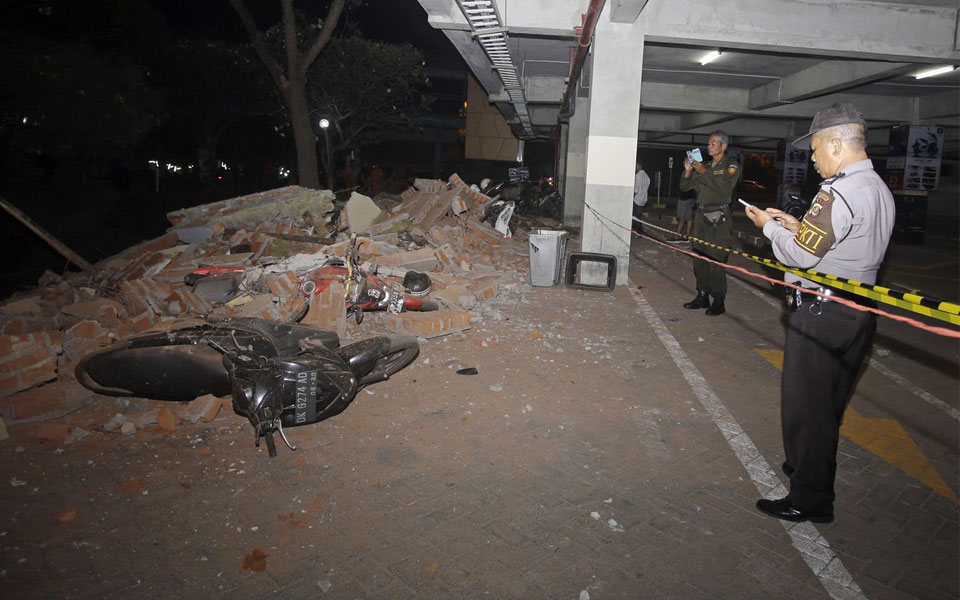
Jakarta, Aug 6 : At least 91 people were killed and hundreds others injured in a massive quake measuring 7 on the Richter scale that struck Indonesia's Lombok Island, authorities said on Monday.
The shallow quake on Sunday evening that occured only 10 km underground, comes a week after another temblor hit Lombok, popular with tourists who visit its beaches and hiking trails, killing 16 people.
It was followed by about 130 aftershocks, some over magnitude 5. A tsunami warning was issued but was lifted after a few hours. The earthquake was also felt in neighbouring Bali as well as some parts of East Java.
The Indonesian National Board for Disaster Management (BNPB) on Monday morning sent a search and rescue team to the affected area, reports Efe news.
Most fatalities were caused by the collapse of buildings, according to the BNPB, which added that hundreds of the injured have to be treated outside hospitals because of the poor condition of the buildings.
"The main focus at this time is the search, rescue and assistance to people affected by the earthquake and meeting their basic needs," the BNPB said, pointing out the urgent needs for medical personnel, clean water, food, blankets and medicine.
BNPB spokesperson Sutopo Purwo Nugroho said 1,000 domestic and foreign tourists were evacuated. President Joko Widodo said the government will compensate victims whose houses were ruined by the quake, reports The Jakarta Post.
"As (the President) and on behalf of Indonesian citizens, I express deep sorrow for the lives that were lost during the earthquake," Joko said.
Indonesia is prone to earthquakes because it lies on the Ring of Fire - the line of frequent quakes and volcanic eruptions that circles virtually the entire Pacific rim, the BBC reported.
More than half of the world's active volcanoes above sea level are part of the ring.
Let the Truth be known. If you read VB and like VB, please be a VB Supporter and Help us deliver the Truth to one and all.
NCW chief condemns rape-murder of 4-year-old girl in Pune, calls for swift action
New Delhi (PTI): National Commission for Women (NCW) Chairperson Vijaya Rahatkar has condemned the alleged rape and murder of a four-year-old girl in Maharashtra's Pune, calling it "deeply distressing" and a "blot on humanity".
The girl was allegedly raped and killed by a 65-year-old labourer, who has a criminal record, in Bhor tehsil of Pune on Friday. The accused allegedly lured the child to a cattle enclosure on the pretext of giving her food. After raping her, he killed her by hitting her with a stone, according to police.
The accused has been arrested.
In a post on X on Saturday, Rahatkar said the incident in the Nasrapur area in Pune was heartbreaking and has shaken society.
"The brutal torture and murder of a four-year-old innocent girl in Nasrapur (Bhor, Pune) is deeply painful, heartbreaking, and shocking. It is a blot on humanity," she said.
She said Pune Rural police has arrested the accused and noted that Maharashtra Chief Minister Devendra Fadnavis and Deputy Chief Minister Sunetra Pawar have assured strict action in the case.
Rahatkar said the NCW has taken cognisance of the matter and written to the National Commission for Protection of Child Rights (NCPCR), requesting the body to ensure necessary and prompt action.
It has also been recommended that the case be pursued under stringent provisions of the Protection of Children from Sexual Offences (POCSO) Act and be closely monitored from the filing of the chargesheet to proceedings in a fast-track special court to ensure time-bound justice, she added.
Ensuring justice for the victim and stringent punishment for the accused is a collective responsibility, the NCW chairperson underlined.
In a post on X, the NCW said it has taken suo motu cognisance of the extremely "heinous" incident.
"This heinous crime causes profound pain and outrage, and it highlights serious concerns regarding the safety of young girls," it said.
Strongly condemning this grave "inhuman act", the NCW said such crimes constitute a serious violation of children's rights and raise questions about society's security system.