Al-Qaeda chief Zawahiri killed in US drone strike in Afghanistan
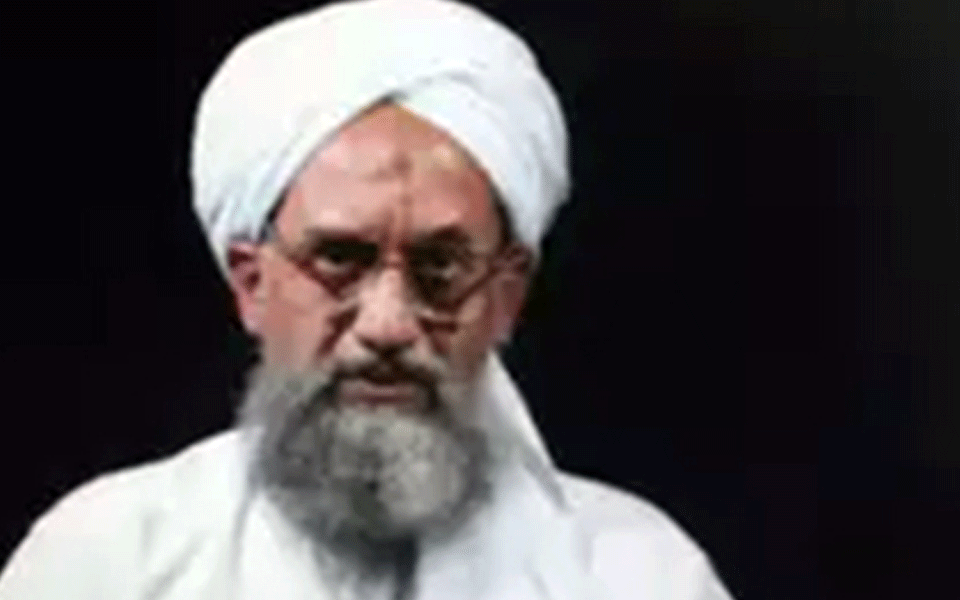
Washington(PTI): Al-Qaeda chief Ayman al-Zawahiri, who played central role in 9/11 attacks and later created the terror group's regional affiliate in the Indian subcontinent, has been killed in a US "precision strike" in Afghanistan's capital Kabul, in the biggest blow to the global terror network since killing of its founder Osama bin Laden in 2011 in Pakistan.
Zawahiri, who assumed the leadership of al-Qaeda after the death of bin Laden, was killed in a drone strike carried out by CIA on Saturday evening at a house in Kabul where he was sheltering to reunite with his family, US President Joe Biden said on Monday, declaring that justice has been delivered and this terrorist is no more .
The 71-year-old Egyptian surgeon, who had a USD 25 million bounty on his head, was bin Laden's second-in-command during 9/11 attacks and took over as the head of al-Qaeda after his death. He remained a visible international symbol of the terror group, 11 years after the US killed bin Laden during a raid in Pakistan's Abbottabad in May 2011.
"I authorised a precision strike that would remove him from the battlefield, once and for all," Biden said on Monday in a speech from the White House.
According to officials, Zawahiri was on the balcony of a safe house when the drone fired two missiles at him. Other family members were present, but they were unharmed and only Zawahiri was killed.
"He was deeply involved in the planning of 9/11, one of the most responsible for the attacks that murdered 2,977 people on American soil. For decades, he was the mastermind of attacks against Americans, said Biden.
The US president was kept abreast of the strike against Zawahiri as he was isolated with a rebound case of Covid-19. Biden spoke outdoors on Monday from the Blue Room Balcony at the White House.
"Now, justice has been delivered and this terrorist leader is no more. People around the world no longer need to fear the vicious and determined killer," Biden said.
"The United States continues to demonstrate our resolve and our capacity to defend the American people against those who seek to do us harm. We make it clear again tonight, that no matter how long it takes, no matter where you hide, if you are a threat to our people, the United States will find you and take you out," he was quoted as saying by CNN.
Biden said the precision strike targeting was the result of the "extraordinary persistence and skill" of the nation's intelligence community.
"Our intelligence community located Zawahiri earlier this year - he moved to downtown Kabul to reunite with members of his immediate family," Biden said.
His killing will bring closure to families of the victims of the 2001 attacks, Biden said, adding that Zawahiri had also masterminded other acts of violence, including the suicide bombing of the USS Cole naval destroyer in Aden in October 2000 which killed 17 US sailors.
The strike comes one year after Biden ordered the withdrawal of US troops from Afghanistan, prompting Taliban forces to rapidly seize control of the war-torn nation.
Zawahiri comes from a distinguished Egyptian family, according to the New York Times.
His grandfather, Rabia'a al-Zawahiri, was an imam at the prestigious al-Azhar University in Cairo. His great-uncle, Abdel Rahman Azzam, was the first secretary of the Arab League.
He played central role in the attacks on US embassies in Kenya and Tanzania in 1998, and eventually helped to mastermind the deadliest terror attack on American soil, when hijackers turned US airliners into missiles.
In September 2014, Zawahiri had announced the creation of Al-Qaeda's regional affiliate - the Al-Qaeda in the Indian Subcontinent (AQIS), taking advantage of sanctuaries in Afghanistan, Pakistan and Bangladesh.
Let the Truth be known. If you read VB and like VB, please be a VB Supporter and Help us deliver the Truth to one and all.
Delhi: Teenager slashes boy for refusing money for drugs; held

New Delhi (PTI): A 16-year-old boy has been apprehended for allegedly attacking a teenager with a paper cutter near the Red Fort area last month after the victim refused to give him money for drugs, an official said on Tuesday.
The juvenile, who had been absconding after the incident, was also found to be involved in another attempt to murder case registered at Jama Masjid police station, they said.
The case came to light on April 5 when police received information from LNJP Hospital about a 17-year-old boy, a resident of Nangloi, who had been admitted with serious injuries.
The victim had sustained sharp wounds on his neck and abdomen and was unfit to give a statement, the police said.
Preliminary inquiry revealed that the victim quarrelled with an unidentified boy at Parade Ground near the Red Fort, following which he was attacked. A case under relevant sections of the BNS was registered.
A team was constituted to trace the accused, which analysed CCTV footage from the area and identified a suspect seen fleeing the spot. The boy was later identified with the help of local intelligence as a vagabond frequenting the Chandni Chowk area, police said.
Despite multiple raids in Delhi and adjoining areas, the accused remained untraceable. Subsequently, his mobile number was tracked, and technical surveillance led police to Haridwar in Uttarakhand.
On April 29, the police team conducted a raid in a village in Haridwar and apprehended the juvenile after sustained efforts, an officer said.
During questioning, the accused disclosed that he had been living in the Chandni Chowk area for the past two years and was addicted to drugs. On the night of April 4, he allegedly got into an argument with the victim after the latter refused to give him money and slapped him. Enraged, he attacked the boy with a paper cutter, inflicting multiple injuries.
The police said the accused later attacked another person near the Jama Masjid Metro Station on the same night before fleeing to Haridwar.
He also disposed of the weapon and clothes by throwing them from a moving train to evade arrest, they said.
Further investigation is underway, they added.