Biggest challenge in 2021 is to ensure people in all countries get access to COVID-19 vaccine: WHO
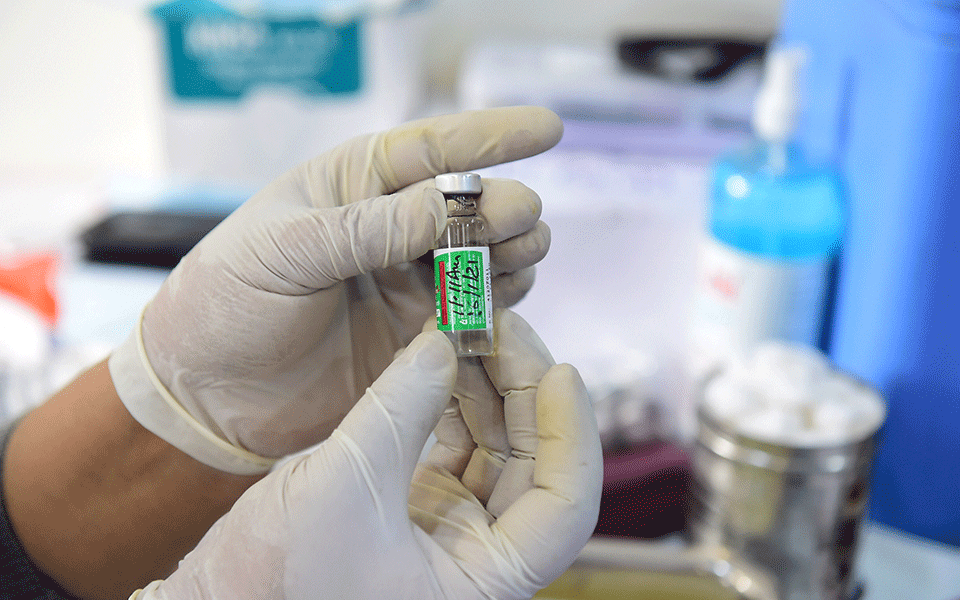
Thiruvananthapuram: The single biggest challenge in 2021 would be ensuring that people in all the countries, both rich and poor, get access to the COVID-19 vaccine, World Health Organisation's Assistant Director General Dr Peter Singer said on Wednesday.
Singer pointed out that WHO Director General Dr Tedros Adhanom Ghebreyesus had observed that the "world is on the brink of a moral catastrophe" as the vaccine distribution had so far been skewed in favour of high income countries.
He commended the role of Kerala and India in checking the spread of COVID-19 in the face of several difficulties and said "what we saw was a test of global solidarity" in 2020.
He said there were clear signs of the pandemic receding as the number of recoveries had far exceeded the number of people still affected.
Also, the vaccination process was gaining momentum.
Overcoming the pandemic was crucial to achieving the other UN goals such as reduction of poverty, hunger, illiteracy, gender inequality and air pollution, besides ensuring availability of clean water and sanitation, he said.
According to a state government release, Singer was addressing a virtual international conference on 'Kerala Health : Making the SDG A Reality', organised by the Health and Family Welfare Department of Kerala government.
Singerexpressed hope that the situation was "quickly correcting now" following the approval of more and more vaccine candidates, including that of AstraZeneca and of Serum Institute of India.
The Special Advisor to the WHO Director General said 2021 would turn out to be the year of "vaccine equity."
WHO was keen on ensuring equity "among countries and within individual countries" so that COVID-19 vaccines were available to all sections of people as this was crucial to achieving United Nations Sustainable Development Goals (SDGs), including Universal Health Coverage, he said.
Singer acknowledged that all the countries were lagging behind in the matter of SDGs even before the outbreak of Covid-19.
The pandemic had thrown the SDG goals further off-track and it would require a great deal of effort to cover the lost ground and restore and accelerate the momentum on health targets so that the goals could be achieved by 2030 as originally envisaged.
"2022 is hopefully going to be primary healthcare- based recovery, for achieving SDGs," he said.
As for Kerala, he said tackling the high prevalence of hypertension and diabetes was the challenge in meeting social health parameters.
Non-communicable diseases (NCDs) accounted for most of the deaths across the globe, he pointed out.
Former Union Health and Family Welfare Secretary Sujatha Rao said Universal Health Coverage (UHC) can be achieved only through a system anchored on primary health care (PHC), which requires micro-level planning and deliberate institutional reform.
Rajeev Sadanandan, Former state Additional Chief Secretary of Health and Family Welfare, said the huge prevalence of Non-Communicable Diseases in Kerala will be a real burden for the state.
"To tackle it conventional strategies won't work.
It is time the state turned to Artificial Intelligence and digitisation to counter the problem," he said.
The speakers were part of a panel discussion on the inaugural day of the five-day Kerala Health Conference focusing on various aspects of health system development centered on the Sustainable Development Goals.
Let the Truth be known. If you read VB and like VB, please be a VB Supporter and Help us deliver the Truth to one and all.
Two held for 'firing' at BJP leader's house in Bengal

Kolkata (PTI): A day before the counting of votes for the West Bengal assembly elections, two persons were arrested on Sunday for allegedly being involved in a firing incident outside the residence of a BJP leader in North 24 Parganas district, police said.
BJP leader Kundan Singh lodged a police complaint, alleging that a few gunmen fired at his house in the Noapara constituency around Saturday midnight.
Based on the CCTV footage, the two accused were apprehended, a senior officer said.
BJP's Noapara candidate Arjun Singh, in a post on social media, claimed that around 12.05 am, two armed miscreants arrived on a motorcycle at the residence of Kundan Singh, a BJP functionary and secretary of the Barrackpore organisational district, with an "intent to kill him".
According to the BJP leader, the accused are residents of Garulia and are known criminals.
Their names as offenders had been submitted to the Election Commission, he said.
The police officer did not specify whether the two arrested persons were the same individuals named by Arjun Singh.
According to the complaint, one round of firing took place outside Kundan Singh's house, triggering panic in the area.
The BJP candidate also questioned the role of the police, claiming that one of the accused had been detained by the police on the polling day but was later released in the evening.
The Noapara assembly seat went to the polls on April 29.
Several BJP leaders alleged that attempts were being made to create an atmosphere of fear ahead of the counting and weaken the organisation of the opposition parties.
The counting of votes will take place on May 4. Polling for the West Bengal assembly elections was held on April 23 and April 29.
The BJP urged the Election Commission to intervene immediately to ensure peaceful counting.
TMC candidate Somnath Shyam rubbished Arjun Singh’s allegation, claiming that the BJP nominee had orchestrated the firing incident to divert attention from imminent defeat.
“Arjun Singh knows all the gangsters in the Barrackpore belt. Everyone knows about his links with the underworld. Let the police investigate the incident,” Shyam said.