Blast at a Tennessee explosives plant leaves 19 people missing and feared dead, sheriff says
_vb_45.jpeg)
McEwen (AP): A blast levelled an explosives plant Friday in rural Tennessee, leaving behind a mass of twisted metal, burned-out shells of cars and at least 19 people missing and feared dead, authorities said.
“There's nothing to describe. It's gone,” Humphreys County Sheriff Chris Davis said of the blast site at Accurate Energetic Systems, which supplies and researches explosives for the military. He said it was one of the worst scenes he's ever seen and especially gut-wrenching because he knows three families connected to the tragedy. Davis said multiple people were killed but declined to say how many, referring to the 19 missing as “souls” because officials were still speaking to family.
The blast occurred at about 7:45 am, Davis said. Aerial footage showed the company's hilltop location smouldering and smoky. Debris was scattered over at least a half-mile area and people more than 15 miles (24.1 kilometres) away felt the explosion, he said.
Families of the missing were waiting in a parking lot by an undamaged building near the site Friday afternoon, waiting for news as officials searched the site.
The company's website says it processes explosives and ammunition at an eight-building facility that sprawls across wooded hills in the Bucksnort area, about 60 miles (97 kilometres) southwest of Nashville. It's not immediately known how many people worked at the plant or how many were there when the explosion happened.
Davis said investigators are trying to determine what happened and couldn't say what caused the explosion. Emergency crews were initially unable to enter the plant because of continuing detonations, Hickman County Advanced EMT David Stewart said by phone.
By Friday afternoon, there was no further danger of explosions, and the scene was under control, according to Grey Collier, a spokesperson for the Humphreys County Emergency Management Agency.
Accurate Energetic Systems, based in nearby McEwen, did not immediately respond to a phone message seeking comment Friday morning.
The company has been awarded numerous military contracts, largely by the US Army and Navy, to supply different types of munitions and explosives, according to public records. The products ranged from bulk explosives to landmines and small breaching charges, including C4.
When the explosion occurred, residents in Lobelville, a 20-minute drive from the scene, said they felt their homes shake and some people captured the loud boom of the explosion on their home cameras.
The blast rattled Gentry Stover from his sleep.
“I thought the house had collapsed with me inside of it,” he told The Associated Press. “I live very close to Accurate and I realised about 30 seconds after I woke up that it had to have been that.”
State Rep. Jody Barrett, a Republican from the neighbouring town of Dickson, was worried about the possible economic impact because the plant is a key employer in the area.
“We live probably 15 miles as the crow flies and we absolutely heard it at the house,” Barrett said. “It sounded like something going through the roof of our house.”
The US has a long history of deadly incidents at workplaces, including the Monongah coal mine explosion that killed 362 men and boys in West Virginia in 1907. Several high-profile industrial accidents in the 1960s helped lead President Richard Nixon to sign a law creating the Occupational Safety and Health Administration the next year.
In 2019, Accurate Energetic Systems faced several small fines from the US Department of Labor for violations of policies meant to protect workers from exposure to hazardous chemicals, radiation and other irritants, according to citations from OSHA.
Let the Truth be known. If you read VB and like VB, please be a VB Supporter and Help us deliver the Truth to one and all.
4 workers die after being buried under coal slurry in Jharkhand's Dhanbad
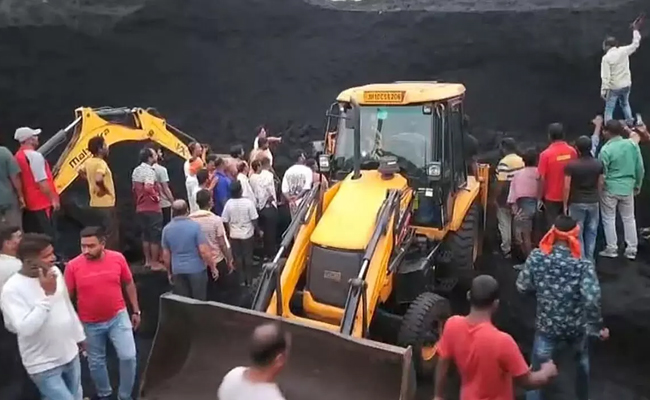
Dhanbad (Jharkhand) (PTI): At least four workers died after being buried under coal slurry in Jharkhand's Dhanbad district on Saturday, a police official said.
The incident took place at Moonidih coal washery in the command area of Bharat Coking Coal Limited (BCCL).
"Bodies of all four workers were dug out of debris during a rescue operation," Putki police station in-charge Waqar Hussain told PTI.
The incident took place when coal slurry was being loaded into trucks by workers, during which a large chunk of slurry fell and trapped several workers underneath, officials said.
The deceased have been identified as Manik Bauri, Dinesh Bauri, Deepak Bauri, and Hemlal Gope.
Meanwhile, the family members of the deceased and local villagers placed the bodies in front of the washery gate and began a protest.
They demanded compensation, jobs for dependents and action against those responsible for the incident.
Police and administration officials are trying to pacify the protesters, an official said.