Boko Haram killed 'at least 60' in NE Nigeria: Amnesty

Lagos, Feb 2: Boko Haram killed at least 60 civilians in an attack on the remote town of Rann in northeast Nigeria earlier this week, Amnesty International said on Friday.
The human rights group's Nigeria director Osai Ojigho said "at least 60 people" were killed while satellite imagery showed "mass burning" of structures used by displaced people.
"Eleven bodies were found within Rann town, and 49 were found outside," the group said in an e-mailed statement, adding that some 50 people were still missing.
It quoted one of 10 civilian militia members who travelled to Rann to bury the dead as saying the bodies found outside the town all had gunshot wounds.
"This attack on civilians who have already been displaced by the bloody conflict may amount to possible war crime, and those responsible must be brought to justice," said Ojigho.
The death toll made it the "deadliest" by Boko Haram on Rann, she added.
In January 2017, a botched Nigerian air strike intended to hit jihadists killed at least 112 people as aid workers distributed food.
Rann, which is some 175 kilometres (110 miles) northeast of the Borno state capital, Maiduguri, has now been hit four times since March last year.
The first attack killed three aid workers and saw three others kidnapped. Two of the three were later executed. The second attack happened in early December.
On January 14, fighters loyal to the Boko Haram faction led by Abubakar Shekau attacked a military position.
Some 9,000 people fled across the border into Cameroon but were sent back, as troops from Nigeria's eastern neighbour were deployed to Rann as reinforcements.
Cameroonian forces were withdrawn last Sunday, which the UN said forced more than 30,000 people to flee in fear of another attack.
AFP has been told the remaining Nigerian soldiers also withdrew because there were not enough of them to fight off Boko Haram if they came in greater numbers.
Amnesty's Ojigho said "environmental sensors detected fires" in and around Rann on Monday and Tuesday, indicating the jihadists returned after the troops pulled out.
Analysis of satellite images indicated the two attacks had left most of the town "heavily damaged or destroyed", and "well over 100" structures had been burned down.
Many of the structures destroyed date back to 2017, indicating they had been constructed for those who had fled to Rann in search of refuge from the fighting.
Rann had been home to some 35,000 internally displaced people (IDPs), according to the International Organization for Migration.
Amnesty International said it wanted Nigeria to investigate the withdrawal of troops, as it "may have left tens of thousands of civilians exposed" to attack.
On Wednesday, the Norwegian Refugee Council called on Cameroon to keep open its borders to those fleeing Boko Haram attacks.
More than 27,000 people have been killed in nearly 10 years of fighting, while some 1.8 million others remain homeless and reliant on aid for food, shelter, healthcare and water.
The UN this week said it needed USD 848 million (741 million euros) to fund projects for affected civilians in Borno state and two other northeast states over the next three years.
An additional USD 135 million was required to help the 228,500 Nigerian refugees who have fled to neighbouring Cameroon, Chad and Niger, it added.
Let the Truth be known. If you read VB and like VB, please be a VB Supporter and Help us deliver the Truth to one and all.
Transport Min. Ramalinga Reddy inaugurates redeveloped parking facility at KBS
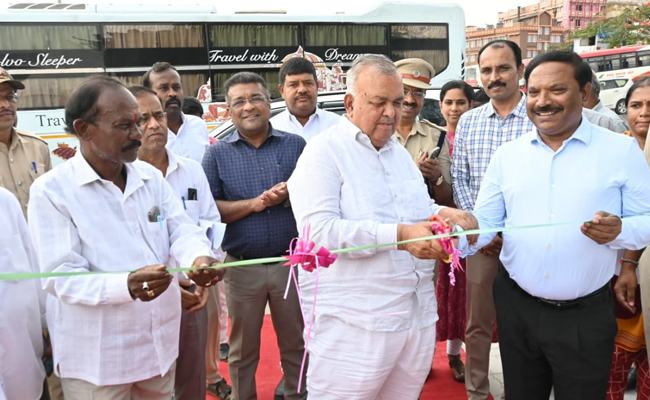
Bengaluru: Transport and Muzrai Minister Ramalinga Reddy inaugurated a redeveloped parking facility at Terminal-1 of Kempegowda Bus Station on Thursday, April 16.
The parking area has been developed at a cost of Rs 3.29 crore to facilitate smoother movement of vehicles and improve convenience for staff and passengers.
According to officials, the area adjacent to Terminal-1 near the rest house was earlier filled with potholes and prone to waterlogging during rains, causing inconvenience to commuters and staff.
The issue was brought to the notice of the minister, who visited the site and directed that the development be taken up on priority.
A tender was floated to develop around 2.5 acres of land into a structured parking facility.
According to KSRTC, the facility can accommodate around 100 buses and is equipped with 11 electric light poles. An electrical panel room has also been constructed as part of the project.
Parking space has been allocated for buses belonging to North Western (NWKRTC) and Kalyana Karnataka Road Transport Corporations (KKRTC).