British PM May's Brexit deal overwhelmingly crushed by lawmakers
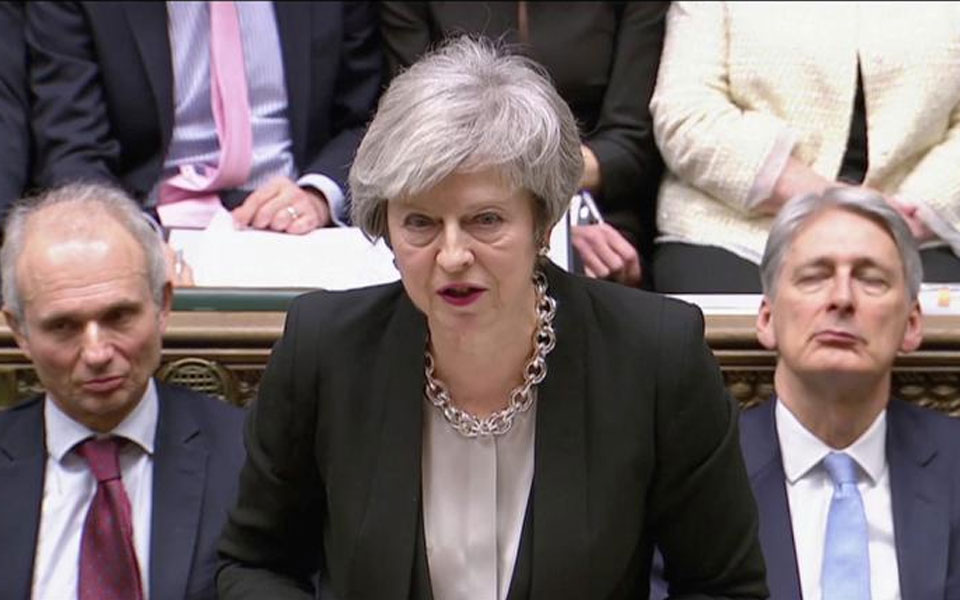
London: British Prime Minister Theresa May has suffered yet another crushing Parliament defeat over Brexit when MPs overwhelmingly rejected her plan to quit the EU, plunging the UK into a further period of political uncertainty just 17 days before its divorce from the bloc.
May's pleas in the House of Commons for lawmakers to support her draft exit deal on Tuesday, or run the risk of a chaotic exit from the European Union (EU) or no Brexit at all, were rejected by 391 votes to 242.
May was hopeful that last-minute concessions from the EU would swing the vote in her favour, but many lawmakers dismissed those changes as ineffectual or cosmetic.
While this marked a smaller defeat than the 230-vote margin with which they rejected her deal back in January, it was a decisive rejection of government strategy even after May had claimed significant changes to the controversial Irish backstop clause had been achieved.
The Irish backstop, an insurance policy designed to maintain an open border on the island of Ireland between UK territory Northern Ireland and EU member-state - the Republic of Ireland - has been the biggest sticking point for many MPs in the UK.
The historic bruising for May in January led her to seek changes to the agreement in order to table a second "meaningful vote" before Parliament that she hoped would stand a better chance of being voted through.
The British Prime Minister made a statement to the Commons soon after the bruising result was announced to confirm that Parliament will vote on a new motion on Wednesday to decide if the UK should leave the EU within the March 29 deadline without any deal in place.
In an unusual move, she announced that all Conservative Party MPs will be given a free vote on the issue instead of being made to vote in a particular way by the government.
"This is an issue of grave importance for the future of our country. Just like the referendum, there are strongly held and equally legitimate views on both sides," she said.
"For that reason, I can confirm that this will be a free vote on this side of the House," she said.
There is unlikely to be a majority in favour of a no-deal chaotic Brexit, which would then give way to a third parliamentary motion on Thursday to determine if the Brexit deadline of March 29 needs to be extended, which would then have to be ratified by the EU.
May, visibly tired and struggling to speak as a result of a sore throat, admitted that Tuesday's vote confirms that there is no support for "this deal" and how the Brexit process moves forward remains all the more uncertain.
Opposition Labour Party leader Jeremy Corbyn called for a general election to allow the British public to decide who should lead them into the next phase of Brexit.
The EU's Chief Brexit negotiator, Michel Barnier, said in a Twitter statement: "The EU has done everything it can to help get the Withdrawal Agreement over the line. The impasse can only be solved in the UK. Our 'no-deal' preparations are now more important than ever before."
Earlier on Tuesday, May made a final push for the UK Parliament to back her Brexit withdrawal agreement in the vote after she claimed to have secured "legally binding" changes to the draft rejected by the Home of Commons earlier this year.
She had called on the Commons to get behind her enhanced agreement setting out the UK's exit strategy from the EU or risk going against the will of the majority that voted for Brexit in the June 2016 referendum.
"This is the moment and this is the time. Back this motion and get the deal done... We cannot serve our country by overturning a democratic decision of the British people," she said, hours after she had claimed a breakthrough in negotiations with the EU to secure changes to the controversial Irish backstop to make it more acceptable to all sides of Parliament.
Corbyn countered that it was the same "bad deal" MPs had rejected in January and that his party would be voting against it again because it risks people's living standards and jobs.
The clash came soon after UK Attorney General Geoffrey Cox confirmed that the legal risk from the controversial Irish backstop "remains unchanged", leading to hard-Brexiteers from within May's own Conservative Party refusing to back the so-called "improved" divorce arrangement.
In his official advice as the country's chief legal adviser, Cox said the extra assurances won by May do "reduce the risk that the United Kingdom could be indefinitely and involuntarily detained" in the backstop if talks on the two sides' future relationship broke down due to "bad faith" by the EU.
However, he reiterated that the "legal risk remains unchanged" that if no such agreement can be reached due to "intractable differences", the UK would have "no internationally lawful means" of leaving the backstop without EU agreement.
The Brexit-backing European Research Group (ERG) within the Tory Party declared soon after that it will not be voting for the withdrawal agreement in the Commons later, in a major blow to May's leadership.
The Democratic Unionist Party (DUP), which provides May's government its majority, also declared they would vote against the deal as the changes did not alleviate their concerns over the backstop.
The March-end deadline for Brexit kicked in when the UK triggered Article 50 of the Lisbon Treaty following a referendum in favour of Brexit by nearly 52 per cent to 48 per cent in June 2016.
Let the Truth be known. If you read VB and like VB, please be a VB Supporter and Help us deliver the Truth to one and all.
25 lakh properties in Bengaluru brought under e-Khata system: Shivakumar
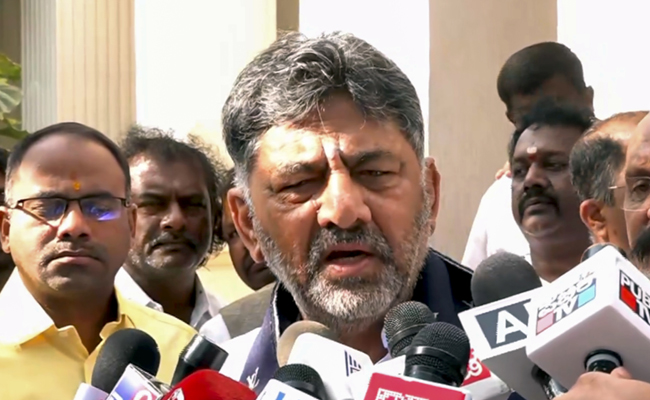
Bengaluru (PTI): Karnataka Deputy Chief Minister D K Shivakumar on Friday said that the state government has brought over 25 lakh properties under the e-Khata system in Bengaluru.
e-Khata is an electronic property certificate that maintains ownership information in an online database.
The e-Khata initiative aimed to ensure accuracy, transparency and universal coverage for property owners, he said.
Addressing a press conference here, Shivakumar, who is also the Bengaluru in-charge Minister, said over 25 lakh properties are being brought under the e-Khata system. Of them more than 7,000 applications have been processed, and additional outreach measures being planned for those yet to obtain their e-Khata.
"Twenty five lakh e-Khatas is a great number which has created history," he said.
The Deputy CM said the government is ensuring that every e-Khata will have its GPS, the shape of the property, and the measurement with every photo and document.
He explained that the government is integrating Aadhaar details, digital documentation, GPS mapping and property sketches to create a robust database.
"We want to see that every record is filled right. They (officials) are asking for documentation, stamp, digital documents. We wanted to connect every Aadhaar card and have it online," Shivakumar said.
To facilitate access, the Deputy CM announced the opening of more than 50 centres across Bengaluru, many of them in government schools, where citizens can apply for or rectify their e-Khata records.
"All of them will be working this Saturday. This 'Khata Mela' will be done. It is 'Nanna Khata, Nanna Swathu'," he said.
Applicants whose documents require verification will be given an acknowledgement and asked to return after 15 days, during which officials will conduct site inspections, he said.
Shivakumar said the government has also taken steps to identify and reclaim properties recorded as roads in revenue documents, asserting that such lands belong to the government.
"We have decided through the law that all the roads in the revenue records have been taken out. Those properties belong to the government itself," he said.
He noted that the initiative has received recognition from the Union government. "The Government of India has awarded us. It said that it is the model for the entire country," he said, while thanking officials involved in the project.
The Deputy CM said the government expects around 10 lakh additional households to benefit from the drive and assured that even those who have not downloaded their documents will receive printed copies free of cost at their residences.
"We will see that all the 25 lakh people will get their e-Khata to their home free of cost," Shivakumar said.
On apartment properties, he said all flats that have obtained occupancy certificates have been cleared.
"All the 37,460 flats (who have applied for e-Khata) have been issued an occupancy certificate. We have cleared all of them," the Deputy CM said.