Canada's government calls on House speaker to resign over inviting a man who fought for a Nazi unit
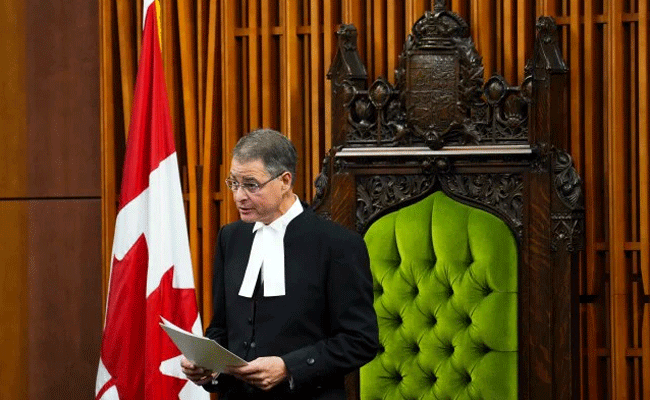
Toronto (AP): Canadian Prime Minister Justin Trudeau 's government urged the speaker of the House of Commons to resign Tuesday for inviting a man who fought for a Nazi military unit during World War II to attend a speech by the Ukrainian president.
Just after Ukrainian President Volodymyr Zelenskyy delivered an address in the House of Commons on Friday, Canadian lawmakers gave 98-year-old Yaroslav Hunka a standing ovation when Speaker Anthony Rota drew attention to him. Rota introduced Hunka as a war hero who fought for the First Ukrainian Division.
Rota is meeting with the House of Commons' party leaders later Tuesday. Two opposition parties called for Rota to step down on Monday, and government House leader Karina Gould said Tuesday that she believes lawmakers have lost confidence in Rota.
Gould said Rota invited and recognized Hunka without informing the government or the delegation from Ukraine.
"It is time for him to do the honorable thing," Gould said.
Foreign Minister Melanie Joly also urged him to resign.
"It is completely unacceptable. It was an embarrassment to the House and Canadians, and I think the speaker should listen to members and step down," Joly said.
Joly said she spoke to the government in Ukraine about it.
Asked if he'll continue in the job, Rota said Tuesday: "We'll have to see about that and I'm sure you'll hear more about that later today."
The 1st Ukrainian Division was also known as the Waffen-SS Galicia Division, or the SS 14th Waffen Division, a voluntary unit that was under the command of the Nazis.
"It's a good thing that Speaker Rota apologized personally and I am sure that he is reflecting now on the dignity of the House going forward," Trudeau said to reporters before he entered a Cabinet meeting.
Canadian Health Minister Mark Holland called it "incredibly embarrassing."
The Friends of Simon Wiesenthal Center for Holocaust Studies also called for Rota to step down.
"While we acknowledge his apology, Speaker Rota's decision to invite a former member of the Waffen-SS, notorious for its involvement in Holocaust atrocities, to Canada's Parliament has left a stain on our country's venerable legislature with profound implications both in Canada and globally," the center said in a statement.
"This incident has compromised all 338 Members of Parliament and has also handed a propaganda victory to Russia, distracting from what was a momentously significant display of unity between Canada and Ukraine. It has also caused great pain to Canada's Jewish community, Holocaust survivors, veterans and other victims of the Nazi regime."
In his apology on Sunday, Rota said he alone was responsible for inviting and recognizing Hunka, who is from the district that Rota represents. The speaker's office said Monday it was Rota's son who contacted Hunka's local office to see if it was possible if he could attend Zelenskyy's speech.
Members of Parliament from all parties rose to applaud Hunka unaware of the details of who he was.
In Moscow, a Kremlin spokesman said it was "outrageous" that Hunka received a standing ovation during a visit to Ottawa.
Russian President Vladimir Putin has painted his enemies in Ukraine as "neo-Nazis," even though Zelenskyy is Jewish and lost relatives in the Holocaust.
"It's highly unfortunate and the only winner here is the Putin regime, which is already spinning what happened on Friday to justify its ongoing military actions in Ukraine," said Daniel B land, a political science professor at McGill University in Montreal,
The opposition Conservatives in Canada have blamed Trudeau for the invite and ovations.
"The Conservatives want to pin this on the Trudeau government, but Mr. Rota is an officer of parliament who doesn't participate in Liberal caucus meetings and is not a member of Cabinet. He has his own staff and he should have known better," B land said.
"The speaker is the person who should be blamed for this." (AP)
Let the Truth be known. If you read VB and like VB, please be a VB Supporter and Help us deliver the Truth to one and all.
Man arrested with Rs 2.54-crore heroin in Mumbai
Mumbai (PTI): Police have arrested a man and seized over 500 grams of heroin worth Rs 2.54 crore in the illicit market from him in Mumbai, officials said on Friday.
The police's Anti-Narcotics Cell (ANC) made the drug seizure in Santacruz in the western suburbs. The operation was conducted by the Kandivali unit of the ANC on Thursday as part of a special crackdown against drug trafficking in the area, they said.
Acting on specific inputs, an ANC team conducted a raid in Santacruz (East) and intercepted a man. During a search, the team recovered 508 grams of high-grade heroin from his possession, an official said.
The seized contraband, a highly addictive, opioid drug derived from morphine, is estimated to be worth Rs 2.54 crore in the international market, he informed.
Following the seizure, a case was registered against the man under relevant sections of the Narcotic Drugs and Psychotropic Substances (NDPS) Act, 1985, and he was formally placed under arrest in the early hours of Friday.
The police are currently investigating the source of the drug and trying to identify the intended recipients of the consignment, he said.