China accused of 'human rights violations' against Muslims
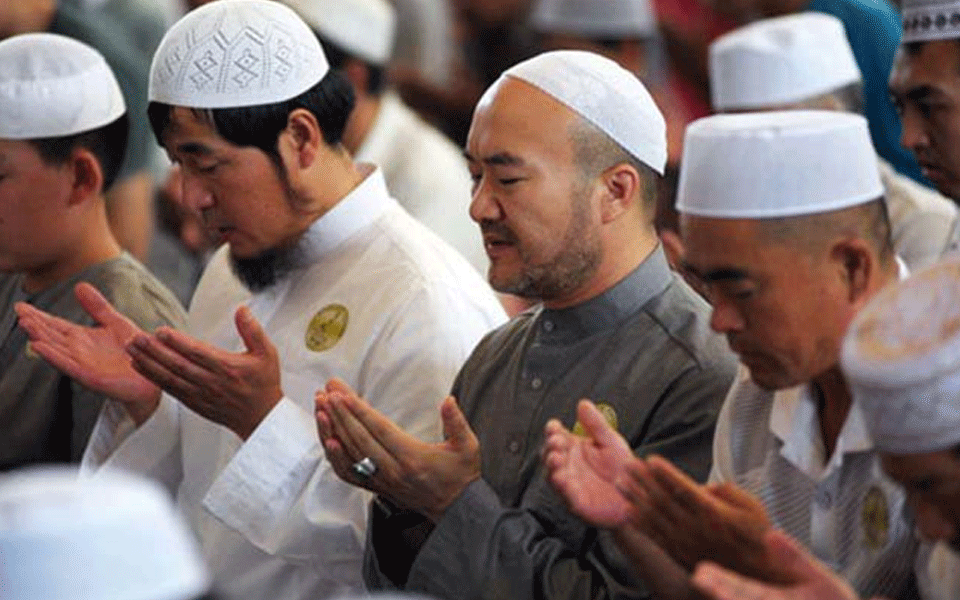
Beijing, Sep 10: A rights group on Monday accused the Chinese government of conducting a mass, systematic campaign of human rights violations against Muslims in the far western region of Xinjiang.
The new Human Rights Watch (HRW) report comes after a UN committee last month raised alarm at the "numerous reports of detention of large numbers of ethnic Uighurs and other Muslim minorities held incommunicado and often for long periods, without being charged or tried, under the pretext of countering terrorism and religious extremism", CNN reported.
In the report, HRW documents the increasing government control over the 13 million Muslims living in Xinjiang.
It is estimated that in the area, one million are currently detained in re-education camps where they are forced to learn Mandarin and sing the praises of the Chinese Communist Party.
"The Chinese government is committing human rights abuses in Xinjiang on a scale unseen in the country in decades," Efe news quoted said Sophie Richardson, HRW China director, as saying.
Detainees in these political re-education camps have not been charged with any crime, have no access to lawyers or contact with relatives.
HRW pointed out that they have been held under circumstances that do not constitute a crime, including having links with foreign countries, using foreign communications tools like WhatsApp - censored by the Chinese authorities - or peacefully expressing their identity and religion.
"I asked (the authorities) if I can hire a lawyer and they said, 'No, you shouldn't need a lawyer because you're not convicted. There's no need to defend you against anything. You're in a political education camp - all you have to do is just study'," a man who spent months in the camps told HRW.
"Nobody can move because they watch you through the video cameras, and after a while a voice came from the speakers telling you that now you can relax for a few minutes... We were watched, even in the toilet," another detainee told the rights group.
Outside these centres, Xinjiang citizens are under mass surveillance with high-tech systems such as phone spyware, biometrics, QR codes and big data, and officials make regular visits to their homes where they stay, the report said.
Passport controls, compulsory attendance in Mandarin night schools or flag-raising ceremonies are also common, with authorities even encouraging neighbours to spy on each other and sowing division between families.
Amid the allegations of systematic abuse by numerous organisations in Xinjiang, the Chinese government insisted that people in China have complete freedom to choose their religion.
Let the Truth be known. If you read VB and like VB, please be a VB Supporter and Help us deliver the Truth to one and all.
4 workers die after being buried under coal slurry in Jharkhand's Dhanbad

Dhanbad (Jharkhand) (PTI): At least four workers died after being buried under coal slurry in Jharkhand's Dhanbad district on Saturday, a police official said.
The incident took place at Moonidih coal washery in the command area of Bharat Coking Coal Limited (BCCL).
"Bodies of all four workers were dug out of debris during a rescue operation," Putki police station in-charge Waqar Hussain told PTI.
The incident took place when coal slurry was being loaded into trucks by workers, during which a large chunk of slurry fell and trapped several workers underneath, officials said.
The deceased have been identified as Manik Bauri, Dinesh Bauri, Deepak Bauri, and Hemlal Gope.
Meanwhile, the family members of the deceased and local villagers placed the bodies in front of the washery gate and began a protest.
They demanded compensation, jobs for dependents and action against those responsible for the incident.
Police and administration officials are trying to pacify the protesters, an official said.