China tests new Hydrogen bomb without nuclear fusion
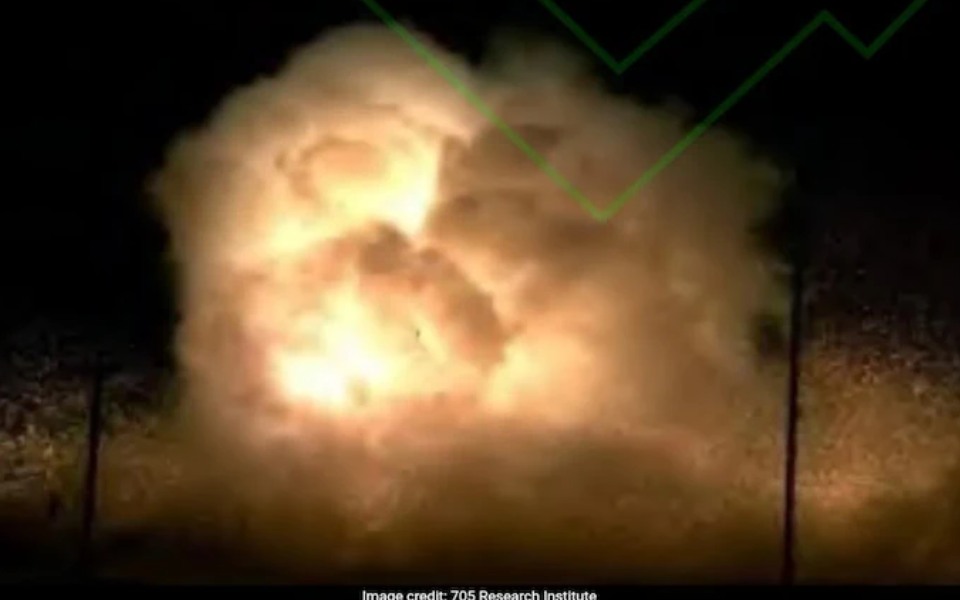
Beijing: China has reportedly tested a new kind of explosive device that uses hydrogen but does not involve any nuclear materials. This new weapon was developed by the China State Shipbuilding Corporation (CSSC). It works differently from traditional hydrogen bombs, which rely on nuclear fusion. Instead, this device uses a chemical reaction with a substance called magnesium hydride. The explosion creates a powerful fireball that gives off extreme heat for a longer time, reported Economic Times.
The explosive weighs only 2 kilograms and uses a unique method to create a powerful blast. Magnesium hydride, which stores hydrogen at high densities, breaks down quickly when triggered by a normal explosive. This releases hydrogen gas, which then mixes with air and catches fire. The result is a fireball with temperatures above 1,000°C much hotter than regular explosives like TNT.
Quoting Wang Xuefeng, a top scientist at the China State Shipbuilding Corporation (CSSC), The Economic Times reported that hydrogen explosions require very little energy to ignite and can spread rapidly. Wang explained that such fires possess the intensity to burn through strong materials, including aluminium alloys. Due to its precision and destructive power, the device could be highly effective in targeted military strikes.
During a field test, the explosive showed a peak pressure of 428.43 kilopascals at a distance of two meters. This is around 40% of the pressure made by TNT. But the real strength of this device lies in the heat it produces. While most explosives create a quick shockwave, this one keeps burning at very high temperatures for more than two seconds.
This long-lasting heat could make the explosive useful for hitting specific military targets, such as power plants or communication centers. It could also be used to block enemy forces by burning roads or transport routes, making them unusable.
Let the Truth be known. If you read VB and like VB, please be a VB Supporter and Help us deliver the Truth to one and all.
Vartha Bharati–Sankalp predictions align closely with Karnataka bypoll results

Bengaluru: The Vartha Bharati–Sankalp election analysis has shown a high level of accuracy in predicting the outcome of the recent Karnataka Assembly by-elections held in May 2026, correctly calling winners in both constituencies and closely estimating vote share trends.
The by-elections were held in Bagalkot and Davanagere South, drawing significant political attention as both seats were seen as key tests for the ruling Congress and opposition BJP.
According to the analysis, Vartha Bharati–Sankalp had made three major projections ahead of the results the winning party, vote share percentages, and margin of victory.
In both constituencies, the platform accurately predicted that the Congress would emerge victorious. The outcome matched the projections, with Congress candidates winning in Bagalkot and Davanagere South.
In terms of vote share, the predictions were largely in line with the final results. In Bagalkot, the BJP’s vote share was forecast in the range of 40 to 46 per cent, while the actual figure stood at 42.9 per cent. The Congress vote share, however, exceeded expectations, with the party securing 55.4 per cent against a projected range of 43 to 48 per cent.
The margin of victory in Bagalkot turned out to be significantly higher than anticipated. While the projection had placed the margin between 2,000 and 3,500 votes, the final margin was around 22,332 votes.
In Davanagere South, the predictions also remained largely accurate. The Congress vote share was projected between 43 and 51 per cent, and the final figure stood at 43.9 per cent. The BJP was expected to secure between 42 and 50 per cent but ended with 40.3 per cent.
The analysis had also identified the role of SDPI as a potential spoiler in the constituency. While its vote share was estimated around 6 per cent, the party eventually secured around 12 per cent of the vote.
The margin of victory in Davanagere South was predicted to be between 1,500 and 2,600 votes. The actual margin was higher at around 5,708 votes, though the contest remained relatively close as anticipated.
Overall, the performance of Vartha Bharati–Sankalp stood out for correctly identifying the winning parties in both seats and maintaining close accuracy in vote share estimates, with only limited deviations in specific cases.