COVID-19 causes severe disruption to Indian economy, says World Bank
Washington: The World Bank on Sunday said the coronavirus outbreak has severely disrupted the Indian economy, magnifying pre-existing risks to its outlook.
In its South Asia Economic Update: Impact of COVID-19 , the World Bank estimated the Indian economy to decelerate to 5 per cent in 2020 and projected a sharp growth deceleration in fiscal 2021 to 2.8 per cent in a baseline scenario.
The COVID-19 outbreak came at a time when India's economy was already slowing, due to persistent financial sector weaknesses, the report said.
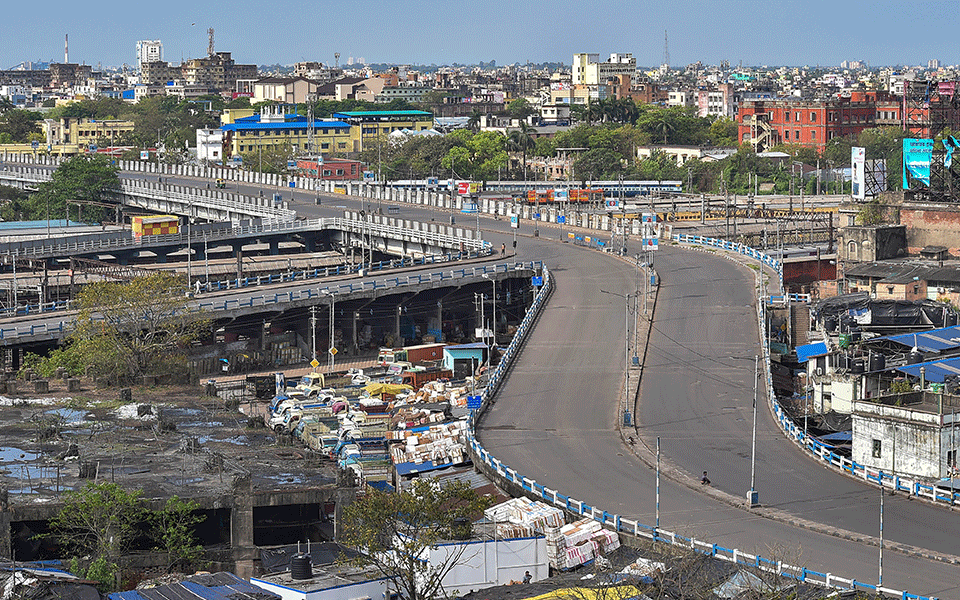
To contain it, the government imposed a lockdown' with restrictions on mobility of goods and people.
The resulting domestic supply and demand disruptions (on the back of weak external demand) are expected to result in a sharp growth deceleration in FY21 to 2.8 percent in a baseline scenario (an estimate subject to wide confidence intervals), the report said, adding that the services sector will be particularly impacted.
A revival in domestic investment is likely to be delayed given enhanced risk aversion on a global scale, and renewed concerns about financial sector resilience.
Growth is expected to rebound to 5.0 per cent in fiscal 2022 as the impact of COVID-19 dissipates, and fiscal and monetary policy support pays off with a lag, the report said.
In a conference call with reporters, World Bank Chief Economist for South Asia Hans Timmer said India's outlook is not good.
And if the domestic lockdown is prolonged, then the economic result can be much worse than what the World Bank has in its baseline range of forecasts.
Among the steps that India can take to address this challenge, Timmer said the first step is to focus on mitigating the spread of the disease, and to make sure that everybody has food.
Then, it is very important to prepare for a rebound and that means there should be a focus on temporary jobs programmes, especially at the local levels. Those initiatives should be supported. And it is important to prevent bankruptcies especially of a small and medium sized enterprise, Timmer said in response to a question.
In the longer run, this is really an opportunity to bring the Indian economy on sustainable path not just fiscally, but also socially, he said.
The World Bank is working with India to mitigate the challenge posed by COVID-19. It has approved USD1 billion to India, of which the first tanche has already been released to deal with the emergency in the health care sector.
The first tranche aims at delivering civilian diagnostic equipment, put in place additional capacity to deal with testing and make testing available that benefits the entire population, said World Bank Vice President for South Asia Hartwig Schafer.
The World Bank is also working with India on two additional operations, which is anticipated to be ready in a matter of weeks.
These include, employment, banking and micro, small and medium enterprise sector. In its report, the World Bank said that the COVID-19 outbreak has magnified pre-existing risks to India's economic outlook.
The government is undertaking measures to contain the health and economic fallout, and the RBI has begun providing calibrated support in the form of policy rate cuts and regulatory forbearance.
Given significant uncertainties, there is a wide confidence interval around the baseline estimate. If a large-scale domestic contagion scenario is avoided, early policy measures payoff, and restrictions to the mobility of goods and people can be lifted swiftly, an upside scenario could materialize in FY21, with growth around four per cent, it said.
However, if domestic contagion is not contained, and the nationwide shutdown is extended, growth projections could be revised downwards to 1.5 per cent, and fiscal slippages would be larger, the World bank said.
Let the Truth be known. If you read VB and like VB, please be a VB Supporter and Help us deliver the Truth to one and all.
Man arrested with Rs 2.54-crore heroin in Mumbai

Mumbai (PTI): Police have arrested a man and seized over 500 grams of heroin worth Rs 2.54 crore in the illicit market from him in Mumbai, officials said on Friday.
The police's Anti-Narcotics Cell (ANC) made the drug seizure in Santacruz in the western suburbs. The operation was conducted by the Kandivali unit of the ANC on Thursday as part of a special crackdown against drug trafficking in the area, they said.
Acting on specific inputs, an ANC team conducted a raid in Santacruz (East) and intercepted a man. During a search, the team recovered 508 grams of high-grade heroin from his possession, an official said.
The seized contraband, a highly addictive, opioid drug derived from morphine, is estimated to be worth Rs 2.54 crore in the international market, he informed.
Following the seizure, a case was registered against the man under relevant sections of the Narcotic Drugs and Psychotropic Substances (NDPS) Act, 1985, and he was formally placed under arrest in the early hours of Friday.
The police are currently investigating the source of the drug and trying to identify the intended recipients of the consignment, he said.