DJ Avicii dies at 28

Madrid, April 21: World-renowned Swedish DJ and electronic music producer Avicii was found dead in Muscat, Oman, his agent said on Friday. He was 28.
"It is with profound sorrow that we announce the loss of Tim Bergling, also known as Avicii," Efe quoted Diana Baron as saying.
"The family is devastated and we ask everyone to please respect their need for privacy in this difficult time," Baron said. "No further statements will be given."
Bergling had struggled with health problems, some caused by excessive drinking and was hospitalized for 11 days in 2012 for treatment of acute pancreatitis.
In early 2016, he announced his temporary retirement from touring, citing a desire to "explore other interests."
"To me it was something I had to do for my health," Bergling told The Hollywood Reporter in 2016, adding that he had taken on board "too much negative energy" from the music scene.
Avicii achieved global fame in 2011 with the release of his smash hit "Levels," which was followed by other chart sensations, such as "Wake Me Up" and "Hey Brother".
He was known for his collaborations with other artists, including Coldplay, David Guetta, Lenny Kravitz, Robbie Williams and Rita Ora.
In 2014, he teamed up with Carlos Santana, Wyclef Jean and Alexandre Pires on the official FIFA World Cup anthem, "We Will Find a Way".
Let the Truth be known. If you read VB and like VB, please be a VB Supporter and Help us deliver the Truth to one and all.
'Godman' Kharat held in 8th sexual exploitation case; court denies police remand, sends him to jail
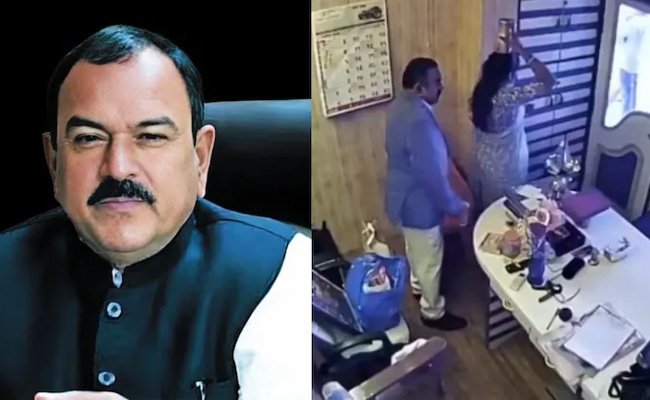
Nashik (PTI): Police took custody of self-proclaimed godman-cum-astrologer Ashok Kharat in an eighth case related to sexual exploitation of women and produced him before a Nashik district court which sent him to jail till May 12 after rejecting the plea for his police remand on Thursday.
On April 29, the Special Investigation Team (SIT) of the Nashik police in north Maharashtra filed a request application in the court demanding Kharat's custody in the eighth case.
After the court granted them the necessary permission, the SIT took custody of Kharat, who was in jail in connection with the seventh case of sexual exploitation registered against him.
The 'godman', named in a dozen FIRs related to rape and financial fraud, was produced before Chief Judicial Magistrate B N Ichpurani in the eighth case through video conferencing due to security reasons.
The eighth case related to Kharat allegedly sexually exploiting a woman who had approached him in search of solutions to her family problems, according to police.
During the hearing, the prosecution demanded police custody of the accused in the latest case.
However, the defence strongly opposed the demand and argued that the SIT was giving same reasons for police custody every time and there was no strong reason for accepting their plea.
The court accepted the argument put forth by the defence and remanded Kharat to judicial custody till May 12 in the eighth case.
The SIT will produce Kharat in the court on Friday again and seek his police custody in the ninth case. As the self-styled godman has been granted judicial custody in the eighth case, he will be sent to Nashik Road Central Jail and the SIT will take his custody from there.
Meanwhile, Kharat's judicial custody in the fourth case ended on Thursday. On April 18, the accused was remanded to judicial custody till April 30 in the fourth case of sexual exploitation of women.
In a related development, the SIT conducted a search at Kharat's office in the 'Canada Corner' area of Nashik city on Wednesday. A 'panchnama' (record of search and seizure proceedings) was conducted and the office was locked and sealed again.
Kharat, a well-heeled man with political connections, was arrested for the first time on March 18 after a woman alleged he had repeatedly raped her for three years.
He is accused of sexually exploiting several women by claiming to have divine powers and knowledge of black magic, and also committing large-scale financial fraud.
The SIT is conducting a probe into 12 cases of sexual exploitation and financial fraud registered against the astrologer in Nashik and Ahilyanagar districts.