Final toll from collapsed Russian building: 39 dead
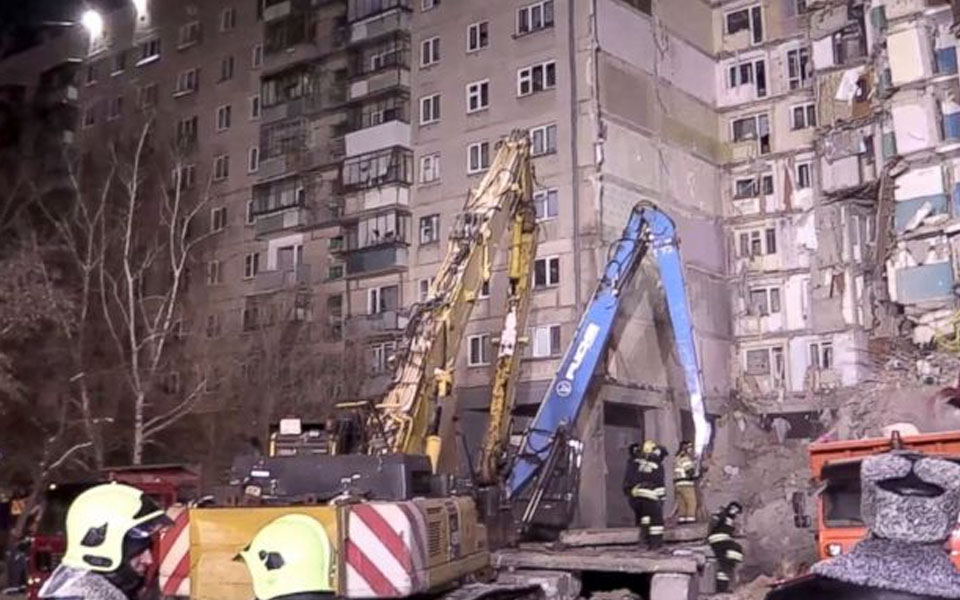
Moscow, Jan 4 (AP) After three-and-a-half days of fighting a mountain of concrete, cold weather and time, rescue teams in an industrial Russian city ended a search for people who were inside an apartment building where an explosion triggered a partial collapse, giving a final death toll Thursday of 39.
The massive operation launched by the Russian Emergencies Ministry in the jumbled maze of rubble where a section of a 10-story building stood in Magnitogorsk until Monday morning combined sophisticated equipment with gruelling manual labour.
Russian officials said from the start that emergency crews were racing to reach survivors before they died of hypothermia in temperatures as low as minus 29 degrees Celsius. Supervisors ordered fans to blow warm air into the wreckage while drones, flexible ocular devices and the hands of hundreds probed for signs of life.
A search dog brought hope to the grim work Tuesday when it pointed to a place where rescue workers would hear the cries of a baby. The 10-month-old boy who was pulled out 35 hours after the building came down ended up being the only person found alive in the debris.
The child was airlifted 1400 kilometres to a top hospital in Moscow with severe injuries that included fractures, frostbite and the combination of shock and kidney damage that doctors call "crush syndrome." He was in stable condition Thursday, the Health Ministry said.
A cat was found alive on Wednesday, but that did not provide much solace as search crews discovered more and more bodies. The number of victims grew from four on Monday and kept mounting until the search ended Thursday night.
"We took out the last, the 39th body today and we guarantee that there are no more people in the building," Deputy Emergencies Minister Alexander Chuprian told reporters.
Tallies earlier in the day said 38 bodies were recovered and three building residents still were unaccounted for, suggesting as many as 41 people had been buried in the rubble. It was not immediately clear why officials ended the search when the number of casualties reached 39.
The collapse followed an explosion that officials say likely was caused by a gas leak. Explosions caused by gas leaks in poorly built and indifferently maintained buildings occur often in Russia, but the Magnitogorsk disaster claimed an unusually high number of lives.
Along with the physical demands of wrestling jagged chunks of debris and the emotional stress of a bleak job, the search teams worked around the clock with the constant worry that still-standing parts of the building would fall on them. The search had to be suspended several times while workers stabilized walls or tore away pieces that looked like they might come crashing down.
The operation "was unique in its high risk to people," Chuprian said. On Thursday, the mayor of Magnitogorsk southeast of Moscow, told journalists there was no connection between the explosion at the apartment building and the fiery explosion of a minibus on the same street a day later.
The vehicle explosion took place about 2.5 kilometres from the apartment block. Police said the minibus was carrying gas canisters but have given few other details.
But video of the burning vehicle, including some posted on YouTube by Russia's RT satellite TV channel, featured sounds resembling gunfire and an observer's voice is heard saying people are shooting assault rifles.
Unconfirmed reports have suggested the apartment blast could have been a terrorist act and that the occupants of the exploded vehicle were suspects.
"I want to say that there are no clear facts showing any kind of confirmation of what is described on the internet today," Mayor Sergei Berdnikov said of the reports, according to state news agency Tass.
Let the Truth be known. If you read VB and like VB, please be a VB Supporter and Help us deliver the Truth to one and all.
First direct US-Venezuela commercial flight in 7 years to land in Caracas
Caracas (Venezuela) (AP): The first direct commercial flight between the United States and Venezuela is scheduled to land on Thursday in the Venezuelan capital, Caracas, seven years after the US Department of Homeland Security ordered an indefinite suspension, citing security concerns.
The resumption of a commercial flight between the two countries comes in the wake of the US capture of Nicolás Maduro in a stunning nighttime raid on his residence in Caracas, Venezuela's capital, in early January.
It also comes a month after the US formally reopened its embassy in Caracas following the restoration of full diplomatic relations with the South American country.
Flight AA3599 operated by Envoy Air, a subsidiary of American Airlines, was scheduled to depart from Miami at 10:16 a.m. local time and arrive three hours later in the Venezuelan capital, returning to Florida later in the afternoon.
Earlier, the airline said a second daily flight between Miami and Caracas will start on May 21.
In late January, US President Donald Trump said he informed Venezuela's acting President Delcy Rodríguez that he would open up all commercial airspace over Venezuela, allowing Americans to visit.
“American citizens will be very shortly able to go to Venezuela, and they'll be safe there,” Trump said at the time.
The flights mark the resumption of nonstop travel between the US and Venezuela for the first time since diplomatic ties were severed in 2019. For the past seven years, passengers have relied on international airlines and indirect routes through neighbouring Latin American countries.
In January, when the airline announced the resumption of flights it said it would give customers the opportunity to reunite with families and pursue new business opportunities.
American Airlines was the last US airline flying to Venezuela. It suspended flights in 2019 between Miami and Caracas, as well as flights to the oil hub city of Maracaibo. Delta and United Airlines pulled out in 2017 amid a political crisis that forced millions to flee the country.