France recognises Palestinian statehood at UN meeting to revive peace efforts
United Nations (AP): As the Gaza war rages on, France recognized Palestinian statehood on Monday at the start of a high-profile meeting at the United Nations aimed at galvanizing support for a two-state solution to the Mideast conflict. More nations are expected to follow, in defiance of Israel and the United States.
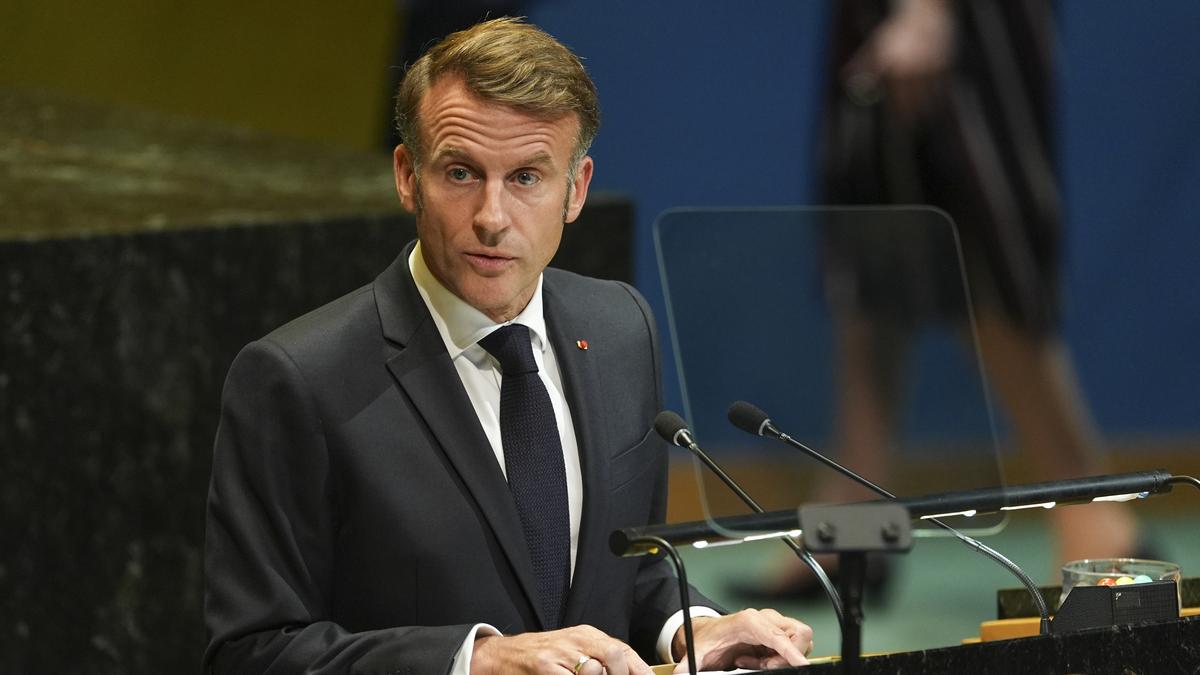
French President Emmanuel Macron's announcement in the UN General Assembly hall received loud applause from the more than 140 leaders in attendance. The Palestinian delegation, including its UN ambassador, Riyad Mansour, could be seen standing and applauding as the declaration was made. Mahmoud Abbas, the Palestinian president, was seen applauding on a live-camera view after the US government banned him from attending the UN gathering in person.
“True to the historic commitment of my country to the Middle East, to peace between the Israelis and the Palestinians, this is why I declare that today, France recognizes the state of Palestine,” Macron said.
The meeting and expanded recognition of Palestinian statehood are expected to have little if any actual impact on the ground, where Israel is waging another major offensive in the Gaza Strip and expanding settlements in the occupied West Bank.
Macron announced recognition of the state of Palestine at the start of the meeting, at which several world leaders were expected to speak. Palestinian President Mahmoud Abbas is expected to address the meeting by video after he and dozens of other senior Palestinian officials were denied US visas to attend the conference.
UN secretary-general Antonio Guterres said “statehood for the Palestinians is a right, not a reward." That appeared to push back against the Israeli government, which says recognizing statehood rewards Hamas after its Oct. 7 attack that set off the war in Gaza two years ago.
The UK, Canada, Australia and Portugal recognized the state of Palestine on Sunday, and the Palestinians expect a total of 10 countries to do so in the coming days. Around three-fourths of the 193-member United Nations recognizes Palestine, but major Western nations had until recently declined to, saying one could only come about through negotiations with Israel.
Palestinians have welcomed the moves toward recognition, hoping they might someday lead to independence. “This is a beginning, or a glimmer of hope, for the Palestinian people,” Fawzi Nour al-Deen said Sunday as he held a bag on his head, joining thousands of people fleeing south from Gaza City. “We are a people who deserve to have a state.”
International community widely backs a Palestinian state
The creation of a Palestinian state alongside Israel in the West Bank, Gaza and east Jerusalem — territories seized by Israel in the 1967 Mideast war — is widely seen internationally as the only way to resolve the conflict, which began more than a century before Hamas' Oct. 7 attack.
Israel's Benjamin Netanyahu government opposed Palestinian statehood even before the war and now says such a move would reward Hamas, the militant group that still controls parts of Gaza. He has hinted Israel might take unilateral steps in response, including annexing parts of the West Bank, which would put a viable Palestinian state even further out of reach.
UN spokesman Stephane Dujarric brushed off such threats, saying efforts to bring about a two-state solution should continue regardless of Israel's actions. “I think we have to be determined in achieving the goal that we want to achieve, and we cannot be distracted by threats and intimidation,” he said.
Netanyahu is under pressure from his far-right coalition to move ahead with annexation, but the UAE — the driving force behind the 2020 Abraham Accords, in which the UAE and three other Arab states forged ties with Israel — has called it a "red line," without saying how it could affect the two countries' now close ties.
Netanyahu said he would decide on Israel's response to the Palestinian statehood push after meeting with President Donald Trump at the White House next week, their fourth meeting since Trump returned to office. The Israeli leader is set to address world leaders at the UN on Friday.
The Trump administration is also opposed to growing recognition of a Palestinian state and blames it for the derailment of ceasefire talks with Hamas. Trump's envoy, Steve Witkoff, walked away from the talks in July, and earlier this month an Israeli strike targeted Hamas negotiators in Qatar, a key mediator.
The Palestinians are politically fragmented
Abbas' internationally recognized Palestinian Authority is led by rivals of Hamas and administers parts of the West Bank. It recognizes Israel, cooperates with it on security matters, and is committed to a two-state solution. France and Saudi Arabia have advanced a phased plan in which a reformed Palestinian Authority would eventually govern the West Bank and Gaza with international assistance. It was overwhelmingly supported by the General Assembly on September 12 by a vote of 142-10. Twelve members abstained.
Israel says the Palestinian Authority is not fully committed to peace and accuses it of incitement to militancy. Many Palestinians view the leadership in the West Bank as corrupt and increasingly autocratic.
Let the Truth be known. If you read VB and like VB, please be a VB Supporter and Help us deliver the Truth to one and all.
JD(U) supremo Nitish Kumar's son Nishant to start maiden political yatra on Sunday
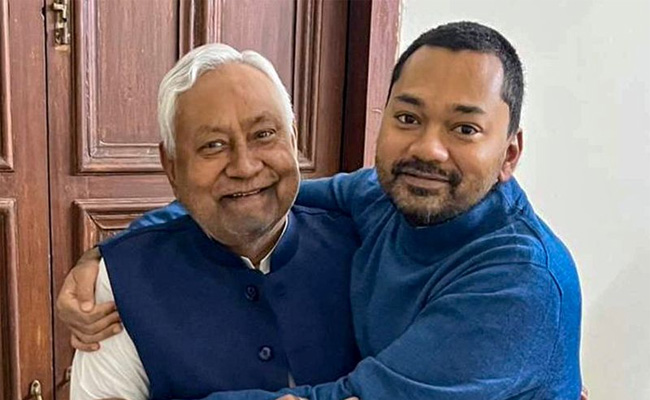
Patna (PTI): JD(U) leader Nishant Kumar, whose belated political entry has shone a ray of hope on the party rattled by his father Nitish Kumar's sudden relinquishment of power, is set to launch his first public outreach programme in Bihar on Sunday.
The 45-year-old, who joined the party only last month, is scheduled to kick off his "Sadbhav Yatra" (goodwill tour) from Valmiki Nagar in West Champaran district.
The place had been chosen multiple times by his father as the starting point for numerous "yatras" during a nearly two-decade-long tenure as the chief minister of Bihar.
The party, which is still recovering from the shock of the 75-year-old leader's sudden decision to enter the Rajya Sabha, triggering fears of a diminution in political clout, has coined a catchy slogan to announce the arrival of the heir apparent.
"Jai Nishant, tay Nishant" (victory for Nishant, his rise is inevitable) is a catchphrase that can now be seen splashed on the JD(U)'s posters as well as social media handles.
On the eve of the launch of "Sadbhav Yatra", JD(U) spokesperson and MLC Neeraj Kumar told a press conference in West Champaran's headquarters of Bettiah, that "Nishant belongs to the land where Emperor Asoka was born.
Like his father, he is starting a Yatra from the land of Sage Valmiki".
"Both Valmiki and Asoka epitomised renunciation. Our supreme leader Nitish Kumar showed the same spirit of renunciation when he decided to give up the seat of power to live by his convictions," said Neeraj Kumar.
He added that "the same dispassion for power has been demonstrated by Nishant. He could have secured a berth in the new Cabinet or the state legislature any time. But he chose to shun shortcuts and earn his spurs through the tried and tested method of mass contact".
After the JD(U) supremo stepped down as chief minister, a new government headed by BJP leader Samrat Choudhary has been formed in Bihar.
"Nitish Kumar had always followed the policy of zero tolerance for crime, corruption and communalism. The new government, too, has adopted the same as its motto. In Nishant, we have a leader who will carry forward the legacy," said Neeraj Kumar.