Head of Human Rights Watch to resign after nearly 3 decades
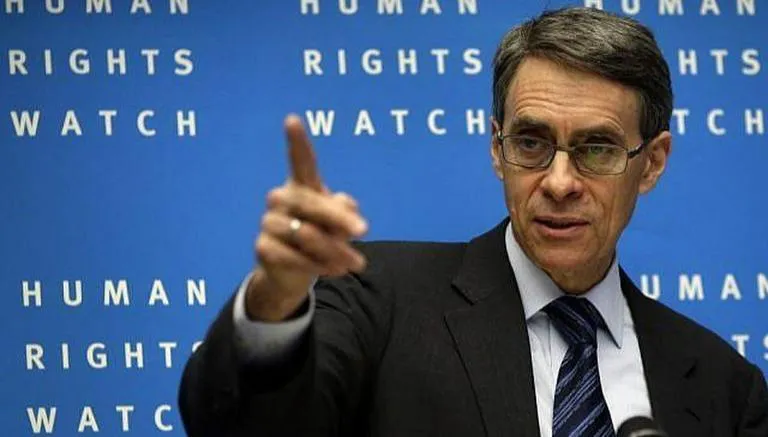
New York, Apr 26: The longtime leader of Human Rights Watch announced Tuesday he will step down this summer as executive director after nearly three decades at the helm of one of the world's leading advocacy organisations.
Kenneth Roth ran the New York-based group as it shared a Nobel Peace Prize in 1997 for its efforts to ban anti-personnel land mines. The group also pushed to establish the International Criminal Court for prosecuting war crimes, crimes against humanity and genocide.
Former ICC chief prosecutor Fatou Bensouda called Roth an inspiration.
Ken's fearless passion for justice, his courage and compassion towards the victims of human rights violations and atrocity crimes was not just professional responsibility but a personal conviction to him, she said.
Roth became executive director in 1993, when the group had a staff of about 60 and a USD 7 million annual budget. It now has over 550 employees in more than 100 countries and a nearly USD 100 million budget to campaign against human rights abuses.
Ken Roth turned Human Rights Watch into a juggernaut for justice, said Anthony Romero, executive director of the American Civil Liberties Union. He has inspired a generation of human rights defenders to fight for a better world.
The group has been at the forefront of advocacy on some of the world's most hot-button rights issues.
According to Human Rights Watch, that earned Roth many enemies over the years.
Despite being Jewish (and having a father who fled Nazi Germany as a 12-year-old boy), he has been attacked as a supposed anti-Semite because of the organization's criticism of Israeli government abuses, the group said in a statement Tuesday.
The Chinese government imposed sanctions' on him and expelled him from Hong Kong when he traveled there to release Human Rights Watch's World Report in January 2020, which spotlighted Beijing's threat to the global human rights system, it said.
During his early years there, Roth conducted fact-finding investigations including in Haiti and Cuba, on the Israel-Palestinian conflict, and in Kuwait after the 1990 Iraqi invasion. In recent years, he's been especially concerned with addressing atrocities during the Syrian war as well as Chinese repression of the Uyghur minority in Xinjiang.
After the Sept. 11, 2001, terrorist attacks in the United States, Human Rights Watch documented and exposed the use of black sites where U.S. officials interrogated and tortured terrorism suspects. The group pressed the U.S. government to investigate and prosecute those responsible.
The organization said its reporting and advocacy contributed to convictions of former Liberian President Charles Taylor, former Peruvian President Alberto Fujimori and Bosnian Serb wartime leaders Radovan Karadzic and Ratko Mladic.
Roth began his human rights career as a volunteer, working on nights and weekends while serving as an attorney and a federal prosecutor. He joined Human Rights Watch in 1987 as deputy director and soon after he took the top job in 1993 he joined its regional rights watch groups together under a single identity as Human Rights Watch.
After Roth steps down at the end of August, Human Rights Watch said deputy executive director Tirana Hassan will serve as interim executive director while it holds a search for Roth's successor.
I had the great privilege to spend nearly 30 years building an organisation that has become a leading force in defending the rights of people around the world, said Roth. I am leaving Human Rights Watch but I am not leaving the human rights cause.
Let the Truth be known. If you read VB and like VB, please be a VB Supporter and Help us deliver the Truth to one and all.
EAM Jaishankar meets Jamaican PM, gifts over 10 BHISHM Cubes
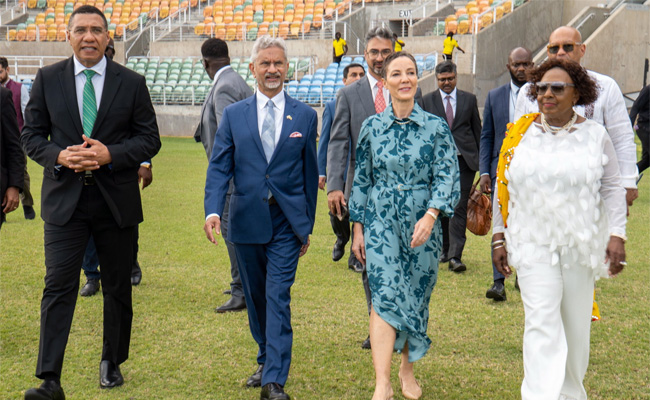
Kingston (PTI): External Affairs Minister S Jaishankar on Monday met Jamaican Prime Minister Andrew Holness and discussed ways to further deepen "political, economic and people-to-people cooperation."
Jaishankar also conveyed greetings from Prime Minister Narendra Modi to Holness.
"Pleased to call on Prime Minister @AndrewHolnessJM in Kingston. Conveyed the greetings of PM @narendramodi," Jaishankar posted on X.
"Discussed deepening our political, economic and people-to-people cooperation. Value his commitment towards further strengthening India-Jamaica relations," the post further read.
Also, the external affairs minister handed over 10 BHISHM (Bharat Health Initiative for Sahyog Hita & Maitri) Cubes as a gift to Jamaica.
"Formally handed over 10 BHISHM Cubes as a gift from India to Jamaica, in the presence of PM @AndrewHolnessJM, Health Minister @christufton and FM @kaminajsmith," Jaishankar posted on X.
"The BHISHM Cube mobile hospital system, designed for rapid deployment, will help Jamaica during disasters and emergencies. The gift of these cubes is a statement of friendship, a commitment to disaster preparedness, and an outcome of innovation," the post said.
Jaishankar arrived in Kingston on Saturday evening, marking the first leg of his nine-day tour of Jamaica, Suriname, and Trinidad and Tobago, aimed at further strengthening India's strategic and cultural ties with the Caribbean nations.
Earlier in the day, he interacted with the Indian diaspora and discussed India's ongoing transformation in infrastructure, human development and technology-driven governance and entrepreneurship with them.
He also highlighted the cricket bond between both countries as India gifted a scoreboard to Jamaica.
A scoreboard was dedicated at Sabina Park in Kingston. It is the home of the Jamaica cricket team and is the only Test cricket ground in the Caribbean island nation.
The minister expressed hope that the new scoreboard would witness many memorable innings, including those symbolising the enduring friendship between the two countries.
Cricket has long been a strong cultural bridge between India and Jamaica, which is part of the West Indies cricket team.
Jamaican players, including Chris Gayle, Courtney Walsh and Michael Holding, have played a major role in shaping the legacy of West Indies cricket in the international arena, contributing to its dominance in earlier decades and its continued global appeal.