Imran Khan To Be Sworn In As PM Before Pakistan's Independence Day: Party
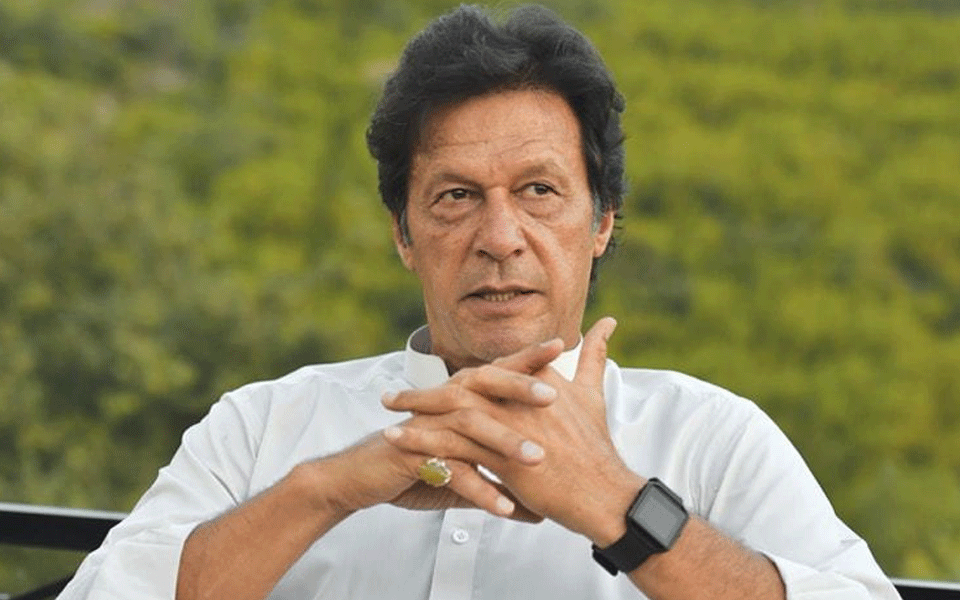
ISLAMABAD: Imran Khan will be sworn in as Pakistan's new Prime Minister before the country's independence day on August 14, his party has announced as it is trying to reach out to smaller parties and independents to form the next government.
Though the Pakistan Tehreek-e-Insaf (PTI) has emerged as the single largest party in the National Assembly after the July 25 elections, the party is still short of numbers to form its government on its own.
PTI leader Naeenul Haq told the media on Saturday night that consultations are on to complete the number game.
"We have done our homework and he will take oath as Prime Minister before August 14," Mr Haq said.
According to the complete preliminary results announced by the Election Commission of Pakistan, the PTI has obtained 115 general seats, 12 short of a simple majority, while the PML-N and PPP have won 64 and 43 seats, respectively.
Pakistan's lower house of Parliament comprises a total of 342 members, of which 272 are directly elected. A party can only form the government if it manages to secure 172 seats in total.
Meanwhile, political activities are at full swing and parties are holding open meetings and secret parleys to arrange the political chessboard.
Pakistan's two major parties -- the Pakistan Peoples Party (PPP) and the Pakistan Muslim League-Nawaz (PML-N) - are expected to meet in a couple of days to devise a joint strategy in a bid to give a tough time to the PTI in parliament, the Dawn reported.
The Pakistani electronic media throughout the day yesterday kept on mentioning names of possible candidates for key government offices and possible members of the federal cabinet.
The PTI leaders who have won more than one seat will have to vacate additional seats as the law allows an individual to retain only one seat. PTI chairman Khan has won five seats and he will have to vacate four seats.
Ghulam Sarwar Khan of Taxila has also won two NA seats by defeating former interior minister Chaudhry Nisar Ali Khan and he will also have to vacate one seat.
Former chief minister of Khyber Pakhtunkhwa Pervez Khattak has won both National Assembly and provincial assembly seats.
If the PTI decides to nominate him again for the office of the chief minister, he will also have to vacate the NA seat which means that the party's seats will be reduced to 109.
It was after these calculations that the PTI leadership has now decided to reach out to other smaller groups and independents since the party has already declared that it will not join hands with the PPP and the PML-N, the daily said.
The Dawn reported that Former secretary general of the PTI Jahangir Tareen had established contacts with independents and the Muttahida Qaumi Movement-Pakistan (MQM-P) which has won six seats. There are 13 independents who have won the NA seats.
If the PTI obtains support of the GDA, MQM-P, PML-Q and the Awami Muslim League, the number of its seats will become 122 - still 15 short of the required numbers, which is more than the independents who have won the elections.
Other parties which will have representation in the NA are the Balochistan National Party-Mengal (BNP-M) with three members, and Jamhoori Watan Party, Awami National Party and Pakistan Tehreek-i-Insaniyat with one seat each.
Though the PPP and the PML-N have also rejected the elections results, sources in the two parties told Dawn that they would not support the Muttahida Majlis-i-Amal (MMA)'s call for boycotting the oath-taking session of the National Assembly.
"We have decided to play the role of an aggressive opposition in parliament," said a senior PML-N leader who had participated in the MMA-convened multiparty conference in Islamabad on Friday.
A senior leader of the PPP said so far they had not finalised any strategy for the elections of key parliamentary offices.
PPP chairman Bilawal Bhutto-Zardari on Saturday formed a committee to engage with political parties to discuss the way forward in the post-poll scenario.
The sources said contact had been established between the PPP and the PML-N and the leaders of the two sides were expected to hold a meeting in a few days.
courtesy: ndtv.com
Let the Truth be known. If you read VB and like VB, please be a VB Supporter and Help us deliver the Truth to one and all.
Two held for 'firing' at BJP leader's house in Bengal

Kolkata (PTI): A day before the counting of votes for the West Bengal assembly elections, two persons were arrested on Sunday for allegedly being involved in a firing incident outside the residence of a BJP leader in North 24 Parganas district, police said.
BJP leader Kundan Singh lodged a police complaint, alleging that a few gunmen fired at his house in the Noapara constituency around Saturday midnight.
Based on the CCTV footage, the two accused were apprehended, a senior officer said.
BJP's Noapara candidate Arjun Singh, in a post on social media, claimed that around 12.05 am, two armed miscreants arrived on a motorcycle at the residence of Kundan Singh, a BJP functionary and secretary of the Barrackpore organisational district, with an "intent to kill him".
According to the BJP leader, the accused are residents of Garulia and are known criminals.
Their names as offenders had been submitted to the Election Commission, he said.
The police officer did not specify whether the two arrested persons were the same individuals named by Arjun Singh.
According to the complaint, one round of firing took place outside Kundan Singh's house, triggering panic in the area.
The BJP candidate also questioned the role of the police, claiming that one of the accused had been detained by the police on the polling day but was later released in the evening.
The Noapara assembly seat went to the polls on April 29.
Several BJP leaders alleged that attempts were being made to create an atmosphere of fear ahead of the counting and weaken the organisation of the opposition parties.
The counting of votes will take place on May 4. Polling for the West Bengal assembly elections was held on April 23 and April 29.
The BJP urged the Election Commission to intervene immediately to ensure peaceful counting.
TMC candidate Somnath Shyam rubbished Arjun Singh’s allegation, claiming that the BJP nominee had orchestrated the firing incident to divert attention from imminent defeat.
“Arjun Singh knows all the gangsters in the Barrackpore belt. Everyone knows about his links with the underworld. Let the police investigate the incident,” Shyam said.