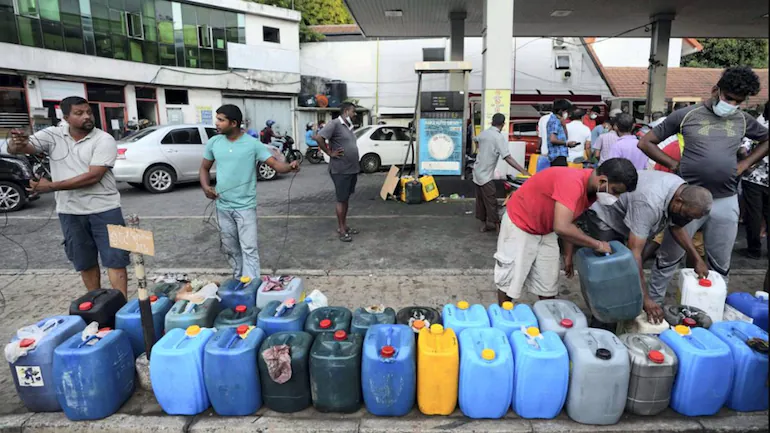
Colombo, Jul 22: Two men died in cash-strapped Sri Lanka on Friday while waiting in serpentine queues to purchase fuel as widespread shortages and soaring inflation levels continue to heap misery on citizens.
The two deaths were reported on a day when newly-elected President Ranil Wickremesinghe on Friday appointed Dinesh Gunawardena as the Prime Minister in a bid to restore political stability and mitigate the worst economic crisis that has virtually bankrupted the island nation.
The 59-year-old man had left his motorcycle for over two nights near a filling station in Kinniya, a town located in Sri Lanka's Eastern Province, collapsed on Friday, according to news portal Lanka First.
The victim's body was shifted to the Kinniya Base Hospital for post-mortem examination, it said.
A 70-year-old man also died after collapsing while waiting in line for fuel at a filling station in Mathugama, in the country's Western Province.
Fuel was delivered to the filling station after 10 days, and there was a rush to obtain fuel due to the absence of a proper system of distribution, the report said.
The man collapsed during the rush and was admitted to the Meegahatenna Regional Hospital where he was ruled dead upon admission, it added.
This is not the first time that a person has died while waiting for fuel in Sri Lanka.
Similar incidents have been reported since the beginning of 2022, with some even dying of exhaustion brought about by severe heat.
Last week, Power and Energy Minister Kanchana Wijesekera introduced a National Fuel Pass for the citizens to obtain fuel through regularising distribution, according to news portal Economy Next.
The new fuel pass will allow each motorist to obtain a minimum quantity of fuel on a weekly basis, Wijesekera said.
Despite these measures, filling stations are going dry and frequent clashes are being witnessed near filling stations across the country.
Sri Lanka received the first of three fuel shipments last week, Wijesekera said, the first shipments to reach the country in about three weeks.
Meanwhile, Sri Lanka's inflation firmed up in June as the country's broader measure of consumer prices jumped by 59 per cent from a year ago, accelerating from 45.3 per cent in May, according to the country's National Consumer Price Index.
Sri Lanka's newly-elected President Ranil Wickremesinghe, has been leading crucial talks with the International Monetary Fund, last week said that negotiations were nearing conclusion.
Sri Lanka needs about USD 5 billion in the next six months to cover basic necessities for its 22 million people, who have been struggling with long queues, worsening shortages and power cuts.
Let the Truth be known. If you read VB and like VB, please be a VB Supporter and Help us deliver the Truth to one and all.
New Delhi: A bill to set up a 13-member body to regulate institutions of higher education was introduced in the Lok Sabha on Monday.
Union Education Minister Dharmendra Pradhan introduced the Viksit Bharat Shiksha Adhishthan Bill, which seeks to establish an overarching higher education commission along with three councils for regulation, accreditation, and ensuring academic standards for universities and higher education institutions in India.
Meanwhile, the move drew strong opposition, with members warning that it could weaken institutional autonomy and result in excessive centralisation of higher education in India.
The Viksit Bharat Shiksha Adhishthan Bill, 2025, earlier known as the Higher Education Council of India (HECI) Bill, has been introduced in line with the National Education Policy (NEP) 2020.
The proposed legislation seeks to merge three existing regulatory bodies, the University Grants Commission (UGC), the All India Council for Technical Education (AICTE), and the National Council for Teacher Education (NCTE), into a single unified body called the Viksit Bharat Shiksha Adhishthan.
At present, the UGC regulates non-technical higher education institutions, the AICTE oversees technical education, and the NCTE governs teacher education in India.
Under the proposed framework, the new commission will function through three separate councils responsible for regulation, accreditation, and the maintenance of academic standards across universities and higher education institutions in the country.
According to the Bill, the present challenges faced by higher educational institutions due to the multiplicity of regulators having non-harmonised regulatory approval protocols will be done away with.
The higher education commission, which will be headed by a chairperson appointed by the President of India, will cover all central universities and colleges under it, institutes of national importance functioning under the administrative purview of the Ministry of Education, including IITs, NITs, IISc, IISERs, IIMs, and IIITs.
At present, IITs and IIMs are not regulated by the University Grants Commission (UGC).
Government to refer bill to JPC; Oppn slams it
The government has expressed its willingness to refer it to a joint committee after several members of the Lok Sabha expressed strong opposition to the Bill, stating that they were not given time to study its provisions.
Responding to the opposition, Parliamentary Affairs Minister Kiren Rijiju said the government intends to refer the Bill to a Joint Parliamentary Committee (JPC) for detailed examination.
Congress Lok Sabha MP Manish Tewari warned that the Bill could result in “excessive centralisation” of higher education. He argued that the proposed law violates the constitutional division of legislative powers between the Union and the states.
According to him, the Bill goes beyond setting academic standards and intrudes into areas such as administration, affiliation, and the establishment and closure of university campuses. These matters, he said, fall under Entry 25 of the Concurrent List and Entry 32 of the State List, which cover the incorporation and regulation of state universities.
Tewari further stated that the Bill suffers from “excessive delegation of legislative power” to the proposed commission. He pointed out that crucial aspects such as accreditation frameworks, degree-granting powers, penalties, institutional autonomy, and even the supersession of institutions are left to be decided through rules, regulations, and executive directions. He argued that this amounts to a violation of established constitutional principles governing delegated legislation.
Under the Bill, the regulatory council will have the power to impose heavy penalties on higher education institutions for violating provisions of the Act or related rules. Penalties range from ₹10 lakh to ₹75 lakh for repeated violations, while establishing an institution without approval from the commission or the state government could attract a fine of up to ₹2 crore.
Concerns were also raised by members from southern states over the Hindi nomenclature of the Bill. N.K. Premachandran, an MP from the Revolutionary Socialist Party representing Kollam in Kerala, said even the name of the Bill was difficult to pronounce.
He pointed out that under Article 348 of the Constitution, the text of any Bill introduced in Parliament must be in English unless Parliament decides otherwise.
DMK MP T.M. Selvaganapathy also criticised the government for naming laws and schemes only in Hindi. He said the Constitution clearly mandates that the nomenclature of a Bill should be in English so that citizens across the country can understand its intent.
Congress MP S. Jothimani from Tamil Nadu’s Karur constituency described the Bill as another attempt to impose Hindi and termed it “an attack on federalism.”