India, Kazakhstan agree to boost trade, defence cooperation
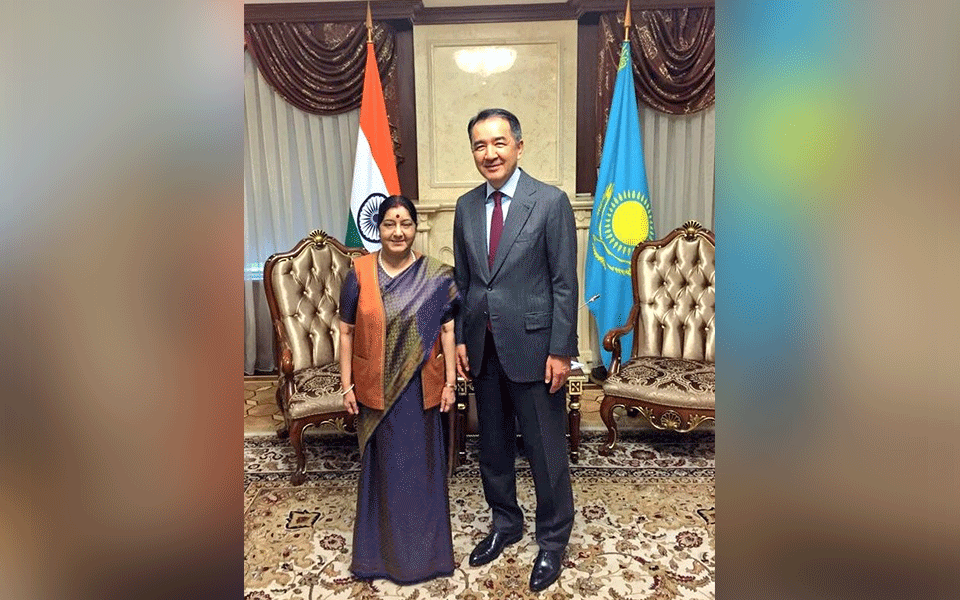
Astana, Aug 3: India and Kazakhstan agreed to strengthen cooperation in the areas of trade and defence and security following delegation-level talks headed by Indian External Affairs Minister Sushma Swaraj and Kazakh Foreign Minister Kairat Abdrakhmanov here on Friday.
"We covered the full range of bilateral, regional and global issues of mutual interest," Sushma Swaraj said while addressing the media following the meeting.
"We took stock of progress in our bilateral relations," she said.
Noting that both India and Kazakhstan have developed multifaceted cooperation in all areas of bilateral and multilateral relations and are strategic partners since 2009, she said New Delhi seeks to consolidate and further strengthen its friendly relations with the Central Asian nation.
"I discussed with Foreign Minister Abdrakhmanov our interest to partner with Kazakhstan to explore markets for new products, diversifying from the trade in traditional products to inject fresh impetus to the trade between the two countries," Sushma Swaraj said.
"There is immense potential to be tapped in sectors like agricultural products, food processing, pharmaceuticals, energy and chemicals."
Kazakhstan is India's largest trade and investment partner in Central Asia. Bilateral trade between the two countries stood at $642.42 million in 2016-17.
Cumulative investments from India into Kazakhstan and from Kazakhstan to India from 2005 to 2016 amounted to $244 million and $83.09 million respectively, according to figures provided by the Indian External Affairs Ministry.
Sushma Swaraj also said that India has keen interest in improving connectivity with the Central Asian region.
"In December 2017, India acceded to TIR convention and in February 2018, India joined the Ashgabat Agreement," she said.
"The International North South Transport Corridor (INSTC) is gaining momentum and the member states are working together to popularise the corridor."
The Transports Internationaux Routiers (TIR) Convention is a multilateral treaty that seeks to simplify and harmonise the administrative formalities of international transport.
The Ashgabat Agreement is a multimodal transport agreement between India, Iran, Kazakhstan, Oman, Turkmenistan and Uzbekistan.
Sushma Swaraj also said that she and Abdrakhmanov expressed their interest to further strengthen defence cooperation between the two sides "based on solid foundation that we have in place".
"Our defence and security sector cooperation has intensified in the last two years," she said.
"Kazakh Armed Forces Unit underwent training on peacekeeping operations in India and presently a mobile training team from the Indian Army is training Kazakh personnel in Almaty."
Pointing out that both countries have growing cooperation in capacity building, Sushma Swaraj said: "Kazakhstan's professionals and students have been attending courses on scholarships in India every year under ICCR (Indian Council for Cultural Relations) and ITEC (Indian Technical and Economic Cooperation) programme in a wide range of disciplines."
She also stressed on enhancing people-to-people contact and promoting tourism between the two countries.
Following the delegation-level talks, Sushma Swaraj called on Kazakh Prime Minister Bakytzhan Sagintayev.
"Good exchange of views on strengthening cooperation in trade and investment, ICT, joint film production, tourism and people-to-people contacts," Indian External Affairs Ministry spokesperson Raveesh Kumar tweeted following the meeting.
Sushma Swaraj arrived here on Thursday on the first leg of her three-nation Central Asian tour that will also see her visiting Kyrgyzstan and Uzbekistan.
She interacted with members of the around 7,000-strong Indian community in Kazakhstan soon after her arrival.
Let the Truth be known. If you read VB and like VB, please be a VB Supporter and Help us deliver the Truth to one and all.
Austrian police detain suspect in case of rat poison found in baby food jars on supermarket shelves
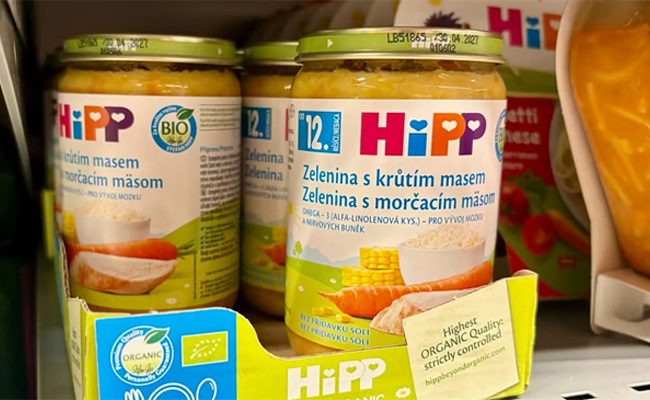
Vienna (AP): Police in eastern Austria say a 39-year-old suspect has been arrested after rat poison turned up in some HiPP baby food jars on supermarket shelves in central Europe.
HiPP, which recalled some of its baby food jars in Austria, Slovakia and the Czech Republic after the case came to light last month, said in a statement Saturday it was “greatly relieved” by the arrest, and would provide further updates as verified details come in.
The Burgenland State Criminal Police Office, under the direction of prosecutors, said a probe was launched after poison turned up in a baby food jar purchased at a supermarket in the city of Eisenstadt on April 18.
It said the suspect was being questioned, and that no further details would be immediately provided. The Burgenland public prosecutor's office has announced an investigation into suspected “intentional endangerment of the public.”
The Austrian Press Agency reported that an expert report on the toxicity of the poison was pending. A total of five tampered baby food jars were seized before they could be consumed, APA reported.
Authorities said previously they believe the tampering occurred in 190-gram (6.7-ounce) jars of baby food made with carrots and potatoes for 5-month-olds that were sold from SPAR supermarkets in Austria.
HiPP responded by recalling all of its baby food jars sold at SPAR supermarkets — which include SPAR, EUROSPAR, INTERSPAR and Maximarkt stores — in Austria as a precaution. Vendors in Slovakia and the Czech Republic also removed all of the brand's baby jars from sale.
The company said the recall was not due to any product or quality defect on its part, and said the jars left its facility in “perfect condition.”
Police said a customer at the time of the discovery had reported that a jar appeared to have been tampered with, but no one had consumed the baby food.