Indian-American eighth-grader Dev Shah crowned 2023 Scripps National spelling Bee champion
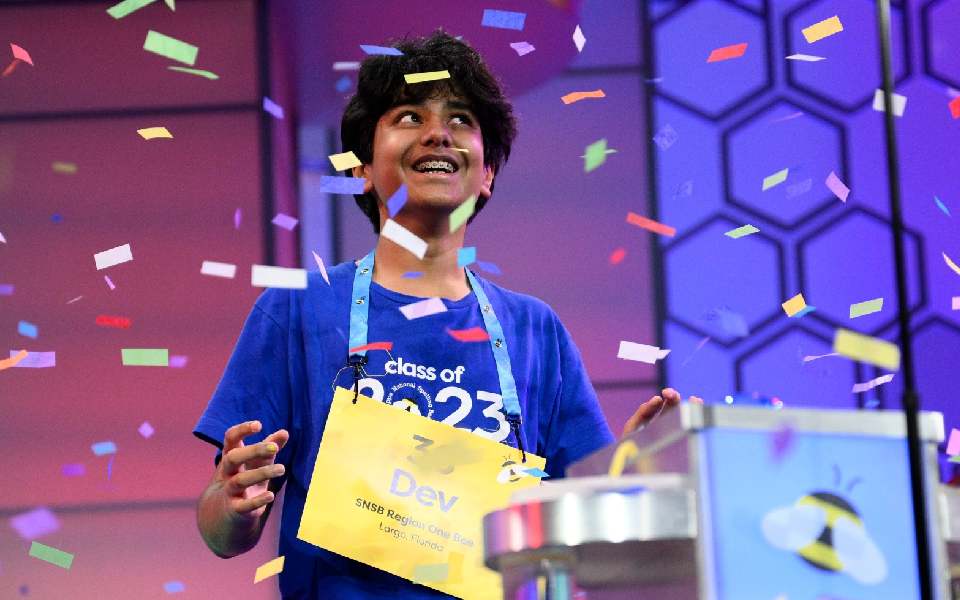
Washington, Jun 2: Dev Shah, a 14-year-old eighth-grader from Florida, who correctly spelled the word "psammophile" has won the 2023 Scripps National Spelling Bee, a prestigious contest where children of Indian origin have ruled the roost.
Shah correctly spelled the word to win the 95th national bee and the USD 50,000 prize on Thursday.
"It's surreal," Shah said onstage after the confetti fell on his head and he lifted the trophy high above.
"I don't know if it's settled in. My legs are still shaking," he said at the competition in National Harbor, Maryland.
"I made a lot of sacrifices these last three months and I'm glad I made them," Shah said. "I'm glad to now get back what I sacrificed."
After much anticipation about a possible spell-off, a smiling Shah won by correctly spelling "psammophile," a plant or animal that thrives in sandy areas, the Washington Post newspaper reported.
"Psammo meaning sand, Greek?" he asked. "Phile, meaning love, Greek?"
Shah instantly identified the roots of his word, but asked for all the information just to be safe, while smiling slightly in a way that suggested he was pretty sure he had it, the New York Times newspaper reported.
Shah cut back on his extracurricular activities to dedicate more time to the dictionary. Some days he would not even go to school, since exams were over. He'd be better off studying, Shah figured. That end-of-year field trip his classmates at Morgan Fitzgerald Middle School went on? No thanks.
"I knew I had to study," Shah said. "It paid off."
Other words that Shah correctly spelled during the competition include: bathypitotmeter, tolsester, rommack, aegagrus, schistorrhachis, poliorcetics, Perioeci, exhortation, cocomat and ardoise.
The moment he heard the word, Shah knew he had the Bee in his pocket.
"I don't feel like I was competing against anyone," Shah said. "In between rounds, and even during rounds, we would congratulate each other. That's what separates the Spelling Bee from other competitions. Everyone's in there together."
Scott Remer, a former speller who coached six of the finalists onstage Thursday, said he began working with Shah about three years ago, the USA Today newspaper reported.
"One of the things that really impresses me about Dev is his perseverance and his commitment," Remer said. "He is extraordinarily mature, self-motivated."
This was Shah's third attempt. His previous two attempts were in 2019 and 2021.
Shah's parents hopped on stage, visibly emotional, and his mother said he's been preparing for this for four years.
Last year, Shah stumbled in regionals and didn't make it to the national competition. In 2021, a virtual competition, he was bounced in the third round of preliminaries. The pandemic cancelled the 2020 Bee and in 2019, Shah bowed out in the quarterfinals.
At 14, this was his last chance. And he responded by training around the clock, including two hours per week with Remer.
"It's hard as a (middle schooler) to have that delayed gratification," Remer said.
Over three days at the Gaylord National Resort and Convention Center, Shah displayed poise onstage, asked the proper questions to ascertain as much information he could from the pronouncers and used his "prodigious" command of word stems and roots, the report added.
Eleven students made the finals after 11 million people entered spelling competitions throughout the world.
The preliminary rounds began Tuesday, while the quarterfinals and semifinals took place Wednesday.
Charlotte Walsh, a 14-year-old from Arlington, Virginia, was the runner-up. A half-hour after Shah won, she returned to the stage to offer a congratulatory hug.
In 2022, Harini Logan, a 14-year-old Indian-American eighth-grader from Texas, won the contest, beating Vikram Raju, her compatriot.
The National Bee is a high-profile, high-pressure endurance test as much as a nerd spelling match and spellers spend months preparing for it. Over the past 20 years, Indian-Americans have been dominating the Spelling Bee contest even though they comprise only about 1 per cent of the US population.
The US Spelling Bee reflects the dominance young children from the small ethnic community have had on this prestigious test for more than a decade now.
Since Balu Natarajan won it in 1985, more than 20 Indian-origin children have been crowned champions at the competition.
The Spelling Bee, which features elementary and middle school students spelling words that would cause most adults to stumble, has had a tumultuous few years. The National Spelling Bee was launched in 1925.
Owing to the Covid-19 pandemic, the competition was cancelled in 2020, a significant shake-up for what is billed as the US' largest and longest-running educational programme.
The Bee returned in 2021 but with a few changes.
Let the Truth be known. If you read VB and like VB, please be a VB Supporter and Help us deliver the Truth to one and all.
Mercury likely to touch 44 deg C in Delhi; IMD issues alert for heatwave-like conditions
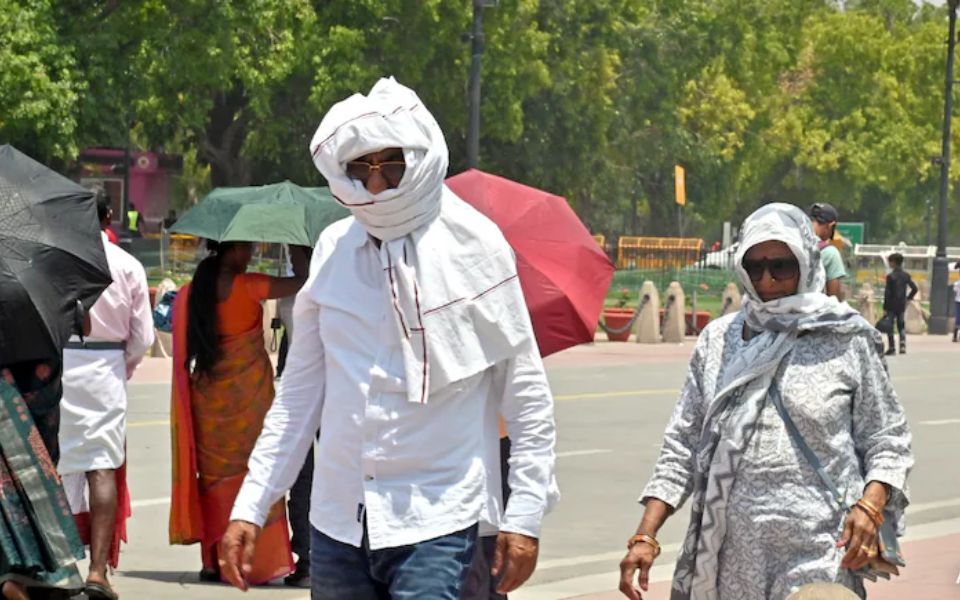
New Delhi (PTI): Delhi recorded a minimum temperature of 26.2 degrees Celsius on Sunday, 2.4 notches below the seasonal average, according to the India Meteorological Department.
The weather department has forecast partly cloudy sky with an orange alert for heatwave-like conditions at isolated places by the evening.
The maximum temperature is expected to reach around 44 degrees Celsius on Sunday, the IMD said.
The relative humidity in the capital was recorded at 43 per cent at 8.30 am.
The air quality was 'poor' at 9 am, with an Air Quality Index (AQI) reading of 223, Central Pollution Control Board (CPCB) data showed.
According to the CPCB, an AQI between zero and 50 is considered 'good', 51 and 100 'satisfactory', 101 and 200 'moderate', 201 and 300 'poor', 301 and 400 'very poor', and 401 and 500 'severe'.