Israelis rally in their largest anti-government protest since the war in Gaza began
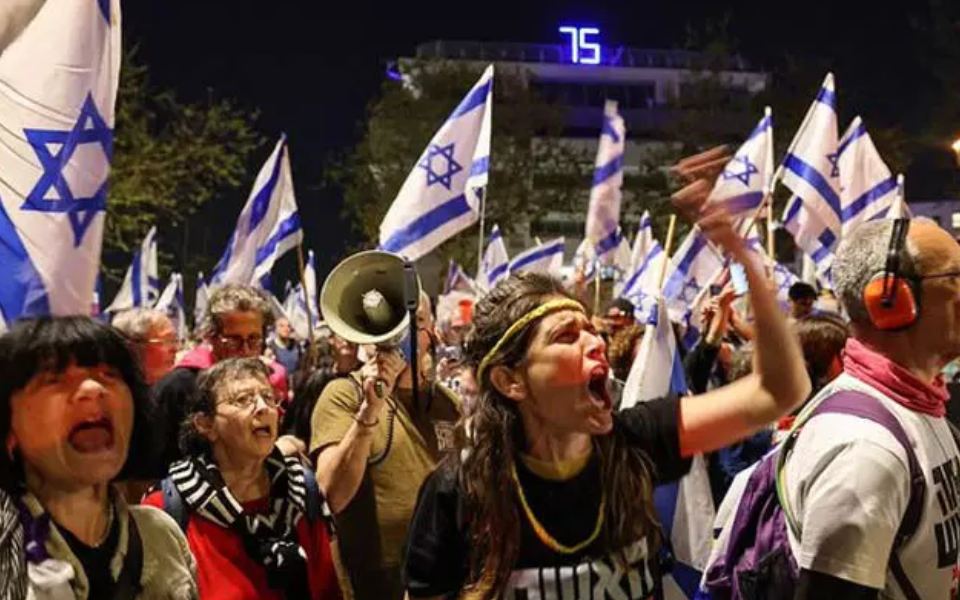
Jerusalem, Mar 31: Tens of thousands of Israelis gathered outside the parliament building in Jerusalem on Sunday in the largest anti-government demonstration since the country went to war in October. They urged the government to reach a deal to free dozens of hostages held by Hamas in Gaza and to hold early elections.
Nearly six months of war have renewed divisions in Israeli society. The Hamas group killed some 1,200 people during its cross-border attack on October 7, and took 250 others hostage. Roughly half the hostages were released during a weeklong cease-fire in November, but repeated attempts by international mediators to broker another cease-fire deal have failed.
Prime Minister Benjamin Netanyahu has vowed to destroy Hamas and bring all the hostages home. But those goals have been elusive. While Hamas has suffered heavy losses, it remains intact, and hostages' families believe time is running out.
“After six months, it seems like the government understands that Bibi Netanyahu is an obstacle,” said demonstrator Einav Moses, whose father-in-law, Gadi Moses, is held hostage. “Like he doesn't really want to bring them back, that they have failed in this mission.”
The crowd stretched for blocks around the Knesset, or parliament building, and organizers vowed to continue the demonstration for several days. They urged the government to cancel an upcoming parliamentary recess and to hold new elections nearly two years ahead of schedule.
Netanyahu, in a nationally televised speech before undergoing hernia surgery later Sunday, said he understood the pain of the hostages' families. “I will do everything to bring the hostages home," he said.
He also said calling new elections — in what he described as a moment before victory — would paralyze Israel for six to eight months and would paralyze the hostage talks.
Netanyahu also repeated his vow for a military ground offensive in Rafah, the southern Gaza city where more than half of territory's population of 2.3 million now shelters after fleeing fighting elsewhere.
“There is no victory without going into Rafah," he said.
The military has said Hamas battalions remain there. Allies and humanitarian groups have warned of catastrophe with a Rafah ground offensive.
Also Sunday, an Israeli airstrike hit a tent camp in the courtyard of a crowded hospital in central Gaza, killing two Palestinians and wounding another 15, including journalists working nearby.
An Associated Press reporter filmed the strike and aftermath at Al-Aqsa Martyrs Hospital in Deir al-Balah, where thousands of people have sheltered. The Israeli military said it struck a command center of the Islamic Jihad group.
Tens of thousands of people have sought shelter in Gaza's hospitals, viewing them as relatively safe from airstrikes. Israel accuses Hamas and other groups of operating in and around medical facilities, which Gaza's health officials deny.
Israeli troops have been raiding Shifa Hospital, Gaza's largest, for nearly two weeks and says it has killed scores of fighters, including senior Hamas operatives.
Only a third of Gaza's hospitals are even partially functioning, while Israeli strikes kill and wound scores of people every day. Doctors say they are often forced to operate without anesthetic and other crucial supplies.
Those wounded in Sunday's strike lay on Al-Aqsa Martyrs Hospital floor and gasped while being treated, one clutching at the underside of a stretcher that held someone else.
Not far from Shifa Hospital in Gaza City, dozens of Palestinian Christians gathered at the Holy Family Church to celebrate Easter, with incense wafting through the rare building that appeared untouched by war. “We are here with sadness,” attendee Winnie Tarazi said. About 600 people shelter in the compound.
Israel is carrying out one of the deadliest and most destructive military campaigns in recent history.
The United Nations and partners warn that famine could occur in devastated, largely isolated northern Gaza. Humanitarian officials say deliveries by sea and air are not enough and that Israel must allow far more aid by road. Egypt has said thousands of trucks are waiting. The top UN court has ordered Israel to open more land crossings and take other measures to address the crisis.
The head of the World Food Program, Cindy McCain, told CBS it was able to get just nine trucks into Gaza on Thursday. “That's nothing. We just cannot continue this way,” she said, calling for unrestricted access. “People are going to die otherwise, and they already are dying.”
Gaza's Health Ministry said Sunday that at least 32,782 Palestinians have been killed since the start of the war, including 77 whose bodies were brought to hospitals over the last 24 hours. The ministry's count does not differentiate between civilians and fighters, but it has said that women and children make up around two-thirds of those killed.
Israel says over one-third of the dead are militants, though it has not provided evidence, and it blames Hamas for civilian casualties because the group operates in residential areas.
The United States, Qatar and Egypt have been trying to broker another cease-fire and hostage release. Talks resumed in Cairo on Sunday with little expectation of any breakthrough.
Hamas wants any such agreement to lead to an end to the war and the withdrawal of Israeli forces. Netanyahu has rejected those demands and says Israel will keep fighting until it has destroyed Hamas' military and governing capabilities.
Amid concerns about a wider conflict in the region, Lebanese state media reported that an Israeli drone struck a car in the southern Lebanese town of Konin.
A Lebanese security official told The Associated Press that Hezbollah leader Ismail al-Zain was killed, speaking on condition of anonymity in line with regulations. Israel's military called al-Zain a “significant commander” in Hezbollah's elite Radwan Forces' anti-tank unit, which has conducted strikes into northern Israel. Hezbollah confirmed the death.
Let the Truth be known. If you read VB and like VB, please be a VB Supporter and Help us deliver the Truth to one and all.
India, Vietnam elevate ties to enhanced comprehensive strategic partnership; set USD 25 bn
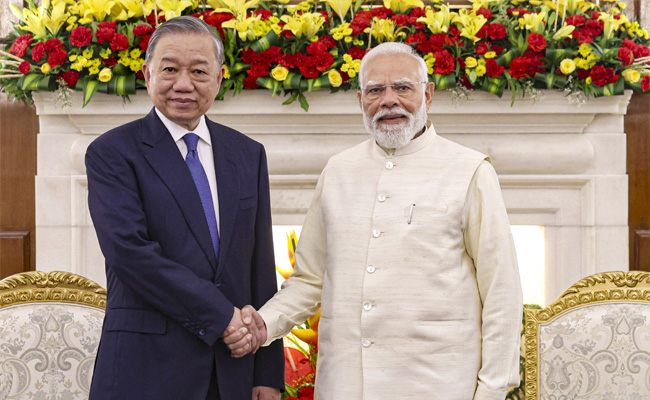
New Delhi (PTI): India and Vietnam on Wednesday elevated their ties to an enhanced comprehensive strategic partnership and set a USD 25 billion annual trade target by 2030 as Prime Minister Narendra Modi and Vietnamese President To Lam held talks focusing on expanding bilateral ties in areas of trade, defence, and critical minerals in the face of increasing geopolitical upheavals.
Following the Modi-Lam meeting, the two sides signed as many as 13 agreements which will provide for deeper two ways engagements in a range of areas including digital payments, rare earth minerals, pharmaceuticals, education, banking and culture.
Modi and Lam also deliberated on the situation in the Indo-Pacific amid China's increasing assertiveness in the region, and agreed to continue to contribute to the rule-of-law, peace, stability, and prosperity.
It is understood that China's growing military muscle-flexing in the South China Sea also figured in the delegation-level talks between the two sides.
Elected as president earlier this month, Lam began his first state visit to India on Tuesday, leading a high-level delegation for a three-day trip.
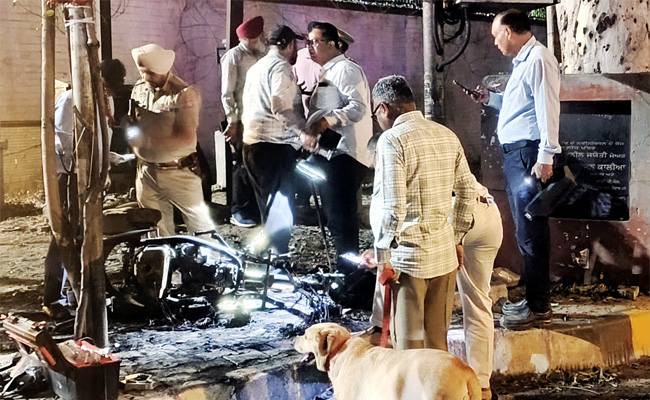
ALSO READ: Explosives used in blast outside Punjab Frontier BSF HQ in Jalandhar: Punjab Police
"A decade ago, Vietnam became India's first comprehensive strategic partner in ASEAN (Association of Southeast Asian Nations) . Since then, our relations have made rapid and comprehensive progress," Modi said in his media statement.
"Building on this strong foundation, today we are elevating our relations to the level of Enhanced Comprehensive Strategic Partnership. We will now advance our partnership to even higher goals," he said.
"Our cooperation will reach new levels in every area ' culture, connectivity, and capacity building, as well as security, sustainability, and supply chain resilience," Modi added.
He noted that the bilateral trade between India and Vietnam has doubled in the last decade to reach USD 16 billion and that the target now is to increase it to USD 25 billion by 2030.
Modi also cited a plethora of agreements signed between the two countries to emphasis that the economic engagement is expected to witness a significant upswing going forward.
"The MoU between our drug authorities will now increase access to Indian medicines in Vietnam. Exports of Indian agricultural, fisheries, and animal products to Vietnam are also set to become easier. Very soon, Vietnam will taste India's grapes and pomegranates," he said.
The two sides also agreed to update the India-ASEAN trade agreement by the end of this year.
"This will provide a new impetus to trade and investment between India and all ASEAN countries. New initiatives in critical minerals, rare earths, and energy cooperation will ensure the economic security and supply chain resilience of both countries," Modi said.
"To boost financial connectivity, we have today decided to enhance cooperation between our central banks. India's UPI and Vietnam's fast payment systems will soon be linked. Furthermore, we are strengthening state-to-state and city-to-city cooperation between the two countries," he noted.
Modi said India is grateful to Vietnam for its strong condemnation of the Pahalgam terrorist attack and standing with India in its fight against terrorism.
"In this era of global turmoil and economic challenges, thanks to their talent, good governance, and economic reforms, India and Vietnam are emerging as the world's fastest-growing economies," he said.
"Now, through our enhanced strategic partnership, we will support each other's rapid growth. As the Buddha's teachings say, 'If you light a lamp for someone else, it also illuminates your own path'," Modi said.
He also described Vietnam a a key pillar of India's Act East Policy and Vision Ocean.
"In the Indo-Pacific region as well, we share a common outlook. Through our strengthening defence and security cooperation, we will continue to contribute to the rule-of-law, peace, stability, and prosperity," he said.
The prime minister said India will broaden its relations with ASEAN with Vietnam's cooperation.
In his remarks, Lam said both sides agreed to deepen political trust and elevate security cooperation.
Last year, the two sides inked a pact to set up a framework for submarine search, rescue and support mechanism. They also signed a letter of intent (LoI) to strengthen bilateral defence industry collaboration.