Israel's PM Netanyahu to address UN as pressure mounts over Gaza war
_vb_65.jpeg)
United Nations, Sep 26 (AP) Facing international isolation, accusations of war crimes and growing pressure to end a conflict he has continued to escalate, Israeli Prime Minister Benjamin Netanyahu gets his chance to push back Friday on the international community's biggest platform.
Netanyahu's annual speech to the UN General Assembly is always closely watched, often protested, reliably emphatic and sometimes a venue for dramatic allegations. But this time, the stakes are higher than ever for the Israeli leader.
In recent days, Australia, Canada, France, the United Kingdom and others announced their recognition of an independent Palestinian state.
The European Union is considering tariffs and sanctions on Israel. The assembly this month passed a nonbinding resolution urging Israel to commit to an independent Palestinian nation, which Netanyahu has said is a non-starter.
The International Criminal Court has issued an arrest warrant accusing Netanyahu of crimes against humanity, which he denies. And the UN's highest court is weighing South Africa's allegation that Israel has committed genocide in Gaza, which it vehemently refutes.
Against that backdrop, Netanyahu sounded resolute Thursday as he boarded a plane in Israel to head for the UN's annual meeting of top-level leaders in New York.
“I will tell our truth,” Netanyahu said. “I will condemn those leaders who, instead of condemning the murderers, rapists and burners of children, want to give them a state in the heart of Israel.”
Opposition to Netanyahu's approach is growing
At a special session of the assembly this week, nation after nation expressed horror at the 2023 attack by Hamas militants that killed about 1,200 people in Israel, saw 251 taken hostage and triggered the war. Many of the representatives went on to call for an immediate ceasefire in Gaza and influx of aid.
Israel's sweeping offensive has killed more than 65,000 Palestinians in Gaza and displaced 90 per cent of its population, with an increasing number now starving.
While more than 150 countries now recognise a Palestinian state, the United States has not, providing Israel with vociferous support. But President Donald Trump pointedly signalled Thursday there are limits, telling reporters in Washington that he wouldn't let Israel annex the occupied West Bank.
Israel hasn't announced such a move, but several leading members in Netanyahu's government have advocated doing so. And officials recently approved a controversial settlement project that would effectively cut the West Bank in two, a move that critics say could doom chances for a Palestinian state. Trump and Netanyahu are scheduled to meet during his visit.
Palestinians had their UN say the day before
Netanyahu was preceded Thursday by Palestinian leader Mahmoud Abbas, who addressed the General Assembly via video, since the US denied him a visa. He welcomed the announcements of recognition but said the world needs to do more to make statehood happen.
“The time has come for the international community to do right by the Palestinian people" and help them realise “their legitimate rights to be rid of the occupation and to not remain a hostage to the temperament of Israeli politics,” he said.
Abbas leads the internationally recognised Palestinian Authority, which administers portions of the West Bank. Hamas won legislative elections in Gaza in 2006 before seizing control from Abbas' forces the following year.
Israel captured the West Bank, east Jerusalem and the Gaza Strip in the 1967 Mideast war, then withdrew from Gaza in 2005. The Palestinians want all three territories to form their envisioned state, part of a “two-state solution” that the international community has embraced for decades.
Netanyahu opposes it robustly, maintaining that creating a Palestinian state would reward Hamas.
“This will not happen,” he said at the airport Thursday.
Let the Truth be known. If you read VB and like VB, please be a VB Supporter and Help us deliver the Truth to one and all.
Tribals, Scheduled Castes preserved India's identity and soul despite foreign invasions: Bhagwat
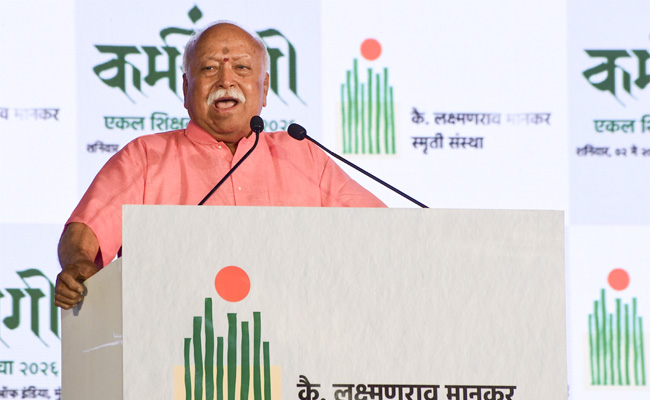
Mumbai (PTI): RSS chief Mohan Bhagwat has said that despite foreign invasions and hardships, tribal communities and Scheduled Castes preserved the country's identity and soul, stressing the need to integrate them into the mainstream development process.
He was speaking on Saturday at the Karmayogi awards ceremony in Mumbai, where Union Road Transport and Highways Minister Nitin Gadkari was also present.
"Human life is defined by giving back to the world, as we are all part of one great family. A person works and spends for the betterment of society, not as a favour, but out of duty. In serving others, we foster our own development. By helping others to thrive, we elevate ourselves and grow as human beings. This principle is the core value of this Indian land, commonly known as a Hindu society," Bhagwat said.
"This is the society's enduring ethos, which has survived for thousands of years. For various reasons, partly because of our indifference and partly because of foreign invasion, those who preserved this ethos paid a heavy price," he said.
The foreign invaders found that this ethos, this value system of the society is its soul and the key to keeping it alive. So they ensured that those who tried to preserve this soul would be uprooted and face extreme hardships, the Rashtriya Swayamsevak Sangh (RSS) chief noted.
But despite foreign invasions and hardships, tribal communities and Scheduled Castes preserved the country's identity and its soul, he said.
"Despite such adversities, the country's core identity remained intact among tribal communities and those belonging to SC and ST groups," he said, emphasising the need to integrate them into the mainstream development process while ensuring they receive equal access to services and facilities.
Referring to global developments, Bhagwat said the present world is "stumbling forward" and struggling to maintain balance, and asserted that India could emerge as a stabilising force.
The country must not only safeguard its own interests but also extend support to the world, he said.
"The world should get to see that the country is not only solving its own misery and sorrow but also helping the world to address similar issues," he said.
The RSS chief stressed that service to society is not a favour but a duty that contributes to one's own development.
Helping others grow also elevates individuals and strengthens the collective fabric of society, he said.
The so-called educated and developed sections have, over time, distanced themselves from these communities, Bhagwat pointed out, and called for the need to bridge this gap.
The identities preserved by these communities represent the true identity of Indian society, he said and underlined that without identity, existence itself is at risk.