Khalistani group threatens siege on Indian consulate in Vancouver
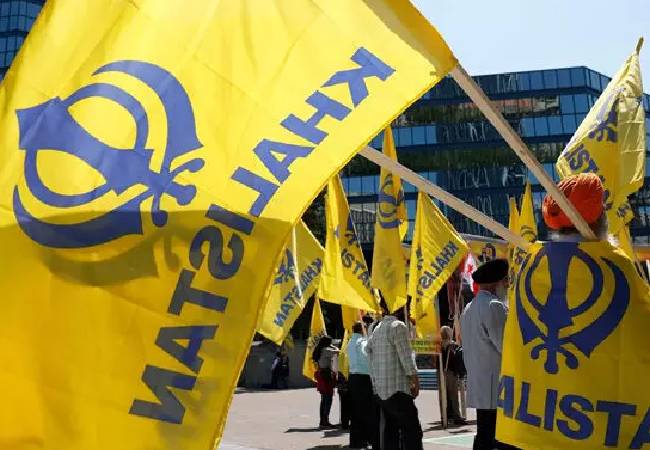
Vancouver: As India and Canada continue efforts to restore diplomatic relations, a pro-Khalistan group has issued a fresh threat against Indian diplomatic establishments in Canada.
Sikhs for Justice (SFJ), a US-based organisation advocating for Khalistan, announced that it will “lay siege” to the Indian Consulate in Vancouver on Thursday. The group has urged Indo-Canadians with scheduled visits to reschedule their appointments.
SFJ released a poster depicting India’s newly appointed High Commissioner to Canada, Dinesh Patnaik, with a target symbol over his face. The organisation accused Indian consulates of running spy networks and carrying out surveillance against Khalistan supporters.
In its statement, the group invoked Canadian Prime Minister Justin Trudeau’s remarks in Parliament on September 18, 2023, when he said Indian agents’ involvement was being investigated in the killing of Hardeep Singh Nijjar. “Two years on, Indian Consulates continue to run a spy network and surveillance targeting Khalistan Referendum campaigners,” SFJ claimed.
The organisation also alleged that threats to its members were so severe that the Royal Canadian Mounted Police (RCMP) had placed Inderjeet Singh Gosal, who took over the Khalistan Referendum campaign after Nijjar’s killing, under witness protection.
SFJ said its planned siege would seek “accountability” for alleged espionage and intimidation carried out by Indian officials on Canadian soil.
Neither India’s Ministry of External Affairs nor the Indian Consulate in Vancouver has responded to the threat.
The issue of Khalistani extremism in Canada has seen renewed focus. A Canadian government report released earlier this month confirmed that extremist Khalistani groups, including Babbar Khalsa International and the International SYF, both proscribed as terrorist organisations under Canada’s Criminal Code, were receiving financial backing from individuals and networks within the country. The report noted that such groups primarily function through smaller, loosely connected networks of supporters rather than large formal organisations.
Let the Truth be known. If you read VB and like VB, please be a VB Supporter and Help us deliver the Truth to one and all.
SC to hear on May 4 PIL seeking stringent guidelines for issuing Aadhaar to adolescents, adults
New Delhi (PTI): The Supreme Court is scheduled to hear on Monday a plea seeking a direction to the Unique Identification Authority of India to issue new Aadhaar cards only to citizens up to the age of six years, and frame stringent guidelines for its issuance to adolescents and adults to stop infiltrators from masquerading as Indian citizens.
As per the apex court's causelist of May 4, the plea would come up for hearing before a bench of Chief Justice Surya Kant and Justice Joymalya Bagchi.
The Public Interest Litigation (PIL) filed by lawyer Ashwini Upadhyay has also sought a direction to the authorities to install display boards at common service centres stating that the 12-digit unique identification number is only a "proof of identity" and not a proof of citizenship, address or date of birth.
Besides all the states and Union Territories, the plea has made the UIDAI -- which is the authority that issues Aadhaar -- and the Union ministries of home, law and justice, and electronics and information technology as parties.
The plea, filed through advocate Ashwani Dubey, said Aadhaar, originally intended as a proof of identity, has increasingly become a "foundational document" enabling individuals to obtain other identification documents, such as ration cards, domicile certificates and voter identity cards.
"The UIDAI has issued 144 crore Aadhaar and 99 percent Indians have been enrolled. Therefore, the petitioner is filing this writ petition as a PIL under Article 32, seeking a direction to UIDAI to issue new Aadhaar to children only and frame new stringent guidelines for adolescents and adults, so as to stop infiltrators from getting it and masquerading as Indian citizens," the plea said.
It said the need to file the plea arose when the petitioner came to know the manner in which infiltrators are able to procure Aadhaar through a verification process that is weak and can be easily manipulated.
"Foreigners apply for Aadhaar under the 'foreign' category. But infiltrators apply for Aadhaar under the 'Indian citizen' category and get it easily made. Thereafter, they obtain a ration card, birth and domicile certificate, driving licence, et cetera, essentially becoming indistinguishable from Indian citizens…," it said.
Besides seeking other directions, the plea has raised legal questions, including whether the Aadhaar Act 2016 has become "temporally unreasonable" for failing to keep up with the legislative intent of distinguishing foreigners from Indian citizens.
It said the alleged misuse of Aadhaar undermines targeted welfare delivery and leads to diversion of public resources.