Learned of Trudeau's allegations against India one hour before public did: British Columbia Premier
Toronto (PTI): The premier of Canada's British Columbia province, where Sikh extremist Hardeep Singh Nijjar was killed, has said he was not taken into the loop on Prime Minister Justin Trudeau's explosive allegations against India and came to know about it only one hour before they came in the public domain.
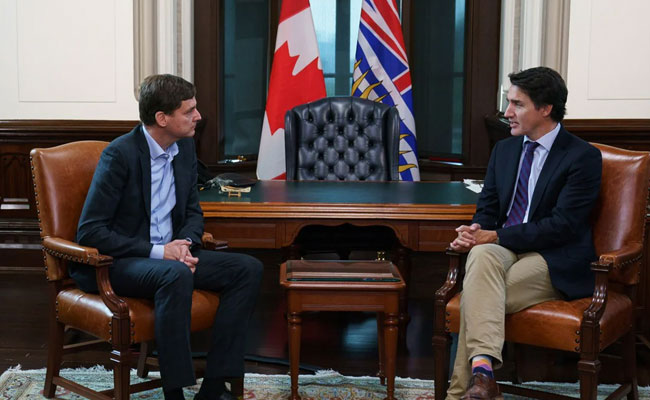
Premier David Eby's comments came as he met Prime Minister Trudeau on Monday, on a day when some Khalistan supporters held demonstrations outside the Indian missions in Vancouver, Ottawa and Toronto.
Tensions flared between India and Canada following Prime Minister Trudeau's allegations of the "potential" involvement of Indian agents in the killing of Nijjar, 45, outside a gurdwara in Surrey in British Columbia on June 18. India had designated Nijjar as a terrorist in 2020.
India has angrily rejected the allegations as "absurd" and "motivated" and expelled a senior Canadian diplomat in a tit-for-tat move to Ottawa's expulsion of an Indian official over the case. India last week asked Canada to crack down on terrorists and anti-India elements operating from its soil and suspended visa services for Canadians.
Eby told CTV News he only learned one hour before the public did about the prime minister's allegation that India may have been involved in the murder.
He said he wants the federal government to share security intelligence with provinces.
"There's a critical need for provinces to be brought into the loop at an earlier stage," CTV News quoted Eby as saying on Monday.
"CSIS (the Canadian Security Intelligence Service), for example, by law is required to only share their intelligence with the federal government, It means that when they brief me which they did that day they can share basically what's in the public domain already, which is not helpful. I can read the newspaper, too," he said.
Following Trudeau's allegations, Eby said he was deeply disturbed and angered by this information.
"I call, yet again, on the federal government to share all relevant information related to any known ongoing foreign interference & transnational organized crime threats with our provincial authorities & our government, so we may act in coordination and protect those at risk," he had said.
On Monday, Prime Minister Trudeau met with Eby.
According to Trudeau's office, the two leaders discussed how all governments can continue working together to improve housing supply and affordability for Canadians.
Prime Minister Trudeau and Premier Eby discussed public safety, including federal legislation to strengthen Canada's bail regime, which was recently passed in the House of Commons. The legislation makes changes to the Criminal Code's bail regime.
Prime Minister Trudeau and Premier Eby agreed to remain in close contact and to continue working together on shared priorities, it said.
Trudeau on Friday said that Canada shared with India "many weeks ago" evidence on the killing of Nijjar and wants New Delhi to commit constructively with Ottawa to establish the facts in the "very serious matter."
When asked about Canada sharing any information in the case with India, the Ministry of External Affairs (MEA) in New Delhi said: "No specific information has been shared by Canada on this case, either then or before or after. We have, you know, as we have said, or I think we have made very clear, we are willing to look at any specific information."
Canada's Defence Minister Bill Blair on Sunday voiced concern over the measures taken by India including the suspension of visa services for Canadians and urged New Delhi to cooperate fully in the investigation of the killing of Nijjar to uncover the truth and work together to resolve it in an appropriate way.
Let the Truth be known. If you read VB and like VB, please be a VB Supporter and Help us deliver the Truth to one and all.
Man arrested with Rs 2.54-crore heroin in Mumbai

Mumbai (PTI): Police have arrested a man and seized over 500 grams of heroin worth Rs 2.54 crore in the illicit market from him in Mumbai, officials said on Friday.
The police's Anti-Narcotics Cell (ANC) made the drug seizure in Santacruz in the western suburbs. The operation was conducted by the Kandivali unit of the ANC on Thursday as part of a special crackdown against drug trafficking in the area, they said.
Acting on specific inputs, an ANC team conducted a raid in Santacruz (East) and intercepted a man. During a search, the team recovered 508 grams of high-grade heroin from his possession, an official said.
The seized contraband, a highly addictive, opioid drug derived from morphine, is estimated to be worth Rs 2.54 crore in the international market, he informed.
Following the seizure, a case was registered against the man under relevant sections of the Narcotic Drugs and Psychotropic Substances (NDPS) Act, 1985, and he was formally placed under arrest in the early hours of Friday.
The police are currently investigating the source of the drug and trying to identify the intended recipients of the consignment, he said.