Marches in Rome, Barcelona, Paris, Madrid protest Israel's military campaign in Gaza
_vb_85.webp)
Barcelona (AP): Hundreds of thousands of Italians and Spaniards marched in Rome, Barcelona and Madrid on Saturday against Israel's military campaign in Gaza in a show of growing international anger over the two-year-old war.
The protests in almost every major Spanish city had been planned for weeks, while the demonstration in Rome followed widespread anger after the Israeli interception of a humanitarian aid flotilla that had set sail from Barcelona in a bid to break the blockade of the Palestinian territory.
The protests across southern Europe come as Hamas said that it has accepted some elements of a plan laid out by US President Donald Trump to end the war, which has left Gaza's largest city in famine and stirred accusations of genocide against Israel.
Rome's police said that 250,000 people turned out, while organisers said that 1 million attended, for a second straight day of Italian demonstrations. Italy already saw more than 2 million people rally on Friday in a one-day general strike to support the Palestinians in Gaza.
In Spain, officials said that 100,000 people marched in Madrid and another 70,000 filled downtown Barcelona. Organisers of the Madrid march raised attendance to 400,000, while organisers in Barcelona said that 300,000 took part.
Spaniards were also called by activists to march in Valencia, Sevilla, Malaga and other cities.
Smaller rallies took place in Paris, Lisbon, Athens and Skopje, North Macedonia, and in London and Manchester, England.
Protests in Rome criticise Giorgia Meloni
The protest in Rome that followed a route by the Colosseum was organised by three Palestinian organisations along with local unions and students.
At Piazza San Giovanni, protesters chanted and applauded the name of Francesca Albanese, an Italian who is the United Nations special rapporteur on the occupied Palestinian territories and a vocal critic of Israel.
Opposition lawmaker Riccardo Magi, secretary of the centre-left Piu Europa (more Europe) party, who was among the marchers, took Italian Prime Minister Giorgia Meloni's government to task for its refusal to recognise a Palestinian state, following the example of Spain, France, the UK and some other Western countries.
“Meloni cannot continue with this obscene victimhood: these are spontaneous demonstrations against the inaction and complicity of her government. She must acknowledge this and begin working diplomatically for peace,” Magi told Italian media.
Big rally in Barcelona
Spain has seen an upsurge of support for Palestinians in recent weeks while its left-wing government intensifies diplomatic efforts against Israeli Prime Minister Benjamin Netanyahu's far-right government. Protests against the presence of an Israeli-owned cycling team repeatedly disrupted the Spanish Vuelta last month, while Spanish Prime Minister Pedro Sanchez called the destruction in Gaza a “genocide” and asked for the ban of all Israeli teams from international sporting events.
People packed Barcelona's wide Passeig de Gracia, the city's main central boulevard. Many families turned out along with people of all ages, carrying Palestinian flags. Hand-held signs bore messages like “Gaza hurts me,” “Stop the Genocide,” and “Hands off the flotilla.”
More than 40 Spaniards, including a former Barcelona mayor, were among the 450 activists that Israel removed from the flotilla's boats this week.
While the protests will likely not sway Israel's government, protesters hope they could inspire other demonstrations and encourage European leaders to take a harder line against Israel.
Maria Jesus Parra, 63, waved a Palestinian flag after making an hourlong trip from another town to Barcelona. She wants the European Union to act against what she described as the horrors she watches on TV news.
“How is it possible that we are witnessing a genocide happening live after what we (as Europe) experienced in the 1940s?” Parra said. “Now nobody can say they didn't know what was happening.”
People in Madrid marched behind banners that read “Shame” and “Racist War, Free Palestine,” while chanting “Netanyahu (is a) Killer.”
Greek police believe a bigger gathering and march will take place Sunday to coincide with a pro-Israeli one. The two protests are separated by some 3 kilometres (2 miles) and police will be on hand to prevent the pro-Palestinian march to the Israeli Embassy, as as happened on previous occasions.
Let the Truth be known. If you read VB and like VB, please be a VB Supporter and Help us deliver the Truth to one and all.
4 workers die after being buried under coal slurry in Jharkhand's Dhanbad
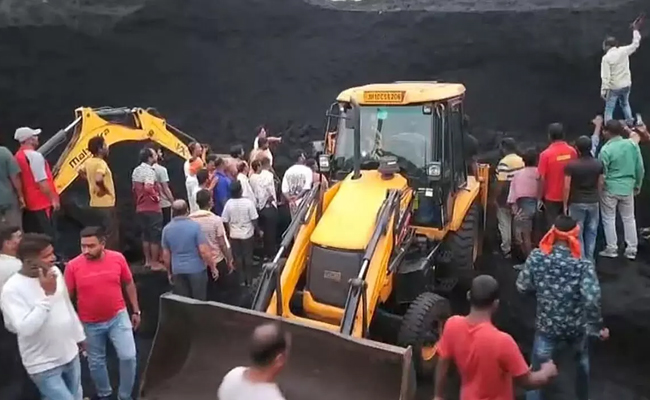
Dhanbad (Jharkhand) (PTI): At least four workers died after being buried under coal slurry in Jharkhand's Dhanbad district on Saturday, a police official said.
The incident took place at Moonidih coal washery in the command area of Bharat Coking Coal Limited (BCCL).
"Bodies of all four workers were dug out of debris during a rescue operation," Putki police station in-charge Waqar Hussain told PTI.
The incident took place when coal slurry was being loaded into trucks by workers, during which a large chunk of slurry fell and trapped several workers underneath, officials said.
The deceased have been identified as Manik Bauri, Dinesh Bauri, Deepak Bauri, and Hemlal Gope.
Meanwhile, the family members of the deceased and local villagers placed the bodies in front of the washery gate and began a protest.
They demanded compensation, jobs for dependents and action against those responsible for the incident.
Police and administration officials are trying to pacify the protesters, an official said.