Meet Indian-Origin Ajay Banga appointed in Gaza’s “Board of Peace” constituted by Trump

Washington: The White House on Friday announced the formation of a “Board of Peace” under US President Donald Trump to oversee the temporary governance of Gaza, even as violence continues in the Palestinian territory despite a fragile ceasefire that has been in place since October.
According to the White House, the newly constituted board will be chaired by President Trump and includes Indian-origin World Bank Group President Ajay Banga as one of its members. The announcement comes amid ongoing instability in Gaza, marked by sporadic clashes and persistent security concerns.
Ajay Banga, 66, is currently the 14th President of the World Bank Group. He was nominated by former US President Joe Biden in February 2023 and confirmed to a five-year term in May the same year. He formally assumed office on June 2, 2023.
Banga completed his undergraduate studies in economics from St. Stephen’s College, Delhi, in 1981, before pursuing a postgraduate programme in management at the Indian Institute of Management Ahmedabad. He began his career as an intern with Nestlé in India and spent over a decade with the company, holding senior roles in sales and marketing.
In 1994, he joined PepsiCo as head of marketing for its snacks division in India. He later moved to Citigroup, where he rose through the ranks of the global consumer banking business and eventually served as CEO of Citigroup Asia Pacific in 2008. Prior to taking charge at the World Bank, Banga was elected chairman of the International Chamber of Commerce in 2020.
Born in Khadki, Maharashtra, to a Sikh family, Banga is the son of an Indian Army officer, a background that led his family to move frequently across the country. He is married to Ritu Banga, an alumna of IIM Ahmedabad, who is associated with the education and business sectors.
The White House said the Board of Peace has been set up to implement Phase Two of President Trump’s plan to end the Gaza conflict. This phase includes a 20-point roadmap aimed at bringing peace, stability, reconstruction and long-term development to the region. The board is expected to provide strategic oversight, mobilise international resources and ensure accountability during Gaza’s transition from conflict.
However, the White House did not spell out the specific roles of individual members of the founding executive board. It also confirmed that no Palestinian representatives have been included so far. According to a Reuters report, additional members of the board are expected to be announced in the coming weeks.
Let the Truth be known. If you read VB and like VB, please be a VB Supporter and Help us deliver the Truth to one and all.
Bengal: Over 55 pc turnout till 1 pm in repoll in 15 booths of 2 assembly seats
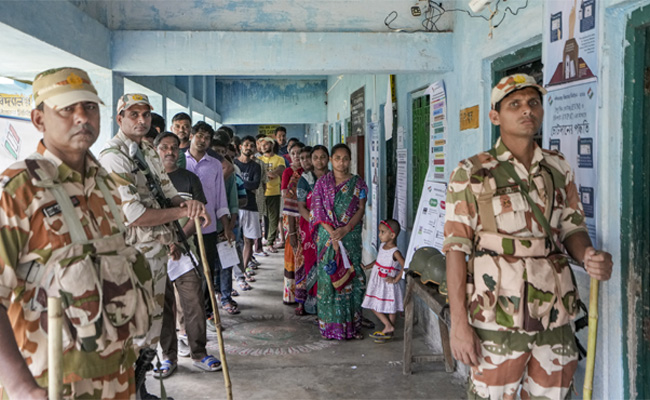
Kolkata (PTI): Over 55 per cent turnout was recorded till 1 pm in repoll in 15 booths of two assembly constituencies in West Bengal's South 24 Parganas district on Saturday, an official said.
Voting was underway more or less peacefully at 11 polling stations of Magrahat Paschim assembly constituency and four in Diamond Harbour, where the EC ordered repoll a day ago, following reports of electoral malpractices.
However, at booth number 179 at Chanda Primary School of Diamond Harbour seat, the Trinamool Congress alleged that a specially abled voter and his mother were harassed by central forces. The alleged incident sparked protests by party workers and locals.
The TMC claimed that the voter's mother, who had entered the booth to assist him, and her son were detained for a considerable time by central forces over alleged rule violations.
ALSO READ: Man arrested for duping Delhi resident of Rs 2 lakh in online car sale fraud
"TMC leaders Manmohini Biswas and Pratik Ur Rahman reached the spot and led the protests, with residents terming the action unwarranted harassment. The matter has been taken care of by our officials there," an official of the poll body said.
Polling was otherwise peaceful across 15 booths in the area, he added.
Voting began at 7 am and will continue till 6 pm, the official said, adding that till 1 pm, the turnout was 55.57 per cent.
Magrahat Paschim registered 56.33 per cent voter turnout, while in Diamond Harbour, it was 54.9 per cent, a poll official stated.
Voting in these two assembly constituencies was held in the second phase of the state elections on April 29.
The repoll order was based on reports received from returning officers and observers of the two constituencies and "material circumstances", the Election Commission official said.
In Magrahat Paschim, TMC's Md Samim Ahamed Molla is pitted against BJP nominee Goursundar Ghosh, while Abdul Majid Halder of the Congress and ISF candidate Abdul Aziz Al Hassan are also in the fray.
TMC candidate Panna Lal Halder is contesting against Dipak Kumar Halder of the BJP in the Diamond Harbour seat. Goutam Bhattacharya of the Congress and CPI(M)'s Samar Naiya are among other candidates.
The BJP had alleged rampant electoral malpractices in certain polling stations of both the assembly seats under the Diamond Harbour Lok Sabha constituency, which is represented by TMC national general secretary Abhishek Banerjee.
The EC had deputed its special observer, Subrata Gupta, to fact-check the allegations from the ground.
The poll panel will decide on repolling in the Falta assembly constituency on Saturday.
The West Bengal assembly elections were held in two phases -- April 23 and April 29 -- amid unprecedented security arrangements.
Counting of votes will take place on May 4.