Musk threatens to withdraw Dragon spacecraft, key space station link for NASA
_vb_46.jpeg)
Washington (AP): As President Donald Trump and Elon Musk argued on social media on Thursday, the world's richest man threatened to decommission a space capsule used to take astronauts and supplies to the International Space Station.
After Trump threatened to cut government contracts given to Musk's SpaceX rocket company and his Starlink internet satellite services, Musk responded via X that SpaceX "will begin decommissioning its Dragon spacecraft immediately.”
It's unclear how serious Musk's threat was. But the capsule, developed with the help of government contracts, is an important part of keeping the space station running. NASA also relies heavily on SpaceX for other programs including launching science missions and, later this decade, returning astronauts to the surface of the moon.
The Dragon capsule
SpaceX is the only U.S. company capable right now of transporting crews to and from the space station, using its four-person Dragon capsules.
Boeing's Starliner capsule has flown astronauts only once; last year's test flight went so badly that the two NASA astronauts had to hitch a ride back to Earth via SpaceX in March, more than nine months after launching last June.
Starliner remains grounded as NASA decides whether to go with another test flight with cargo, rather than a crew.
SpaceX also uses a Dragon capsule for its own privately run missions. The next one of those is due to fly next week on a trip chartered by Axiom Space, a Houston company.
Cargo versions of the Dragon capsule are also used to ferry food and other supplies to the orbiting lab.
NASA's other option: Russia
Russia's Soyuz capsules are the only other means of getting crews to the space station right now.
The Soyuz capsules hold three people at a time. For now, each Soyuz launch carries two Russians and one NASA astronaut, and each SpaceX launch has one Russian on board under a barter system. That way, in an emergency requiring a capsule to return, there is always someone from the U.S. and Russian on board.
With its first crew launch for NASA in 2020 — the first orbital flight of a crew by a private company — SpaceX enabled NASA to reduce its reliance on Russia for crew transport. The Russian flights had been costing the US tens of millions of dollars per seat, for years.
NASA has also used Russian spacecraft for cargo, along with US contractor Northrup Grumman.
SpaceX's other government launches
The company has used its rockets to launch several science missions for NASA as well as military equipment.
Last year, SpaceX also won a NASA contract to help bring the space station out of orbit when it is no longer usable.
SpaceX's Starship mega rocket is what NASA has picked to get astronauts from lunar orbit to the surface of the moon, at least for the first two landing missions. Starship made its ninth test flight last week from Texas, but tumbled out of control and broke apart.
Let the Truth be known. If you read VB and like VB, please be a VB Supporter and Help us deliver the Truth to one and all.
Karnataka by-polls: Cong ahead in Bagalkot, BJP leads in Davanagere South
_vb_21.jpeg)
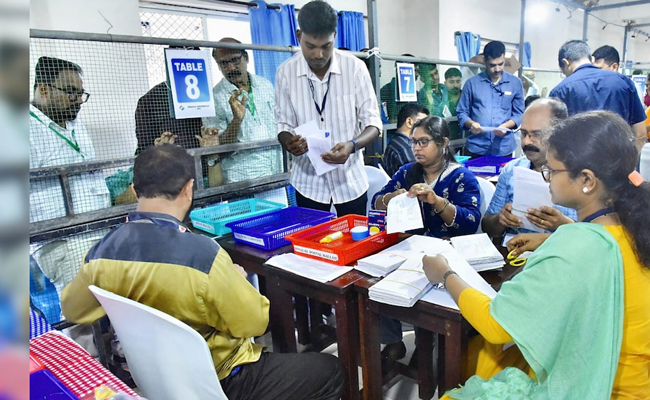
Bengaluru (PTI): Trends show Congress and BJP have maintained leads respectively in Karnataka's Bagalkot and Davanagere South Assembly seats, where counting of votes is underway on Monday, for the bypolls held for two seats on April 9.
The polls were necessitated by the deaths of senior Congress MLAs H Y Meti (Bagalkot) and Shamanur Shivashankarappa (Davanagere South).
According to the Election Commission, Congress party's Umesh Meti was ahead of BJP's Veerabhadrayya Charantimath by a margin of 9,969 votes in Bagalkot.
In Davanagere South, BJP's Srinivas T Dasakariyappa was leading over Congress party's Samarth Mallikarjun by a margin of 8,539 votes.
Nine and 25 candidates were in the fray, respectively in the Bagalkot and Davanagere South Assembly segments.