Nobel laureate Muhammad Yunus to be chief adviser of interim govt in Bangladesh: Protest leaders
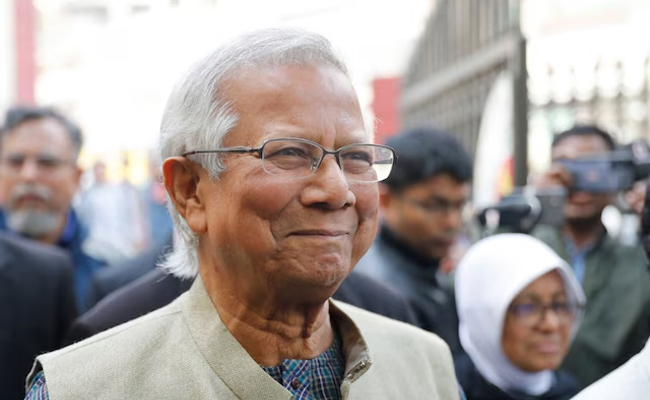
Dhaka (PTI): Nobel laureate Dr Muhammad Yunus will be the chief adviser to the interim government in Bangladesh, the coordinators of the Anti-Discrimination Student Movement announced on Tuesday.
In a video posted on social media early Tuesday morning, Nahid Islam, one of the key coordinators of the movement, said that Prof Yunus has agreed to take on this crucial responsibility at the call of the student community to save the country, the Daily Star newspaper reported.
"We took 24 hours to announce a framework for the interim government. However, considering the emergency situation, we are announcing it now," Nahid said.
"We have decided that the interim government would be formed in which internationally renowned Nobel Laureate Dr Mohammad Yunus, who has wide acceptability, would be the chief adviser," said Nahid, flanked by two other coordinators.
His announcement comes hours after President Mohammed Shahabuddin said an interim government would be formed after dissolving the parliament as soon as possible. In a televised address to the nation late Monday night, the president also ordered the release of former prime minister Khaleda Zia, who is under house arrest after being convicted in several cases.
Nahid urged the president to take steps as soon as possible to form an interim government headed by Dr Yunus.
He said the names of the other members of the interim government would be announced soon.
On the widespread violence, he said it was being carried out by the "ousted fascists and their collaborators" to foil the revolution.
"As there is anarchy in the country, and insecurity over people's lives, we are urging the president to take immediate and effective steps to restore law and order in the country, and that freedom-seeking students will also be on the streets to assist law enforcement forces,” he added.
"No government other than the one proposed by the students will be accepted. As we have said, no military government, or one backed by the military, or a government of fascists, will be accepted," Nahid said.
Bangladesh descended into chaos on Monday as Prime Minister Sheikh Hasina surreptitiously resigned and fled the country in a military aircraft while the Army stepped in to fill the power vacuum.
As the news of Hasina’s departure spread, hundreds of people broke into her residence, vandalising and looting the interiors, providing dramatic expression to the anti-government protests that have killed more than 300 people in a fortnight.
Hasina's residence Sudha Sadan and other establishments were attacked, vandalised and set on fire in the capital after her departure. The residences and business establishments of ministers, party MPs and leaders of Hasina's Awami League government were also attacked in Dhaka and outside Dhaka.
Let the Truth be known. If you read VB and like VB, please be a VB Supporter and Help us deliver the Truth to one and all.
Bhojshala case: Disputed structure built from remains of pre-existing temples, claims ASI
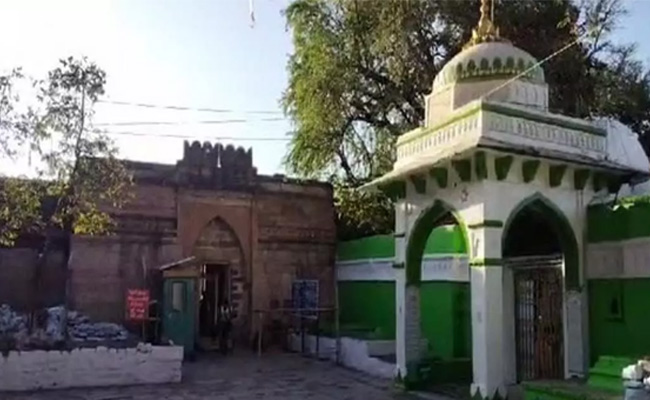
Indore (PTI): The ASI has told the Madhya Pradesh High Court that a massive structure dating back to the Paramara kings' rule existed at the disputed Bhojshala temple-Kamal Maula mosque complex, and the current structure was built from the remains of temples.
The Archaeological Survey of India (ASI) made the claim on Tuesday based on its 98-day scientific survey and over 2,000-page report.
The Hindu community considers Bhojshala a temple dedicated to Vagdevi (Goddess Saraswati), while the Muslim side claims the monument as the Kamal Maula Mosque. The disputed complex is protected by the ASI.
During the hearing before Justices Vijay Kumar Shukla and Alok Awasthi of the HC's Indore bench, Additional Solicitor General Sunil Kumar Jain, representing the ASI, presented a detailed account of the scientific survey conducted two years ago at the complex.
Referring to the ASI's survey report, he said, "Retrieved architectural remains, sculptural fragments, large slabs of inscriptions with literary texts, Nagakarnika inscriptions on pillars, etc, suggest that a large structure associated with literary and educational activities existed at the site. Based on scientific investigations and archaeological remains recovered during the investigations, this pre-existing structure can be dated to the Paramara period."
It can be said that the existing structure was made from the parts of earlier temples, based on scientific investigations, survey and archaeological excavations conducted, study and analysis of retrieved finds, study of architectural remains, sculptures, and inscriptions, art and sculptures, Jain said quoting the report.
Summarising the report, he also drew the court's attention to the fact that the archaeological study identifies that many architectural components, such as pillars and beams, were originally part of temple structures before being repurposed for a mosque.
"The evidence of this transition includes Sanskrit and Prakrit inscriptions that were damaged or hidden, alongside sculptures of deities and animals that were often mutilated or defaced," Jain contended.
The report also states that "all Sanskrit and Prakrit inscriptions are older than the Arabic and Persian inscriptions, indicating that users or engravers of the Sanskrit and Prakrit inscriptions occupied the place earlier".
In light of the Muslim side's earlier objections, the bench wanted to know why there were some discrepancies in the ASI's responses regarding the status of the disputed complex in the cases filed over the years.
The Additional Solicitor General argued that earlier studies of the complex involved only officials, while the current survey involved scientists and the use of advanced technologies such as Ground Penetrating Radar (GPR).
The hearing in the Bhojshala case will continue on Wednesday.
The high court has been regularly hearing four petitions and one writ appeal regarding the religious nature of the Bhojshala temple-Kamal Maula mosque complex since April 6.