PM-elect Imran Khan thanks nation as PTI moves closer to forming government
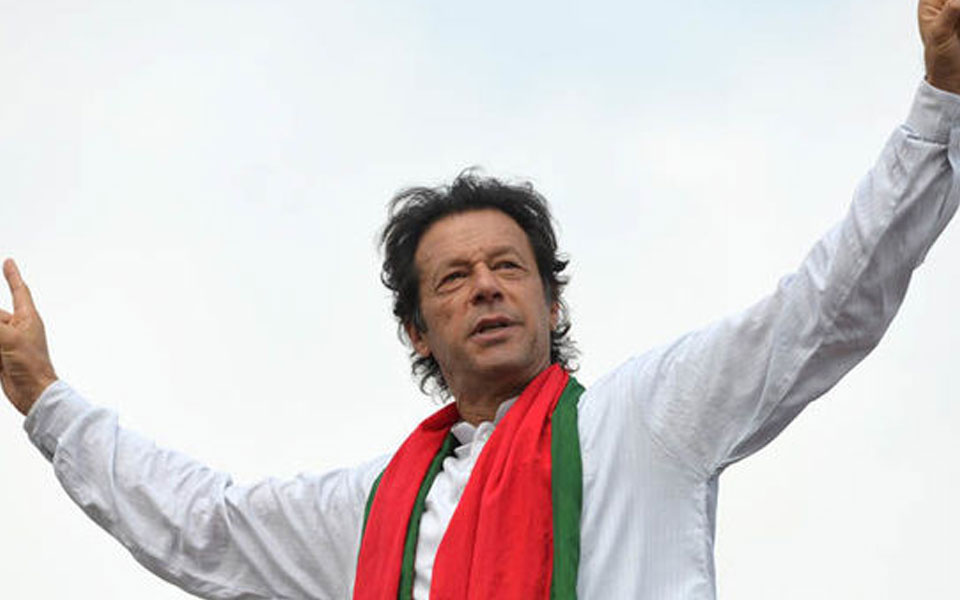
Islamabad, July 27 : Former Pakistani cricketer Imran Khan on Thursday claimed victory in his country's parliamentary elections, promising a new Pakistan following a vote that was marred by allegations of fraud and militant violence.
Khan, who is set to become the next Prime Minister, said in a televised address to the nation that "thanks to God, we won and we were successful".
"If God wills, we will set an example," he said.
Pakistan's election commission has not yet released official final results, but Khan has maintained a commanding lead, according to projections by many television stations. It was still unclear, however, if his Tehreek-e-Insaf (PTI) will win a simple majority or have to form a coalition government.
Election officials said an official count confirming Pakistan's next government was expected in the early hours of Friday. More than a dozen TV channels projected, based on undisclosed methodologies, that PTI would get as many as 119 seats of the 270 national assembly seats contested. A majority of 137 seats is needed to form a government.
Before even half the votes were counted, Khan's leading rival, Shahbaz Sharif, who heads the Pakistan Muslim League (Nawaz), the party of the jailed former Prime Minister Nawaz Sharif, rejected the vote, generating fears that disgruntled losers could delay the formation of the next government.
In a tweet, he said the party had rejected the results "due to manifest and massive irregularities".
Pakistan Peoples Party (PPP) Chairman Bilawal Bhutto Zardari also said he had not received any official results from any constituency where he was contesting, despite it being past midnight.
"My candidates (have been) complaining (that) polling agents have been thrown out of polling stations across the country. Inexcusable and outrageous," he tweeted.
Addressing the concerns of opposition parties regarding rigging, Imran Khan assured that "these have been the cleanest elections in Pakistan's history".
"I will fully cooperate in scrutinising as many constituencies as opposition parties want," he added.
In Punjab, with preliminary results from polling stations available with the ECP, Pakistan Muslim League-Nawaz is currently holding its lead on 123 provincial seats but PTI is closing in with a lead on 122 seats.
Imran Khan's party is clearly steering ahead in Khyber-Pakhtunkhwa with a lead on 67 seats against Muttahida Majlis-e-Amal (MMA), which is currently leading on nine seats.
The preliminary results from Sindh show PPP-P leading on 73 seats, followed by PTI on 22 seats.
In Balochistan, the Balochistan Awami Party (BAP) is leading on 12 provincial seats, followed by the Balochistan National Party (BNP) on eight seats.
Counting is still going on at the polling stations of different constituencies.
According to PTV news, Imran Khan won all his seats he contested from including one in Islamabad against PML-N's Shahid Khaqan Abbasi. The PTI chief was pitted against former Pakistani Prime Minister Abbasi in the crucial National Assembly seat.
The voter turnout was recorded at 50-55 per cent of the nearly 106 million electorate, similar to the previous electoral contest in 2013.
A delay was reported in the transmission of election results due to the breaking down of the Election Commission of Pakistan's Results Transmission System (RTS), which is being run through a software powered by the National Database and Registration Authority (Nadra).
Election Commission secretary Babar Yaqoob flatly denied allegations of vote count manipulation.
Shortly before Sharif spoke, state television said that just one-fifth of the votes had been counted so far -- an unusually slow count that further fuelled suspicions of rigging.
Yaqoob said the vote-counting system, which was untested, had "crashed", adding: "There is definitely no conspiracy, no one wants to influence the results".
As many as 12,570 candidates were in the electoral fray for a total of 849 seats of national and provincial assemblies in the country's 11th general election.
Millions of Pakistanis stepped out to cast their ballot in Wednesday's cliffhanger election, including women in areas where they previously stood disenfranchised.
Polling began at 8 a.m. across the country's 85,307 polling stations and continued until 6 p.m., despite calls by several major parties, including PML-N, PPP and PTI, to extend the polling time by an hour.
The election campaign was marred by violence with three candidates killed in targetted attacks in the run-up to the polls, and culminated with a suicide blast outside a polling station in Quetta which claimed at least 31 lives.
Let the Truth be known. If you read VB and like VB, please be a VB Supporter and Help us deliver the Truth to one and all.
Two held for 'firing' at BJP leader's house in Bengal

Kolkata (PTI): A day before the counting of votes for the West Bengal assembly elections, two persons were arrested on Sunday for allegedly being involved in a firing incident outside the residence of a BJP leader in North 24 Parganas district, police said.
BJP leader Kundan Singh lodged a police complaint, alleging that a few gunmen fired at his house in the Noapara constituency around Saturday midnight.
Based on the CCTV footage, the two accused were apprehended, a senior officer said.
BJP's Noapara candidate Arjun Singh, in a post on social media, claimed that around 12.05 am, two armed miscreants arrived on a motorcycle at the residence of Kundan Singh, a BJP functionary and secretary of the Barrackpore organisational district, with an "intent to kill him".
According to the BJP leader, the accused are residents of Garulia and are known criminals.
Their names as offenders had been submitted to the Election Commission, he said.
The police officer did not specify whether the two arrested persons were the same individuals named by Arjun Singh.
According to the complaint, one round of firing took place outside Kundan Singh's house, triggering panic in the area.
The BJP candidate also questioned the role of the police, claiming that one of the accused had been detained by the police on the polling day but was later released in the evening.
The Noapara assembly seat went to the polls on April 29.
Several BJP leaders alleged that attempts were being made to create an atmosphere of fear ahead of the counting and weaken the organisation of the opposition parties.
The counting of votes will take place on May 4. Polling for the West Bengal assembly elections was held on April 23 and April 29.
The BJP urged the Election Commission to intervene immediately to ensure peaceful counting.
TMC candidate Somnath Shyam rubbished Arjun Singh’s allegation, claiming that the BJP nominee had orchestrated the firing incident to divert attention from imminent defeat.
“Arjun Singh knows all the gangsters in the Barrackpore belt. Everyone knows about his links with the underworld. Let the police investigate the incident,” Shyam said.