Rishi Sunak races ahead with 137 votes, to face Liz Truss in final leg of British PM contest
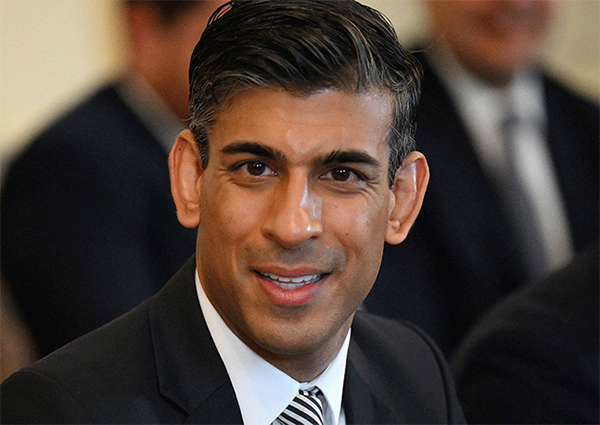
London, Jul 20: Rishi Sunak on Wednesday clinched his place for the final leg of the race to succeed Boris Johnson and will go head-to-head with Foreign Secretary Liz Truss as one of two finalists to take charge as Conservative Party leader and British Prime Minister.
Sunak won the fifth and final voting round of Tory MPs with a resounding 137 votes, while second-placed Truss won the support of 113 MPs. Trade Minister Penny Mordaunt was knocked out of the race after coming in third with 105 votes.
The 42-year-old British Indian former Chancellor, who has topped every voting round so far, added 19 votes to his Tuesday tally of 118 and comfortably crossed the 120 MPs mark seen as the threshold to confirm a place in the final showdown.
Sunak and Truss are now set for their first head-on clash in a live televised debate scheduled on the BBC for Monday.
Earlier, outgoing Prime Minister Johnson used his last Prime Minister's Questions (PMQs) in the House of Commons to bid farewell to the top job with the Spanish phrase hasta la vista, baby .
In his final speech, he had words of advice for his successor: "I want to use the last few seconds, Mr Speaker, to give some words of advice to my successor, whoever he or she may be.
"Number one, stay close to the Americans, stick up for the Ukrainians, stick up for freedom and democracy everywhere.
"Cut taxes and deregulate wherever you can to make this the greatest place to live and invest, which it is.
"I love the Treasury, but remember, that if we'd always listened to the Treasury, we wouldn't have built the M25 or the Channel Tunnel. Focus on the road ahead, but always remember to check the rear-view mirror.
"And remember a bubble. It's not Twitter that counts, it's the people that sent us here.
Johnson's parting shot once again alluded to the thumping majority won by the Tories under his leadership in the 2019 general election, something he had referenced repeatedly in the days before ultimately resigning in the face of an unprecedented Cabinet revolt.
It thrust the 1922 Committee of Tory backbenchers into action to organise the leadership contest and Wednesday's final ballot ends an intense two weeks of voting rounds, which began last week with a shortlist of eight candidates including Indian-origin Attorney General Suella Braverman, Chancellor Nadhim Zahawi, former Cabinet ministers Kemi Badenoch and Jeremy Hunt and Tory backbencher Tom Tugendhat. They were knocked off the race one by one for that shortlist to be whittled down to just two who will now face the estimated 160,000 Tory members eligible to cast votes for their choice of party leader.
Sunak's popularity within the Conservative parliamentary party does not seem to chime with the views of the wider membership base, which has shown favour towards his leading opponents. The most recent YouGov survey of 725 Conservative Party members over Monday and Tuesday showed Truss would beat Sunak by 54 per cent to 35 per cent, and Mordaunt would also beat him 51 per cent to 37 per cent.
There is also some concern that Sunak's prospect to replace Johnson could be hit by Conservative Campaign Headquarters' decision to send out those ballot papers early next month before the bulk of the campaign hustings have been held.
The focus will now shift towards those hustings as both candidates campaign to woo the Tory voters to cast those ballots in their favour.
Let the Truth be known. If you read VB and like VB, please be a VB Supporter and Help us deliver the Truth to one and all.
Delhi: Teenager slashes boy for refusing money for drugs; held

New Delhi (PTI): A 16-year-old boy has been apprehended for allegedly attacking a teenager with a paper cutter near the Red Fort area last month after the victim refused to give him money for drugs, an official said on Tuesday.
The juvenile, who had been absconding after the incident, was also found to be involved in another attempt to murder case registered at Jama Masjid police station, they said.
The case came to light on April 5 when police received information from LNJP Hospital about a 17-year-old boy, a resident of Nangloi, who had been admitted with serious injuries.
The victim had sustained sharp wounds on his neck and abdomen and was unfit to give a statement, the police said.
Preliminary inquiry revealed that the victim quarrelled with an unidentified boy at Parade Ground near the Red Fort, following which he was attacked. A case under relevant sections of the BNS was registered.
A team was constituted to trace the accused, which analysed CCTV footage from the area and identified a suspect seen fleeing the spot. The boy was later identified with the help of local intelligence as a vagabond frequenting the Chandni Chowk area, police said.
Despite multiple raids in Delhi and adjoining areas, the accused remained untraceable. Subsequently, his mobile number was tracked, and technical surveillance led police to Haridwar in Uttarakhand.
On April 29, the police team conducted a raid in a village in Haridwar and apprehended the juvenile after sustained efforts, an officer said.
During questioning, the accused disclosed that he had been living in the Chandni Chowk area for the past two years and was addicted to drugs. On the night of April 4, he allegedly got into an argument with the victim after the latter refused to give him money and slapped him. Enraged, he attacked the boy with a paper cutter, inflicting multiple injuries.
The police said the accused later attacked another person near the Jama Masjid Metro Station on the same night before fleeing to Haridwar.
He also disposed of the weapon and clothes by throwing them from a moving train to evade arrest, they said.
Further investigation is underway, they added.