Rohingya crisis: Bangladesh seeks international support
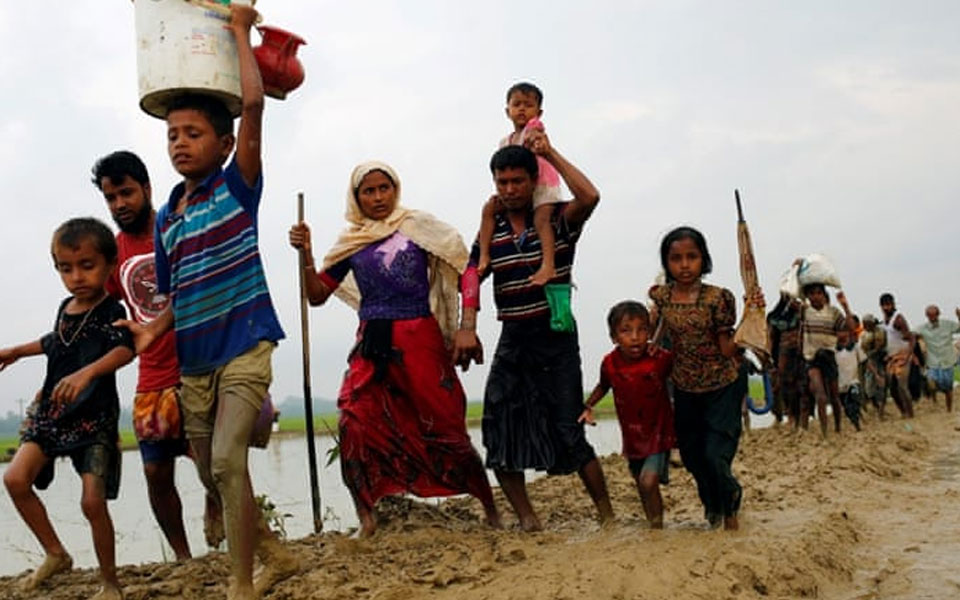
Kolkata, Dec 1 : A Bangladeshi diplomat Saturday stressed the need for international help to overcome the Rohingya refugee crisis in the country and said being the largest nation in South Asia, India had a huge role to play in building trust in the region.
Shahanaj Akhter Ranu, the political counsellor of the Bangladesh Deputy High Commission in the city, said political stability was necessary for economic growth and the non-state refugee issue was having an impact on the neighbouring country.
"We need international help and cooperation to repatriate the Rohingya people to their homeland," she said at the MCCI Logistics Forum.
India had more responsibility in building trust in the region, being the largest country in South Asia, Ranu added.
Bangladesh had in the past also sought India's support in handling the Rohingya issue by mounting pressure on Myanmar to take back the refugees who had taken shelter in the country.
According to the United Nations (UN), nearly seven lakh Rohingya Muslims have fled Myanmar's Rakhine state to Bangladesh since August, 2017.
Bangladesh has accused the Myanmar government of failing to tackle the concerns over the Rohingya Muslims who fled the country and urged the UN Security Council to take action to ensure their safe return home.
Ranu also called for a faster implementation of the BBIN MVA (The Bangladesh, Bhutan, India, Nepal Motor Vehicles Agreement) for a greater economic growth in the region.
Bangladesh, India and Nepal have already given their nod to the operating procedures for the movement of passenger vehicles in the sub-region.
Let the Truth be known. If you read VB and like VB, please be a VB Supporter and Help us deliver the Truth to one and all.
Man arrested with Rs 2.54-crore heroin in Mumbai

Mumbai (PTI): Police have arrested a man and seized over 500 grams of heroin worth Rs 2.54 crore in the illicit market from him in Mumbai, officials said on Friday.
The police's Anti-Narcotics Cell (ANC) made the drug seizure in Santacruz in the western suburbs. The operation was conducted by the Kandivali unit of the ANC on Thursday as part of a special crackdown against drug trafficking in the area, they said.
Acting on specific inputs, an ANC team conducted a raid in Santacruz (East) and intercepted a man. During a search, the team recovered 508 grams of high-grade heroin from his possession, an official said.
The seized contraband, a highly addictive, opioid drug derived from morphine, is estimated to be worth Rs 2.54 crore in the international market, he informed.
Following the seizure, a case was registered against the man under relevant sections of the Narcotic Drugs and Psychotropic Substances (NDPS) Act, 1985, and he was formally placed under arrest in the early hours of Friday.
The police are currently investigating the source of the drug and trying to identify the intended recipients of the consignment, he said.