Royal couple Prince Harry, Meghan Markle become parents to baby boy
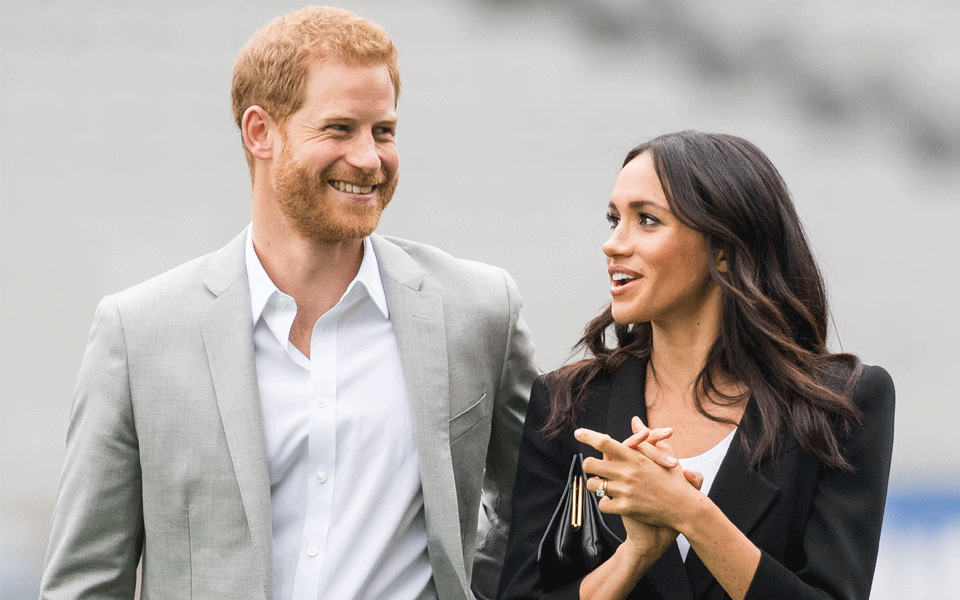
London, May 6: It's a "healthy" baby boy for Prince Harry and wife Meghan Markle, making him seventh-in-line to the British throne.
The 34-year-old father, Duke of Sussex, was present at the birth of his boy, who weighs 3.2 kg.
The new father, Prince Harry, told reporters that Meghan and the baby were doing "incredibly well" and that the couple were "absolutely thrilled" since the birth at 05:26 am (local time).
"It's been the most amazing experience I can ever possibly imagine. How any woman does what they do is beyond comprehension, said Prince Harry, making a brief media appearance as a new father.
"It was amazing, absolutely incredible. I'm so incredibly proud of my wife and as every father would say, this baby is absolutely to die for So, I'm just over the moon," he said, confirming that the baby was "a little bit overdue" and that the couple were still deciding on a name.
"The couple thank members of the public for their shared excitement and support during this very special time in their lives," the palace said, adding that, "More details will be shared in the forthcoming days."
Meghan, 37, went into labour "in the early hours" of Monday morning.
The new royal baby, as Queen Elizabeth II's eighth great grandchild, will be seventh-in-line to the British throne.
He or she will be in line behind its grandfather Prince Charles, uncle Prince William and his children Prince George, Princess Charlotte and Prince Louis and father Harry, Duke of Sussex.
However, the baby will not be bestowed a title of His or Her Royal Highness (HRH), or referred to as a Prince or Princess, unless the 93-year-old monarch steps in to make an exception to the royal titles rule dating back to 1917.
The boy will be able to use one of Harry's lesser titles to be known as the Earl of Dumbarton.
Meghan, a former actress, and Harry got married at a lavish wedding ceremony in Windsor Castle in May last year and announced the pregnancy publicly in October 2018, on the first day of their Commonwealth tour of Australia and New Zealand.
In a break from usual royal tradition, the couple have chosen to keep the birthing plans for their baby a private affair and said that they would be announcing the birth publicly only "once they have a chance to celebrate privately as a family".
The Duke and Duchess of Sussex had moved out of their London home at Nottingham Cottage in Kensington Palace into their newly-refurbished 10-bedroom family home at Frogmore Cottage in Windsor on the Queen's estate recently in preparation of the new arrival.
Their new home has a curious Indian history as the cottage which was a royal gift to Abdul Karim by Queen Victoria, then Empress of India, in recognition of his service and as a sign of her affection towards her Indian aide and confidant.
Karim, whom the monarch referred to as her Munshi , was just 24 when he arrived in England from Agra to present Victoria with a special mohar or gold coin to mark her Golden Jubilee in 1887. He quickly grew close to the ageing monarch, who bestowed many gifts on him including Frogmore Cottage for his own use.
"Queen Victoria gave it to Abdul Karim, as a special gift. She would often visit the cottage and have tea with his wife and him. He had decorated the house with many exotic things, including presents given to him by European royalty," said Shrabani Basu, the author of Victoria and Abdul: The Extraordinary True Story of the Queen's Closest Confidant'.
Harry and Meghan, who have been based at Frogmore Cottage since early April, were appointed Youth Ambassadors for the Commonwealth by the Queen and there have been some speculative UK media reports on them choosing to be based in Africa as part of that role in the future.
Let the Truth be known. If you read VB and like VB, please be a VB Supporter and Help us deliver the Truth to one and all.
AIITA welcomes Karnataka’s ban on obscene songs in school events
Bhatkal: The Karnataka unit of the All India Ideal Teachers Association (AIITA) has welcomed the Karnataka government’s decision to strictly ban school children from dancing to obscene songs during educational and cultural programmes in government, aided, and private schools across the state.
AIITA Karnataka State President M. R. Manvi congratulated the government for taking what he termed an important step to preserve the sanctity of education.
“Such decisions to safeguard the dignity of school children and uphold the values of education are the need of the hour. This rule should not be limited to government schools alone but must be strictly implemented in all private educational institutions as well,” he said.
He further urged the government to address other concerns within school programmes.
“The government should not only prohibit obscene dances in the name of school anniversaries, but also ensure that plays and dialogues that incite religious hatred are avoided. Schools should be centres of harmony, not platforms for spreading hatred,” he added.
According to a recent circular issued by the Department of School Education and Literacy, obscene dances are adversely affecting the mental health and moral values of students.
In this regard, schools have been advised to use songs that promote nationalism, positive thinking, the greatness of Kannada culture, and value-based traditions instead of inappropriate content during programmes.
The circular also emphasises that students should be dressed in decent attire.
AIITA also backed the department’s warning that disciplinary action would be taken against head teachers if such guidelines are violated. The association has further demanded that district Deputy Directors of Public Instruction strictly monitor the implementation of these rules.