Russian President Vladimir Putin announces constitutional reform, his PM steps down

Moscow, Jan 15: President Vladimir Putin accepted the resignation of his prime minister Wednesday after proposing constitutional amendments that could herald his intention to carve out a position that would let him stay at Russia's helm after his presidency ends.
Russian Prime Minister Dmitry Medvedev, who served as a placeholder president in 2008-2012 to allow Putin to observe term limits, said in televised comments that he needed to resign in light of his mentor's proposed changes in government.
Putin thanked Medvedev for his work and appointed him as the deputy head of the presidential Security Council.
In his state of the nation address earlier in the day, Putin suggested amending the constitution to allow lawmakers to name prime ministers and Cabinet members. The authority to make those appointments currently belongs to Russia's president.
It will increase the role of parliament and parliamentary parties, powers and independence of the prime minister and all Cabinet members, Putin told an audience of top officials and lawmakers.
At the same time, Putin argued that Russia would not remain stable if it were governed under a parliamentary system. The president should retain the right to dismiss the prime minister and Cabinet ministers, to name top defense and security officials, and to be in charge of the Russian military and law enforcement agencies, he said.
Putin emphasized that constitutional changes must be put to a nationwide vote.
Putin's current term expires in 2024, and Russia's political elites have been abuzz with speculation about his future plans.
The 67-year-old Putin has remained at the helm for more than 20 years longer than any other Russian or Soviet leader since Josef Stalin. He will have to step down after his term ends under the current law, which limits the president to two consecutive terms.
Political analyst Kirill Rogov said that Putin's proposals indicate his intention to remain in charge while re-distributing powers between various branches of government.
Such a model resembling the Chinese one would allow Putin to stay at the helm indefinitely while encouraging rivalry between potential successors, Rogov said on Facebook.
Alexei Navalny, the most prominent Russian opposition leader, tweeted that the president's speech signaled Putin's desire to continue calling the shots after his term ends.
The only goal of Putin and his regime is to stay in charge for life, having the entire country as his personal asset and seizing its riches for himself and his friends, Navalny alleged.
Putin served two presidential terms in 2000-2008 before shifting into the prime minister's seat for four years to observe the term limit. Medvedev kept his seat warm and then stepped down after just one term to allow his mentor to reclaim the top job in 2012. While in office, Medvedev raised the presidential term from four to six years.
While Putin continued calling the shots during Medvedev's presidency, he wasn't quite happy with his performance. He was particularly critical of Medvedev's decision to give the green light to the Western air campaign over Libya in 2011 that led to the ouster and the killing of long-time dictator Moammar Gadhafi.
Medvedev's decision to step down after one term to let Putin return to the presidency also sparked massive protests in Moscow in 2011-2012 in a major challenge to the Kremlin.
Observers speculated that Putin may stay in charge after 2024 by shifting into the prime minister's seat after increasing the powers of parliament and the Cabinet and trimming presidential authority.
Political analyst Dmitry Oreshkin said Putin's speech made it clear he was pondering the move to premiership.
Putin is advancing the idea of keeping his authority as a more powerful and influential prime minister while the presidency will become more decorative, Oreshkin said.
Other potential options include a merger with neighboring Belarus that would create a new position of the head of a new unified state a prospect rejected by Belarusian President Alexander Lukashenko.
In his address, Putin said the constitution must also specify the authority of the State Council consisting of regional governors and top federal officials.
Some analysts have theorized that Putin may try to continue pulling the strings as head of the council after stepping down as president in 2024.
Putin also emphasized the need to amend the constitution to give it a clear priority over international law.
The requirements of international law and treaties and decisions of international organs can only be valid on the territory of Russia as long as they don't restrict human rights and freedoms and don't contradict the constitution, he said.
He also said that the constitution must be tweaked to say that top government officials aren't allowed to have foreign citizenship or residence permits.
Putin focused his state of the nation address on the need to encourage population growth by offering additional subsidies to families that have children.
The Russian leader said that Russia would remain open for cooperation with all countries while maintaining a strong defense capability to fend off potential threats.
He added that new weapons systems would protect Russia's security for decades ahead. For the first time in history, we aren't trying to catch up with anyone, Putin said. On the contrary, other leading nations are yet to develop the weapons that Russia already has.
Let the Truth be known. If you read VB and like VB, please be a VB Supporter and Help us deliver the Truth to one and all.
Ladakh a living land of dharma for centuries: Amit Shah
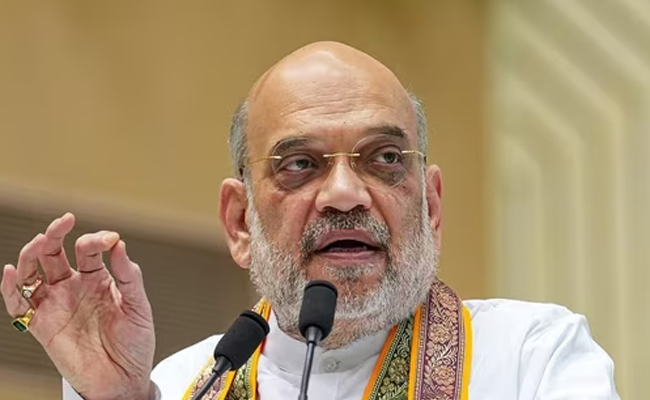
Leh/Jammu (PTI): Union Home Minister Amit Shah on Friday described the return of sacred relics of Lord Buddha to Ladakh after 75 years as a "historic reunion" and said that the Union Territory has remained a "living land of dharma", preserving and nurturing Buddhist knowledge for centuries.
Stressing the relevance of Buddha's teachings in modern times, Shah said the message of peace, compassion and the middle path was even more important today than it was 2,500 years ago.
"Ladakh has been a living land of dharma for centuries. When the Dalai Lama comes here, he says this land is not merely a geographical land but a living laboratory of Buddhist culture and compassion," Shah said, speaking after the inauguration of the sacred holy relics exposition of Tathagata Buddha and the 2569th Buddha Purnima celebrations at Jivetsal in Leh during his two-day visit to Ladakh.
Calling Ladakh a land of compassion, he said this land has preserved and nurtured knowledge. "Whenever Buddhism faced crises, this land worked to protect the teachings of Buddha. And when peace returned, it helped to expand and carry forward that preserved wisdom," he added.
"Unless one internalises knowledge and makes it a part of oneself, liberation is not possible. Knowledge is incomplete without spiritual practice, while spiritual practice without knowledge is blind. Therefore, the union of spiritual practice and knowledge is the right path. Even after all this, if there is no moral discipline, one cannot lead a truly wise life. The basis of a life of wisdom is moral discipline," he said.
Shah said it was through Ladakh and adjoining routes that the teachings of Tathagata Buddha, which originated in India, spread to China and several other countries.
"The message that emerged from the land of Ladakh has become a guiding force for many people around the world to take their lives forward. The presence of these sacred relics in Ladakh reminds us that India's civilisation has, for thousands of years, given the message of peace and coexistence," he said.
He said that in a diverse region like Ladakh and Kargil, this message becomes even more relevant. "This heritage still tells us today that amidst conflict and unrest, only the path of peace and compassion can provide solutions."
He said the return of the relics on Buddha Purnima had enhanced the significance of the festival for the people of Ladakh.
"These sacred relics have come to Ladakh after 75 years. It is as if Buddha himself is present here today," Shah said, adding that followers of Buddhism and people of other faiths in Ladakh and Kargil would draw spiritual energy from the relics.
Highlighting Ladakh's role in the spread of Buddhism, Shah said Kashmir was once an ancient centre of Buddhist studies, Mahayana philosophy and Buddhist art, from where Ladakh first came into close contact with Buddhism.
He said Emperor Ashoka's envoys laid the foundation of Buddhist influence in Ladakh through Kashmir and Gandhara, while Mahayana Buddhism expanded in the region during the Kushan period between the first and third centuries CE.
The Silk Route linking Kashmir, Leh, Yarkand, Khotan and Tibet became a channel not only for trade but also for ideas, monks, manuscripts and artistic traditions, Shah said.
He added that later, Tibetan influence between the seventh and tenth centuries further enriched Ladakh through Mahayana and Vajrayana traditions.
Stressing the relevance of Buddha's teachings in modern times, Shah said the message of peace, compassion and the middle path was even more important today than it was 2,500 years ago.
"Amid conflict and unrest, only the path of peace and compassion can provide solutions," he said.
Shah also appealed to the Ladakh administration to ensure complete arrangements so that followers of all faiths, especially Buddhists, could visit and pay obeisance to the relics.
#WATCH लेह, लद्दाख: केंद्रीय गृह मंत्री अमित शाह ने कहा, "जब दलाई लामा यहां आते हैं तो वे कहते हैं कि यह भूमि केवल भौगोलिक भूमि नहीं है। यह भूमि बौद्ध संस्कृति और करुणा की जीवंत प्रयोगशाला है। इस भूमि पर ज्ञान का संरक्षण हुआ है... भारत की सभ्यता हजारों वर्षों से शांति का संदेश… https://t.co/2nwG0w2CE6 pic.twitter.com/W13itRBqeX
— ANI_HindiNews (@AHindinews) May 1, 2026