Riyadh (AP): President Donald Trump opened his four-day Mideast trip on Tuesday by paying a visit to Saudi Arabia's de facto ruler, Crown Prince Mohammed bin Salman, for talks on US efforts to dismantle Iran's nuclear programme, end the war in Gaza, hold down oil prices and more.
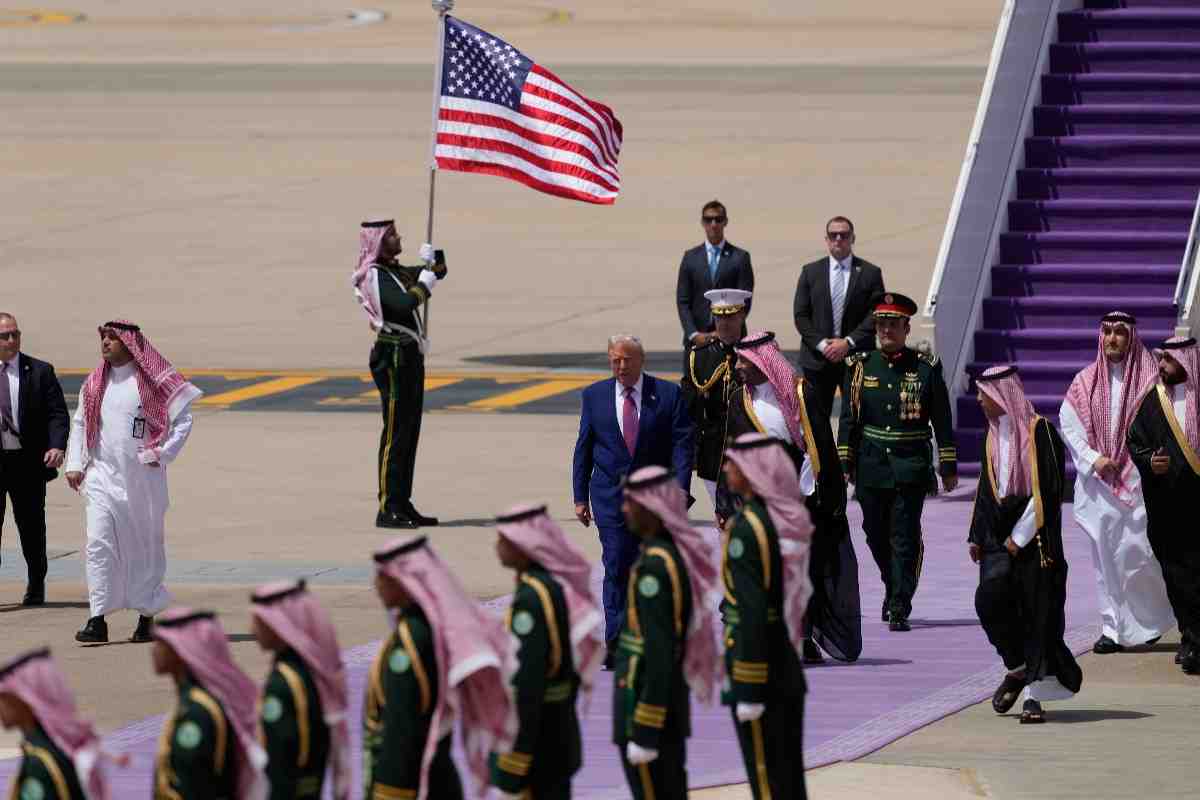
Bin Salman warmly greeted Trump as he stepped off Air Force One and kicked off his Middle East tour. The two leaders then retreated to a grand hall at the Riyadh airport for a coffee ceremony.
The crown prince will fete Trump with a formal dinner and Trump is slated to take part later Tuesday in a US-Saudi investment conference.
The US president on Wednesday will join a gathering of members of the Gulf Cooperation Council, which is made up of Bahrain, Kuwait, Oman, Qatar, Saudi Arabia and the United Arab Emirates, before leaving Riyadh.
Saudi Arabia and fellow OPEC+ nations have already helped their cause with Trump early in his second term by stepping up oil production.
Trump sees cheap energy as a key component to lowering costs and stemming inflation for Americans. The president has also made the case that lower oil prices will hasten an end to Russia's war on Ukraine.
But Saudi Arabia's economy remains heavily dependent on oil, and the kingdom needs a fiscal break-even oil price of $96 to $98 a barrel to balance its budget. It's questionable how long OPEC+, of which Saudi Arabia is the leading member, is willing to keep production elevated. The price of a barrel of Brent crude closed Monday at $64.77.
“One of the challenges for the Gulf states of lower oil prices is it doesn't necessarily imperil economic diversification programmes, but it certainly makes them harder,” said Jon Alterman, a senior Middle East analyst at the Center for Strategic and International Studies in Washington.
Trump picked the kingdom for his first stop because it has pledged to make big investments in the US, but Trump ended up travelling to Italy last month for Pope Francis' funeral. Riyadh was the first overseas stop of his first term.
The three countries on the president's itinerary — Saudi Arabia, Qatar and the United Arab Emirates — are all places where the Trump Organisation, run by Trump's two elder sons, is developing major real estate projects. They include a high-rise tower in Jeddah, a luxury hotel in Dubai and a golf course and villa complex in Qatar.
Trump is trying to demonstrate that his transactional strategy for international politics is paying dividends as he faces criticism from Democrats who say his global tariff war and approach to Russia's war on Ukraine are isolating the United States from allies.
He's expected to announce deals with the three wealthy countries that will touch on artificial intelligence, expanding energy cooperation and perhaps new arms sales to Saudi Arabia. The administration earlier this month announced initial approval to sell $3.5 billion worth of air-to-air missiles for Saudi Arabia's fighter jets.
But Trump arrives in the Mideast at a moment when his top regional allies, Israel and Saudi Arabia, are far from neatly aligned with his approach.
Ahead of the trip, Trump announced that the US was halting a nearly two-month US airstrike campaign against Yemen's Houthis, saying the Iran-backed rebels have pledged to stop attacking ships along a vital global trade rout
Let the Truth be known. If you read VB and like VB, please be a VB Supporter and Help us deliver the Truth to one and all.
Washington (AP): President Donald Trump said Tuesday he is ordering a blockade of all “sanctioned oil tankers” into Venezuela, ramping up pressure on the country's authoritarian leader Nicolas Maduro in a move that seemed designed to put a tighter chokehold on the South American country's economy.
Trump's escalation comes after US forces last week seized an oil tanker off Venezuela's coast, an unusual move that followed a buildup of military forces in the region. In a post on social media Tuesday night announcing the blockade, Trump alleged Venezuela was using oil to fund drug trafficking and other crimes and vowed to continue the military buildup until the country gave the US oil, land and assets, though it was not clear why he felt the US had a claim.
ALSO READ: Trump sues BBC for USD 10 billion, alleges defamation over edited Jan 6 speech
“Venezuela is completely surrounded by the largest Armada ever assembled in the History of South America,” Trump said in a post on his social media platform. “It will only get bigger, and the shock to them will be like nothing they have ever seen before — Until such time as they return to the United States of America all of the Oil, Land, and other Assets that they previously stole from us.”
Pentagon officials referred all questions about the post to the White House.
Venezuela's government released a statement Tuesday accusing Trump of “violating international law, free trade, and the principle of free navigation” with “a reckless and grave threat” against the South American country.
“On his social media, he assumes that Venezuela's oil, land, and mineral wealth are his property,” the statement said of Trump's post. “Consequently, he demands that Venezuela immediately hand over all its riches. The President of the United States intends to impose, in an utterly irrational manner, a supposed naval blockade on Venezuela with the aim of stealing the wealth that belongs to our nation.”
Maduro's government, according to the statement, plans to denounce the situation before the United Nations.
The US buildup has been accompanied by a series of military strikes on boats in international waters in the Caribbean and eastern Pacific. The campaign, which has drawn bipartisan scrutiny among US lawmakers, has killed at least 95 people in 25 known strikes on vessels.
Trump has for weeks said that the US will move its campaign beyond the water and start strikes on land.
The Trump administration has defended the strikes as a success, saying they have prevented drugs from reaching American shores, and pushed back on concerns that they are stretching the bounds of lawful warfare.
The Trump administration has said the campaign is about stopping drugs headed to the US, but Trump's chief of staff Susie Wiles appeared to confirm in a Vanity Fair interview published Tuesday that the campaign is part of a push to oust Maduro.
Wiles said Trump “wants to keep on blowing boats up until Maduro cries uncle.”
Tuesday night's announcement seemed to have a similar aim.
Venezuela, which has the world's largest proven oil reserves and produces about 1 million barrels a day, has long relied on oil revenue as a lifeblood of its economy.
Since the Trump administration began imposing oil sanctions on Venezuela in 2017, Maduro's government has relied on a shadowy fleet of unflagged tankers to smuggle crude into global supply chains.
The state-owned oil company Petroleos de Venezuela SA, commonly known as PDVSA, has been locked out of global oil markets by US sanctions. It sells most of its exports at a steep discount in the black market in China.
Francisco Monaldi, a Venezuelan oil expert at Rice University in Houston, said about 850,000 barrels of the 1 million daily production is exported. Of that, he said, 80 per cent goes to China, 15 per cent to 17 per cent goes to the US through Chevron Corp, and the remainder goes to Cuba.
In October, Trump appeared to confirm reports that Maduro has offered a stake in Venezuela's oil and other mineral wealth in recent months to try to stave off mounting pressure from the United States.
“He's offered everything,” Trump said at the time. “You know why? Because he doesn't want to f—- around with the United States.”
It wasn't immediately clear how the US planned to enact what Trump called a “TOTAL AND COMPLETE BLOCKADE OF ALL SANCTIONED OIL TANKERS going into, and out of, Venezuela.”
But the US Navy has 11 ships, including an aircraft carrier and several amphibious assault ships, in the region.
Those ships carry a wide complement of aircraft, including helicopters and V-22 Ospreys. Additionally, the Navy has been operating a handful of P-8 Poseidon maritime patrol aircraft in the region.
All told, those assets provide the military a significant ability to monitor marine traffic coming in and out of the country.
Trump in his post said that the “Venezuelan Regime has been designated a FOREIGN TERRORIST ORGANIZATION,” but it wasn't clear what he was referring to.
The foreign terrorist organisation designation has been historically reserved for non-state actors that do not have sovereign immunities conferred by either treaties or United Nations membership.
In November, the Trump administration announced it was designating the Cartel de los Soles as a foreign terrorist organisation. The term Cartel de los Soles originally referred to Venezuelan military officers involved in drug-running, but it is not a cartel per se.
Governments that US administrations seek to sanction for financing, otherwise fomenting or tolerating extremist violence are usually designated “state sponsors of terrorism.”
Venezuela is not on that list.
In rare cases, the US has designated an element of a foreign government as an “FTO.” The Trump administration in its first term did so with the Iranian Revolutionary Guard Corps, an arm of the Iranian government, which had already been designated a state sponsor of terrorism.