Seattle police officer who ran over Indian student Jaahnavi Kandula to not face criminal charges
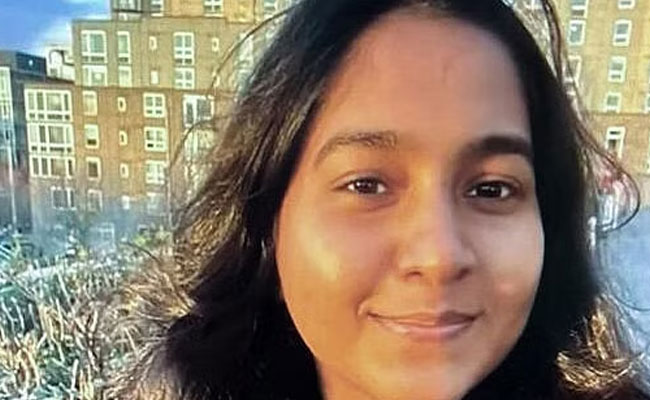
Washington (PTI): The Seattle police officer who struck and killed Indian student Jaahnavi Kandula while responding to an overdose call, will not face any criminal charges due to lack of "sufficient" evidence, authorities said.
On Wednesday, the King County Prosecutor's Office said they will not move forward with criminal charges against Seattle Police Officer Kevin Dave, FOX13 Seattle reported.
In a statement released Wednesday, the King County Prosecuting Attorney said, "Kandula's death is heartbreaking and impacted communities in King County and across the world."
Kandula, 23, was struck by a police vehicle driven by Officer Dave when she was crossing a street in Seattle on January 23. He was driving 74 mph (more than 119 kmh) on the way to a report of a drug overdose call. Kandula was thrown 100 feet when she was struck by the speeding police patrol vehicle.
In bodycam footage released by the Seattle Police Department, Officer Daniel Auderer laughed about the deadly crash and dismissed any implication Dave might be at fault or that a criminal investigation was necessary.
King County Prosecuting Attorney Leesa Manion said that she believes they lack the evidence to prove a criminal case beyond a reasonable doubt, the report added.
"It is the responsibility of the King County Prosecuting Attorney's Office to review all available evidence relating to the case involving Seattle Police Officer Kevin Dave and the January 2023 collision death of Jaahnavi Kandula. After staffing this case with senior deputy prosecuting attorneys and office leadership, I have determined that we lack sufficient evidence under Washington State law to prove a criminal case beyond a reasonable doubt."
The statement also said that the prosecutor's office also finds the comments made by Seattle Police Officer Daniel Auderer, recorded on his body-worn video, "appalling and deeply troubling."
Auderer, who was not involved in the January collision, was captured in the video saying, "But she is dead" and laughing while on the phone.
She was 26 anyway," Auderer said in the video. "She had limited value."
"Officer Auderer's comments were also unprofessional and undermined the public's trust in the Seattle Police Department and law enforcement in general," said Manion.
"As egregious as Officer Auderer's comments are, they do not change the PAO's legal analysis into the conduct of Officer Dave. It is the Office of Police Accountability that bears the responsibility of disciplinary investigation and proceedings relating to Officer Auderer's comment, not the PAO."
Auderer was pulled from patrol in September 2023 and reassigned to a "non-operational position."
Auderer could still be fired after the fallout of his insensitive comments captured on bodycam.
Auderer's chain of command and the Office of Police Accountability (OPA) found he acted unprofessionally. For that, he faces the highest disciplinary range of nearly two weeks suspension up to termination, according to a disciplinary action report.
Before a final disciplinary decision, Auderer will have the chance to meet with Police Chief Adrian Diaz to disagree.
His disciplinary hearing is scheduled for March 4, K5 News reported.
Seattle local media reported that speed was the cause of the collision, as the speed at which Dave was travelling did "not allow (Kandula) or him sufficient time to detect, address and avoid a hazard that presented itself."
Dave was responding to a "priority one" call at the request of the Seattle Fire Department, according to the Seattle Police Department. According to the police report, the officer was responding to a report of a drug overdose.
The officer did not have his siren activated continuously. Instead, the officer "chirped" his siren at the intersection. He did have his emergency lights on, according to a previous statement from the police department.
In a memo to Seattle police, prosecutors wrote there was not enough evidence to prove Dave showed "conscious disregard for others safety."
A drug recognition expert responded to the scene and found no impairment in the officer.
Kandula was a graduate student at Northeastern University at the Seattle campus. The university said in January 2023 that they would award her degree posthumously and present it to her family.
Let the Truth be known. If you read VB and like VB, please be a VB Supporter and Help us deliver the Truth to one and all.
Heavy rain, hailstorms lash parts of Uttarakhand; all districts put on high alert
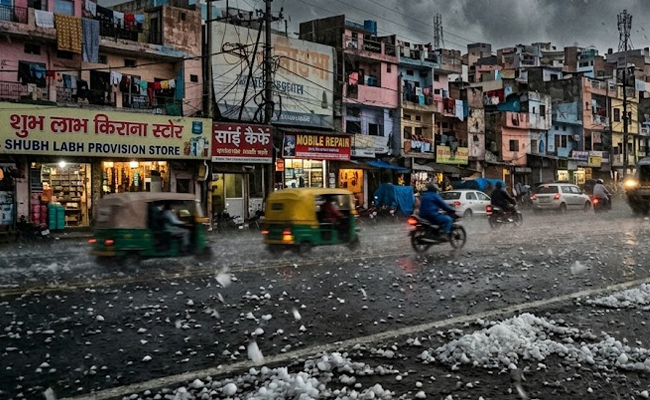
Dehradun (PTI): Heavy rain and hailstorms accompanied by strong winds lashed several districts of Uttarakhand on Sunday morning, prompting the state administration to put all district authorities on high alert.
The sudden change in weather caused uprooted trees to block roads and disrupted power supply at various locations.
Disaster Management and Rehabilitation Secretary Vinod Kumar Suman chaired a review meeting with district officials to assess the situation.
The India Meteorological Department (IMD) has forecast light to moderate rain and thunderstorms at most places across all districts for Monday and Tuesday. Snowfall is expected in regions situated at altitudes of 4,000 metres and above.
An 'orange alert' remains in place for Dehradun, Haridwar, Tehri, Pauri, Nainital, Champawat, and Udham Singh Nagar. These districts are likely to witness isolated heavy rain, hailstorms, and intense to very intense spells of rain accompanied by gusty winds reaching speeds of 40-50 kmph, the IMD said.
The weather office predicted that maximum temperatures across the state are likely to fall by 3-5 degrees Celsius over the next three to four days. During the past 24 hours, maximum temperatures remained "markedly below normal" in the plains and ranged from "markedly" to "appreciably" below normal in the hilly regions.
Dehradun experienced dark, overcast skies early Sunday, creating night-like conditions during morning hours. The city recorded a maximum temperature of 34.7 degrees Celsius, 5.3 degrees Celsius below the seasonal average.
For the state capital, the forecast predicts a partly to generally cloudy sky with a high of 31 degrees Celsius and a low of 19 degrees Celsius.
Significant rainfall was recorded across the state after 8.30 am on Sunday, with Jollygrant receiving 21.6 mm and Mohakampur recording 19.8 mm. Other areas, including Mukteshwar (15.0 mm), Mussoorie (13.4 mm), and Pithoragarh (8.5 mm), also saw measurable precipitation.
Secretary Suman directed officials to clear blocked roads on priority to ensure public convenience. Specific instructions were issued regarding the Char Dham Yatra, ordering that helicopter services must operate strictly according to weather conditions to ensure pilgrims' safety.
Isolated places in the remaining hilly districts are also expected to experience thunderstorms with lightning and intense rain spells.