South Korean opposition leader is stabbed in the neck by a knife-wielding man
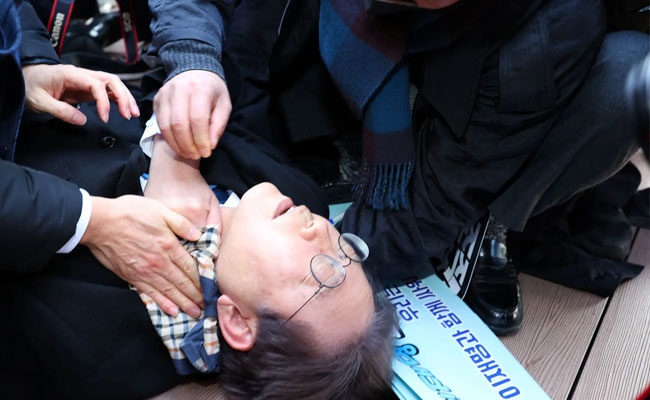
Seoul (AP): South Korea's tough-speaking liberal opposition leader, Lee Jae-myung, was stabbed in the neck by an unidentified knife-wielding man during a visit on Tuesday to the southeastern city of Busan, police said.
Lee, 59, the head of the main opposition Democratic Party, was airlifted to a Seoul hospital for surgery after receiving emergency treatment in Busan. Police and emergency officials earlier said he was conscious after the attack and wasn't in critical condition, but his exact status was unknown.
The attack happened as Lee walked through a crowd of journalists and others after a tour of the proposed site of a new airport in Busan. The attacker approached Lee, saying he wanted to get his autograph, and then stabbed him in the left side of his neck with a knife, senior Busan police officer Sohn Jae-han said in a televised briefing.
Sohn said Democratic Party officials near Lee quickly subdued the attacker before police officers detained him. He said 41 police officers had been deployed to the area for crowd control and traffic management.
TV footage showed Lee, his eyes closed, lying on the ground as a person pressed a handkerchief to his neck to stop the bleeding. A witness, Jin Jeong-hwa, told YTN television that Lee had bled a lot. Videos circulated on social media showed the suspect, wearing a paper crown reading “I'm Lee Jae-myung,” being chased and tackled by several people, apparently including plainclothes police officers.
Sohn said the suspect, aged about 67, told investigators that he bought the 18-centimetre knife online. He said police are investigating the motive for the attack.
Lee's Democratic Party called the incident “a terrorist attack on Lee and a serious threat to democracy.” It called on police to make a through, swift investigation.
At Pusan National University Hospital in Busan, where Lee received emergency treatment, party spokesperson Kwon Chil-seung said Lee's jugular vein was believed to have been damaged and there was concern over the large amount of bleeding. Hospital officials would not comment on Lee's condition.
President Yoon Suk Yeol expressed deep concern about Lee's health and ordered authorities to investigate the attack, saying such violence would not be tolerated, according to Yoon's office.
Lee lost the 2022 presidential election to Yoon by 0.7 percentage point, the narrowest margin ever recorded in a South Korean presidential election.
Since his election defeat, Lee has been a harsh critic of Yoon's major policies. Last year, Lee held a 24-day hunger strike to protest what he called Yoon's failure to oppose Japan's release of treated radioactive wastewater from its crippled Fukushima nuclear power, his handling of the country's post-pandemic economy and his hard-line policies on North Korea.
Lee faces an array of corruption allegations, including that he provided unlawful favors to a private investor who reaped huge profits from a dubious housing project in the city of Seongnam, where Lee was mayor for a decade until 2018. Lee has denied legal wrongdoing and accused Yoon's government of pursuing a political vendetta.
Last September, a South Korean court denied an arrest warrant for Lee over the allegations, but Lee reportedly faces a continuing investigation by prosecutors. The court hearing was arranged after the opposition-controlled parliament voted to lift Lee's immunity to arrest, a move that reflected growing divisions within his Democratic Party over his legal troubles.
Lee, who also served as governor of Gyeonggi province, which surrounds Seoul, is known for his outspoken style. His supporters see him as an anti-elitist hero who could reform establishment politics, eradicate corruption and solve growing economic inequality. Critics view him as a dangerous populist who relies on stoking divisions and demonising his conservative opponents.
Lee is also known for his self-made success story. He worked in a factory as a boy, an experience that left him with an arm disability. He later made his own way through school and passed the country's notoriously difficult bar exam to work as a human rights lawyer.
Lee joined a predecessor of the Democratic Party in 2005. Previously a political outsider, he rose quickly amid public anger over an explosive 2016-17 corruption scandal that eventually led to the ouster of then-President Park Geun-hye, a conservative.
Video footage has surfaced depicting an assault on South Korean opposition leader Lee Jae-myung (SKs Trump).
— Jack Straw (@JackStr42679640) January 2, 2024
During a press conference, he was reportedly stabbed in the neck. As of now, the current condition of Lee Jae-myung remains unknown.
This brought to mind the events of… pic.twitter.com/TczBeVQwzZ
Let the Truth be known. If you read VB and like VB, please be a VB Supporter and Help us deliver the Truth to one and all.
KSCA expresses disappointment over missing IPL playoffs, says it was ready to host matches in B’luru
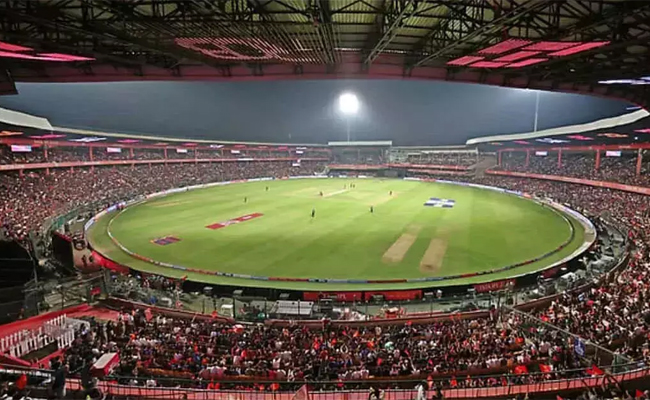
Bengaluru: The Karnataka State Cricket Association (KSCA) has issued a clarification stating that it was fully prepared to host the IPL playoffs and final matches in Bengaluru but the fixtures were allotted to other venues.
In a media note, KSCA said it was disappointed with the decision. The association stated that its president, former India cricketer Venkatesh Prasad, had been in touch with the Board of Control for Cricket in India (BCCI) and had formally conveyed the association’s readiness and interest in hosting the matches at the M. Chinnaswamy Stadium.
KSCA said the IPL matches held in Bengaluru this season were appreciated for smooth conduct, crowd management and overall experience for spectators. It said this reflected its ability to handle high-profile matches.
The association also stated that it had sent a detailed communication to the BCCI explaining its preparedness and the operational arrangements followed during the current IPL season. According to KSCA, these systems have been in place since the start of the Indian Premier League in 2008 and were followed consistently, including during previous playoff matches hosted in Bengaluru.
The clarification added that the communication sent to the BCCI was only meant to provide factual and operational details and to bring clarity on logistical and stakeholder-related requirements involved in hosting such matches.
KSCA said that although it had shown willingness and preparedness, the BCCI has decided to allocate the playoff matches to other venues. It added that the reasons for this decision have not been formally shared with the association, but it respects the authority of the board in taking such decisions.
The association further said it remains ready to host matches of national and international importance and will continue to cooperate with the BCCI, franchises, government authorities and other stakeholders for conducting cricket events.
The statement was issued by KSCA official spokesperson Vinay Mruthyunjaya, who also thanked the media and cricket fans for their continued support.