Spraying disinfectants can be 'harmful', says WHO
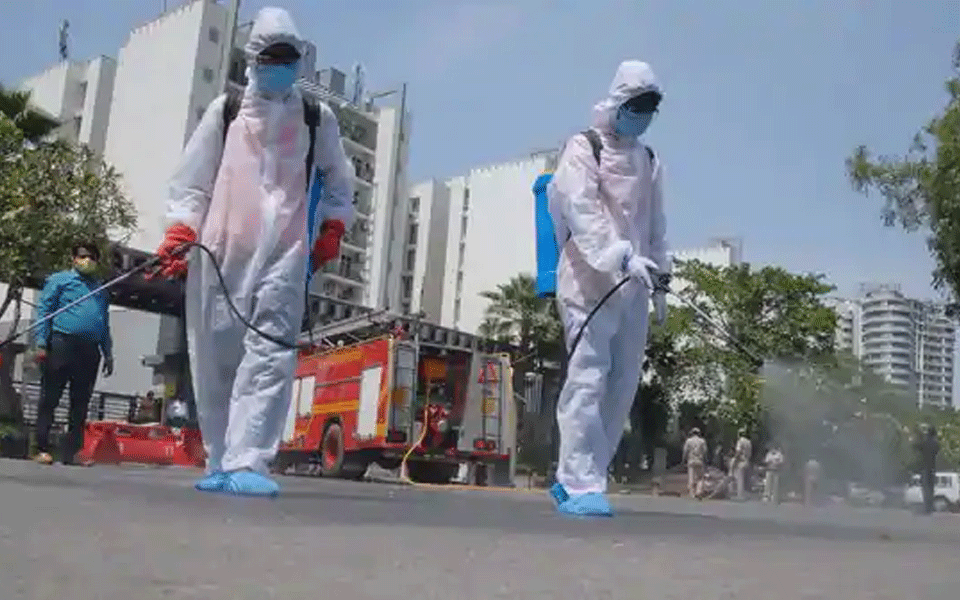
Geneva: Spraying disinfectant on the streets, as practised in some countries, does not eliminate the new coronavirus and even poses a health risk, the World Health Organization (WHO) warned on Saturday.
In a document on cleaning and disinfecting surfaces as part of the response to the virus, the WHO says spraying can be ineffective.
"Spraying or fumigation of outdoor spaces, such as streets or marketplaces, is... not recommended to kill the COVID-19 virus or other pathogens because disinfectant is inactivated by dirt and debris," explains the WHO.
"Even in the absence of organic matter, chemical spraying is unlikely to adequately cover all surfaces for the duration of the required contact time needed to inactivate pathogens." The WHO said that streets and pavements are not considered as "reservoirs of infection" of COVID-19, adding that spraying disinfectants, even outside, can be "dangerous for human health".
The document also stresses that spraying individuals with disinfectants is "not recommended under any circumstances".
"This could be physically and psychologically harmful and would not reduce an infected person's ability to spread the virus through droplets or contact," said the document.
Spraying chlorine or other toxic chemicals on people can cause eye and skin irritation, bronchospasm and gastrointestinal effects, it adds.
The organisation is also warning against the systematic spraying and fumigating of disinfectants on to surfaces in indoor spaces, citing a study that has shown it to be ineffective outside direct spraying areas.
"If disinfectants are to be applied, this should be done with a cloth or wipe that has been soaked in disinfectant," it says.
The SARS-CoV-2 virus, the cause of the pandemic that has killed more than 300,000 people worldwide since its appearance in late December in China, can attach itself to surfaces and objects.
However, no precise information is currently available for the period during which the viruses remain infectious on the various surfaces.
Studies have shown that the virus can stay on several types of surfaces for several days. However, these maximum durations are only theoretical because they are recorded under laboratory conditions and should be "interpreted with caution" in the real-world environment.
Let the Truth be known. If you read VB and like VB, please be a VB Supporter and Help us deliver the Truth to one and all.
Man arrested with Rs 2.54-crore heroin in Mumbai

Mumbai (PTI): Police have arrested a man and seized over 500 grams of heroin worth Rs 2.54 crore in the illicit market from him in Mumbai, officials said on Friday.
The police's Anti-Narcotics Cell (ANC) made the drug seizure in Santacruz in the western suburbs. The operation was conducted by the Kandivali unit of the ANC on Thursday as part of a special crackdown against drug trafficking in the area, they said.
Acting on specific inputs, an ANC team conducted a raid in Santacruz (East) and intercepted a man. During a search, the team recovered 508 grams of high-grade heroin from his possession, an official said.
The seized contraband, a highly addictive, opioid drug derived from morphine, is estimated to be worth Rs 2.54 crore in the international market, he informed.
Following the seizure, a case was registered against the man under relevant sections of the Narcotic Drugs and Psychotropic Substances (NDPS) Act, 1985, and he was formally placed under arrest in the early hours of Friday.
The police are currently investigating the source of the drug and trying to identify the intended recipients of the consignment, he said.