Teen burglar breaks into home, asks sleeping couple for wifi
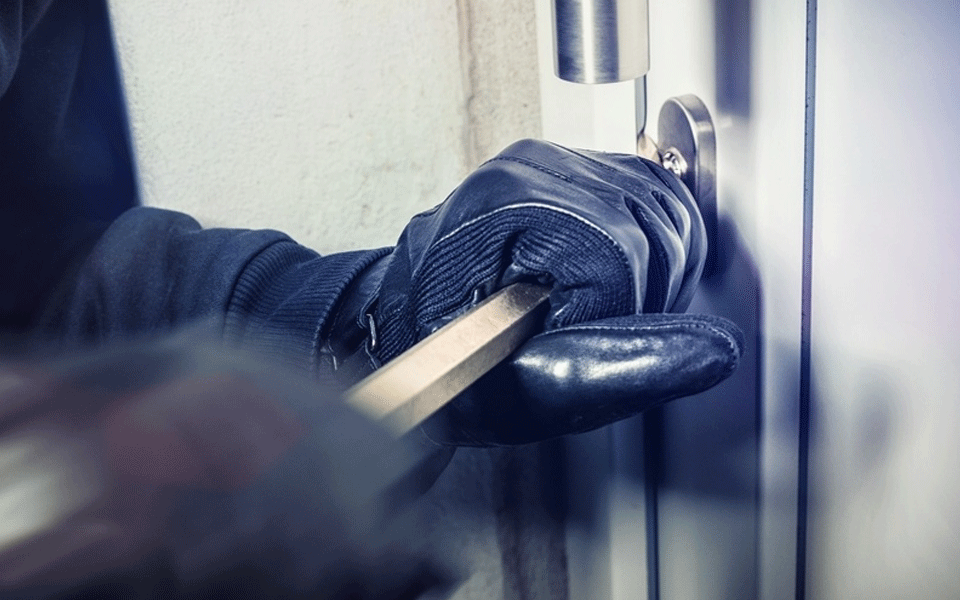
Palo Alto(CA), July 28: Police arrested a 17-year-old burglar last weekend after he entered an occupied residence overnight and awakened the sleeping residents. Officers later connected him to a nearby bicycle theft that had occurred the same night.
On Sunday, July 22, 2018, at about 12:31 a.m., our 24-hour dispatch center received a call from a couple in their sixties reporting they had just awakened to a stranger in the bedroom of their home in the 700 block of East Charleston Road. The male victim reported he had shoved the suspect out of his house and then called police. Officers responded immediately and detained the suspect without incident about a block away.
The investigation revealed that the couple had been asleep in their bedroom when they were awakened by the unknown suspect speaking to them and asking to use their WiFi network. The suspect was wearing something covering over his face. The male victim got out of bed, confronted the suspect, and pushed him down the hallway and out the front door of the house before calling police. No one was injured.
When officers found the suspect, he had a black T-shirt wrapped around the back of his neck under his sweatshirt. Officers believe that was what had been covering his face during the burglary. Officers determined the suspect had climbed into the home after cutting a screen covering an open window in the side yard. The suspect initially lied to police about his identity. The suspect’s motive for entering the home is unknown, but the victims reported that two kitchen knives were missing from a kitchen drawer. Police did not recover any weapons (including those kitchen knives) in the possession of the suspect.
Police arrested the suspect, a 17-year-old male from Palo Alto, for residential burglary (a felony), prowling (a misdemeanor), and providing false information to an officer (a misdemeanor). Officers transported him to Santa Clara County Juvenile Hall. In accordance with our standard release of information procedures, no additional information on the suspect is available since he is under the age of 18. We do not release booking photographs of juveniles in such situations.
During the afternoon of July 22, our 24-hour dispatch center received a call of a bike theft from a backyard that had occurred overnight at a home in the 3800 block of Middlefield Road. Officers learned that at around 11:45 p.m. on July 21, a resident in her twenties noticed the suspect was outside her bedroom window, standing in the home’s side yard, and motioning that he wanted to talk to her. The woman notified another resident of the home, an adult in his late teens, and together the two of them confronted the suspect in the side yard. The suspect asked to use their WiFi network because he was out of data. The residents ordered the suspect to leave, and they watched him ride away on a bicycle. They did not notify police at the time.
The following morning, the male resident realized that his bicycle, which had been in the backyard, was missing. The residents reviewed their surveillance video and saw the suspect stealing the bike from the backyard and moving it to the front of the home prior to returning to the side yard and making contact with the female resident.
Officers checked the area for the stolen bicycle and found it near the location where police had detained the suspect. Officers returned the bicycle to the victim and are recommending that the District Attorney’s Office add a charge of misdemeanor petty theft against the suspect.
Overnight burglaries of occupied homes are very rare in Palo Alto. Police recommend securing side yard gates with a padlock, and promptly reporting any suspicious behavior to authorities. Detectives are investigating to see if this suspect may be connected to any other crimes in Palo Alto or the surrounding area.
Courtesy: www.cityofpaloalto.org
Let the Truth be known. If you read VB and like VB, please be a VB Supporter and Help us deliver the Truth to one and all.
Two held for 'firing' at BJP leader's house in Bengal

Kolkata (PTI): A day before the counting of votes for the West Bengal assembly elections, two persons were arrested on Sunday for allegedly being involved in a firing incident outside the residence of a BJP leader in North 24 Parganas district, police said.
BJP leader Kundan Singh lodged a police complaint, alleging that a few gunmen fired at his house in the Noapara constituency around Saturday midnight.
Based on the CCTV footage, the two accused were apprehended, a senior officer said.
BJP's Noapara candidate Arjun Singh, in a post on social media, claimed that around 12.05 am, two armed miscreants arrived on a motorcycle at the residence of Kundan Singh, a BJP functionary and secretary of the Barrackpore organisational district, with an "intent to kill him".
According to the BJP leader, the accused are residents of Garulia and are known criminals.
Their names as offenders had been submitted to the Election Commission, he said.
The police officer did not specify whether the two arrested persons were the same individuals named by Arjun Singh.
According to the complaint, one round of firing took place outside Kundan Singh's house, triggering panic in the area.
The BJP candidate also questioned the role of the police, claiming that one of the accused had been detained by the police on the polling day but was later released in the evening.
The Noapara assembly seat went to the polls on April 29.
Several BJP leaders alleged that attempts were being made to create an atmosphere of fear ahead of the counting and weaken the organisation of the opposition parties.
The counting of votes will take place on May 4. Polling for the West Bengal assembly elections was held on April 23 and April 29.
The BJP urged the Election Commission to intervene immediately to ensure peaceful counting.
TMC candidate Somnath Shyam rubbished Arjun Singh’s allegation, claiming that the BJP nominee had orchestrated the firing incident to divert attention from imminent defeat.
“Arjun Singh knows all the gangsters in the Barrackpore belt. Everyone knows about his links with the underworld. Let the police investigate the incident,” Shyam said.