Truce in Gaza extended at last minute as talks over dwindling number of Hamas captives get tougher
Rafah (Gaza Strip) (AP): Israel and Hamas on Thursday agreed to extend their cease-fire by another day, just minutes before it was set to expire. The truce in Gaza appeared increasingly tenuous as the number of women and children held by the fighters as bargaining chips dwindled after dozens were released.
Word of the extension came just as the truce was to expire at 7 a.m. (0500 GMT) Thursday. The Qatari Foreign Ministry said the truce was being extended under the same terms as in the past, with Hamas releasing 10 Israeli hostages per day in exchange for Israel's release of 30 Palestinian prisoners.
International pressure has mounted for the cease-fire to continue as long as possible after nearly eight weeks of Israeli bombardment and a ground campaign in Gaza that have killed thousands of Palestinians, uprooted three quarters of the population of 2.3 million and led to a humanitarian crisis.
The war has stoked tensions across the region. On Thursday morning, two gunmen opened fire on people waiting for buses and rides where a main highway from Tel Aviv enters Jerusalem. Israel's Maged David Adom emergency service said one person was killed and six people were wounded, one of them critically. Police said the two attackers were killed.
U.S. Secretary of State Antony Blinken arrived in Israel late Wednesday on his third trip to the region since the start of the war, and is expected to press for further extensions of the truce and the release of more hostages.
The announcement followed a last-minute standoff, with Hamas saying Israel had rejected a proposed list that included seven living captives and the remains of three who the group said were killed in Israeli airstrikes. Israel later said Hamas submitted an improved list, paving the way for the extension.
The talks appear to be growing tougher with most of the women and children taken hostage by Hamas already freed. Israel says it will maintain the truce until Hamas stops releasing captives, at which point it will resume its offensive aimed at eliminating the group.
With Israeli troops holding much of northern Gaza, a ground invasion south where most of Gaza's population is now concentrated will likely bring an escalating cost in Palestinian lives and destruction.
The Biden administration has told Israel that if it launches an offensive in the south, it must operate with far greater precision.
Israel's bombardment and ground invasion in Gaza have killed more than 13,300 Palestinians, roughly two-thirds of them women and minors, according to the Health Ministry in Gaza.
The toll is likely much higher, as officials have only sporadically updated the count since Nov. 11 due to the breakdown of services in the north. The ministry says thousands more people are missing and feared dead under the rubble.
Israel says 77 of its soldiers have been killed in the ground offensive. It claims to have killed thousands of militants, without providing evidence.
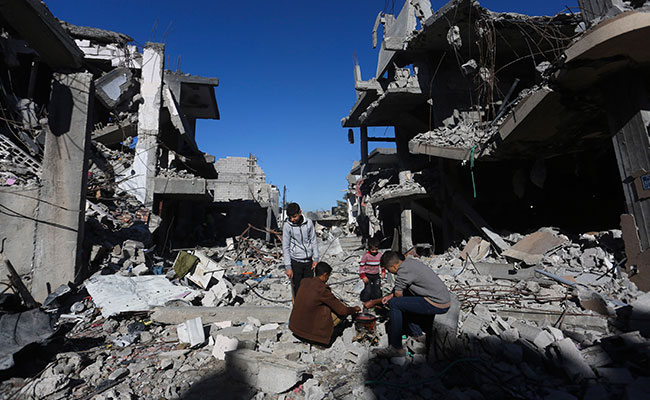
For Palestinians in Gaza, the truce's calm has been overwhelmed by the search for aid and by horror at the extent of destruction.
In the north, residents described entire residential blocks as leveled in Gaza City and surrounding areas. The smell of decomposing bodies trapped under collapsed buildings fills the air, said Mohmmed Mattar, a 29-year-old resident of Gaza City who along with other volunteers searches for the dead under rubble or left in the streets.
In the south, the truce has allowed more aid to be delivered from Egypt, up to 200 trucks a day. But aid officials say it is not enough, given that most now depend on outside aid. Overwhelmed U.N.-run shelters house over 1 million displaced people, with many sleeping outside in cold, rainy weather.
At a distribution center in Rafah, large crowds line up daily for bags of flour but supplies run out quickly.
"Every day, we come here we spend money on transportation to get here, just to go home with nothing," said one woman in line, Nawal Abu Namous.
Let the Truth be known. If you read VB and like VB, please be a VB Supporter and Help us deliver the Truth to one and all.
Gold, silver soar as US-Iran deal hopes lift bullion demand

New Delhi (PTI): Gold prices rebounded by Rs 2,900 to Rs 1.55 lakh per 10 grams in the national capital on Wednesday, while silver climbed to Rs 2.54 lakh per kilogram as easing geopolitical tensions triggered a pullback in oil rates, boosting demand for precious metals.
According to the All India Sarafa Association, the yellow metal of 99.9 per cent purity jumped by Rs 2,900, or nearly 2 per cent, to Rs 1,55,400 per 10 grams (inclusive of all taxes) from Tuesday's closing level of Rs 1,52,500 per 10 grams.
Traders attributed the surge in bullion prices to reports that Washington and Tehran are close to finalising a framework agreement to end months of conflict, raising the prospects of smoother flows through the Strait of Hormuz and easing inflation concerns tied to energy markets.
"Gold rallied strongly on Wednesday as easing geopolitical tensions triggered a sharp reversal in key macro drivers that had recently pressured precious metals," Saumil Gandhi, Senior Analyst - Commodities at HDFC Securities, said.
Silver prices also advanced for the third straight session by rising Rs 3,500, or 1.4 per cent, to Rs 2,54,500 per kg (inclusive of all taxes). The metal had settled at Rs 2,51,000 per kg in the previous session, as per the Association.
"The prospect of a diplomatic breakthrough triggered a steep decline in oil prices and the US dollar, easing concerns about inflation while boosting demand for precious metals," Gandhi said.
Globally, spot gold increased by USD 106.15, or 2.33 per cent, to USD 4,663.70 per ounce while silver gained USD 3.40, or 4.68 per cent, to USD 76.24 per ounce.
"Gold witnessed a sharp rally as markets reacted positively to reports that the US and Iran are moving closer to a one-page agreement framework aimed at ending the conflict," Jateen Trivedi, VP Research Analyst - Commodity and Currency, LKP Securities, said.
Despite strong international gains, rupee strength limited the upside in domestic gold prices. The market is now highly focused on final confirmation and execution of the proposed deal, he added.
Any negative surprise or breakdown in negotiations could trigger a sharp sell-off in gold, while a successful agreement and sustained ceasefire could push the bullion prices higher in the near-term, Trivedi said.