Trump plans to scrap preferential trade status for India, Turkey
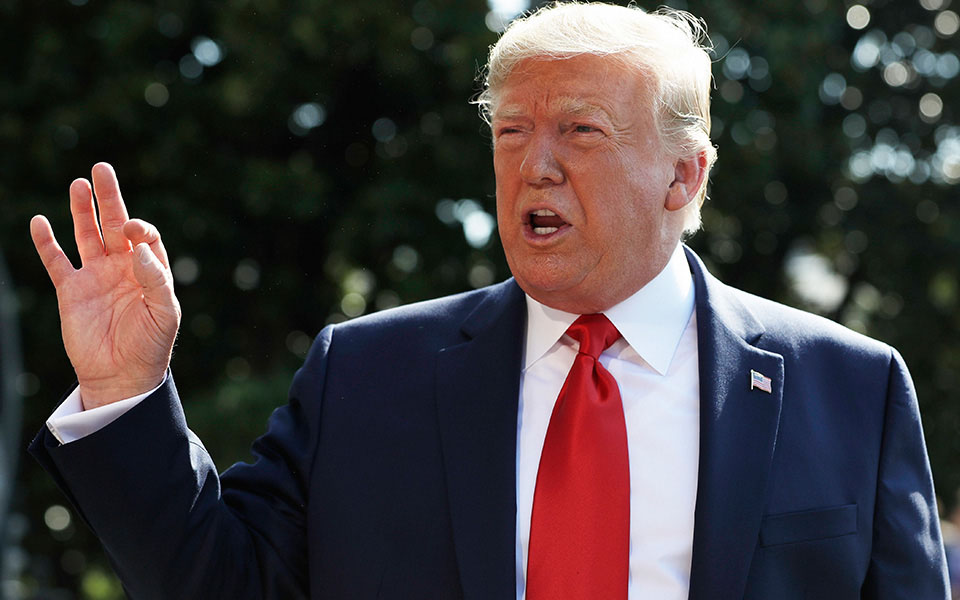
Washington : US President Donald Trump has said he intends to end the preferential trade status granted to India and Turkey, asserting that New Delhi has failed to assure America of "equitable and reasonable" access to its markets, an announcement that could be seen as a major setback to bilateral trade ties.
President Trump notified Congress in letters of his "intent to terminate" trade benefits for both countries under the Generalized System of Preferences (GSP) eligibility criteria.
Under the United States GSP programme, nearly 2,000 products including auto components and textile materials can enter the US duty-free if the beneficiary developing countries meet the eligibility criteria established by Congress.
India was the largest beneficiary of the program in 2017 with USD 5.7 billion in imports to the US given duty-free status and Turkey the fifth largest with USD 1.7 billion in covered imports, according to a Congressional Research Service report issued in January.
In a letter to Speaker of the US House of Representatives Nancy Pelosi, Trump said he was determined that New Delhi had "not assured" the US that it would "provide equitable and reasonable access" to the markets of India.
"I am taking this step because, after intensive engagement between the United States and the Government of India, I have determined that India has not assured the United States that it will provide equitable and reasonable access to the markets of India," Trump said in the letter to congressional leaders on Monday.
"I will continue to assess whether the Government of India is providing equitable and reasonable access to its markets, in accordance with the Generalized System of Preferences (GSP) eligibility criteria," Trump said in his letter, a copy of which was released to the press.
Trump, who has vowed to reduce US trade deficits, has repeatedly called out India for its high tariffs.
Addressing a four-day annual Conservative Political Action Conference (CPAC) in Maryland on Saturday, Trump accused India of being a "high tariff nation" and threatened to impose "a reciprocal tax" to match the heavy duties that New Delhi imposes on goods imported from the United States.
The GSP criteria include, among others, respecting arbitral awards in favour of US citizens or corporations, combatting child labour, respecting internationally recognised worker rights, providing adequate and effective intellectual property protection and providing the US with equitable and reasonable market access.
Countries can also be graduated from the GSP programme, depending on factors related to economic development.
In a separate letter, Trump also informed the Congress of his intent to terminate the GSP beneficiary designation of Turkey.
He said it was primarily because the economy of Turkey had improved a lot in the last four-and-a-half decades.
"In the four-and-a-half decades since Turkey's designation as a GSP beneficiary developing country, Turkey's economy has grown and diversified," he said.
"Increases in Gross National Income per capita, declining poverty rates and export diversification by trading partner and by sector are all evidence of Turkey's increased level of economic development. In addition, Turkey has graduated from other developed countries' GSP programs due to its increase in economic development or through reciprocal arrangements," he argued.
Trump's letter to Pelosi could be seen as a major setback to India-US bilateral relationship, in particular in the arena of trade and economy.
In a separate statement, the US Trade Representative (USTR) said India's termination from GSP followed its failure to provide the US with assurances that it would provide equitable and reasonable access to its markets in numerous sectors.
Turkey's termination from GSP followed a finding that it was sufficiently economically developed and should no longer benefit from preferential market access to the US market, the statement said.
"By statute, these changes may not take effect until at least 60 days after the notifications to Congress and the governments of India and Turkey, and will be enacted by a Presidential Proclamation," the USTR said.
The Trump administration had launched an eligibility review of India's compliance with the GSP market access criterion in April 2018.
"India has implemented a wide array of trade barriers that create serious negative effects on United States commerce. Despite intensive engagement, India has failed to take the necessary steps to meet the GSP criterion," the USTR said.
The US had designated Turkey as a GSP beneficiary developing country in 1975.
An increase in the Gross National Income (GNI) per capita, declining poverty rates and export diversification by trading partner and by sector were evidence of Turkey's higher level of economic development, the USTR said.
The US India Business Council urged the Trump administration to continue GSP benefits for India.
Despite a number of serious bilateral trade issues, both India and the US have gained from trade under the GSP program, it said.
USIBC is in the process of collecting more information from both governments on next steps, including any possible reactions by India, the council said in a late night policy alert.
Let the Truth be known. If you read VB and like VB, please be a VB Supporter and Help us deliver the Truth to one and all.
Centre spent Rs 76.13 lakh on print media ads for RSS centenary, reveals RTI

New Delhi: The Union Ministry of Culture allegedly spent Rs 76.13 lakh on print advertisements marking the 100-year celebrations of the Rashtriya Swayamsevak Sangh (RSS), according to a Right to Information (RTI) reply.
The information was sought by RTI activist Ajay Basudev Bose, who filed an application seeking details on expenditure incurred by the ministry for advertisements commemorating the RSS centenary.
Bose shared a picture of the reply from the ministry on his official ‘X’ handle.
“It is informed that an amount of Rs 76,13,129 has been spent on advertisement given in various print media by the Ministry of Culture on the occasion of the completion of 100 years of RSS,” the government’s reply stated.
RTI reply shows Min of Culture Govt of India spent a Whopping Rs 76L,13K,129 on Advertisement in Print Media on occasion of 100 yrs of #RSS
— AJAY Basudev Bose (@AjayBos93388306) April 16, 2026
When Everyone knows RSS is Not Registered & Does not Pay any Tax is it justified to spend Tax Payers Money on such Private event??@RSSorg… pic.twitter.com/dW4IUtdNCg
Bose questioned the expenditure in the post X, “when Everyone knows RSS is Not Registered & Does not Pay any Tax is it justified to spend Tax Payers Money on such Private event??”
Reacting to the development, Karnataka’s IT-BT and Panchayat Raj Minister Priyank Kharge also criticised the spending.
In a post on X, he asked why public money was being used for what he described as a “private ideological project.”
"Modi Sarkar spent Rs 76,13,129 of public money on newspaper advertisements to celebrate 100 years of the RSS. Why is Government spending taxpayers money on an unregistered, non-tax-paying organisation to celebrate their centenary?," he added.
Why is public money being used to serve a private ideological project?
— Priyank Kharge / ಪ್ರಿಯಾಂಕ್ ಖರ್ಗೆ (@PriyankKharge) April 16, 2026
Modi Sarkar spent ₹76,13,129 of public money on newspaper advertisements to celebrate 100 years of the RSS.
Why is Government spending taxpayers money on an unregistered, non-tax-paying organisation to… pic.twitter.com/EoZ6Pim3IM
According to reports, the RSS describes itself as a volunteer-based organisation and has stated that it functions as a body of individuals rather than a registered entity.
Founded by Keshav Baliram Hedgewar in 1925, the organisation is marking its centenary year beginning from Vijaydashami in 2025, with the milestone observed on October 2.