Trump says Ukraine and Russia are 'closer than ever' to peace after talks with Zelenskyy
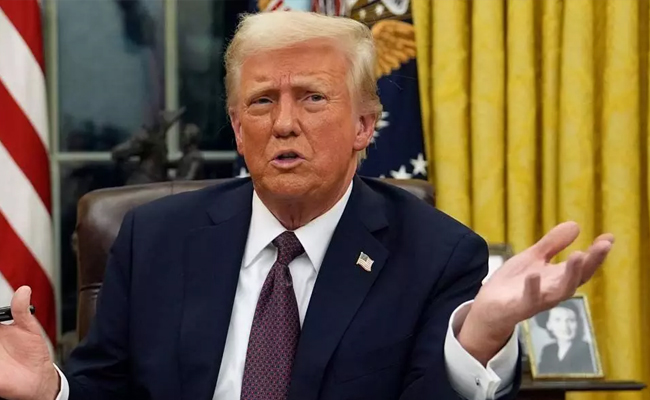
Palm Beach (AP): US President Donald Trump on Sunday insisted Ukraine and Russia are "closer than ever before" to a peace deal as he hosted Ukrainian President Volodymyr Zelenskyy at his Florida resort, but he acknowledged the negotiations are complex and could still break down, leaving the war dragging on for years.
The president's statements came after the leaders met for talks following what Trump said was an "excellent", two-and-a-half-hour phone conversation with Russian President Vladimir Putin, whose invasion of Ukraine launched the war nearly four years ago. Trump insisted he believed Putin still wants peace, even as Russia launched another round of attacks on Ukraine while Zelenskyy flew to the United States for the latest round of negotiations.
"Russia wants to see Ukraine succeed," Trump said during a late afternoon news conference as he stood with Zelenskyy after their meeting. He repeatedly praised his counterpart as "brave".
Trump and Zelenskyy both acknowledged thorny issues remain, including whether Russia can keep Ukrainian territory it controls, as well as security guarantees for Ukraine to ensure it is not invaded again in the future. After their discussion, they called a wide group of European leaders, including Ursula von der Leyen, president of the European Commission, and the leaders of Finland, France, Germany, the United Kingdom and Poland.
Zelenskyy said Trump had agreed to host European leaders again, possibly at the White House, sometime in January. Trump said the meeting could be in Washington or "someplace".
Zelenskyy thanked Trump for his work. "Ukraine is ready for peace," he said.
Trump and Putin will speak again
Trump said he would follow the meeting with another call to Putin. Earlier on Sunday, Putin's foreign affairs adviser Yuri Ushakov said the Trump-Putin call was initiated by the US side and was "friendly, benevolent and businesslike". Ushakov said Trump and Putin agreed to speak again "promptly" after Trump's meeting with Zelenskyy.
But Ushakov added that a "bold, responsible, political decision is needed from Kyiv" on the fiercely-contested Donbas region in eastern Ukraine and other matters in dispute for there to be a "complete cessation" of hostilities.
Both leaders identified deciding the future of the Donbas region as a major sticking point.
Trump said the parties were inching closer to agreement. "That's a very tough issue but one that I think will get resolved," he said.
Zelenskyy said: "Our attitude is very clear. That's why President Trump said this is a very tough question and, of course, we have with Russia different positions on it."
Trump said, however, that he still believes Putin is "very serious" about ending the war, even as Russia continued striking targets in Ukraine as Zelenskyy travelled to the US. Trump said, "I believe Ukraine has made some very strong attacks also."
He held out the possibility that negotiations could still fall apart.
"In a few weeks, we will know one way or the other, I think," Trump said. "We could have something where one item that you're not thinking about is a big item, breaks it up. Look, it's been a very difficult negotiation. Very detailed."
Trump and Zelenskyy's sit-down underscored the apparent progress made by Trump's top negotiators in recent weeks as the sides traded draft peace plans to end the fighting. Zelenskyy told reporters on Friday that the 20-point draft proposal negotiators have discussed is "about 90 per cent ready" -- echoing a figure, and the optimism, that US officials conveyed when Trump's chief negotiators met with Zelenskyy in Berlin this month.
During the recent talks, the US agreed to offer certain security guarantees to Ukraine, similar to those offered to other members of NATO. The proposal came as Zelenskyy said he was prepared to drop his country's bid to join the security alliance if Ukraine received NATO-like protection that would be designed to safeguard it against future Russian attacks.
'Intensive' weeks ahead
Zelenskyy also spoke on Christmas Day with US special envoy Steve Witkoff and Jared Kushner, Trump's son-in-law. The Ukrainian leader said they discussed "certain substantive details" and cautioned "there is still work to be done on sensitive issues" and "the weeks ahead may also be intensive".
The US president has been working to end the war in Ukraine for much of his first year back in office, showing irritation with both Zelenskyy and Putin, while publicly acknowledging the difficulty of ending the conflict. Gone are the days when, as a candidate in 2024, he boasted that he could resolve the fighting in a day. Indeed, on Sunday, Trump referred multiple times to the complexity of the negotiations.
After hosting Zelenskyy at the White House in October, Trump demanded that both Russia and Ukraine halt fighting and "stop at the battle line", implying that Moscow should be able to keep the territory it has seized from Ukraine.
Zelenskyy said last week that he would be willing to withdraw troops from Ukraine's eastern industrial heartland as part of a plan to end the war, if Russia also pulls back and the area becomes a demilitarised zone monitored by international forces.
Putin wants Russian gains kept, and more
Putin has publicly said he wants all the areas in four key regions that have been captured by his forces, as well as the Crimean Peninsula, illegally annexed in 2014, to be recognised as Russian territory. He also has insisted that Ukraine withdraw from some areas in eastern Ukraine that Moscow's forces have not captured. Kyiv has publicly rejected all those demands.
The Kremlin also wants Ukraine to abandon its bid to join NATO. It warned that it would not accept the deployment of any troops from members of the military alliance and would view them as a "legitimate target".
Putin also has said Ukraine must limit the size of its army and give official status to the Russian language, demands he has made from the outset of the conflict.
Ushakov told the business daily "Kommersant" this month that Russian police and national guard would stay in parts of Donetsk -- one of the two major areas, along with Luhansk, that make up the Donbas region -- even if they become a demilitarised zone under a prospective peace plan.
Ushakov cautioned that trying to reach a compromise could take a long time. He said US proposals that took into account Russian demands had been "worsened" by alterations proposed by Ukraine and its European allies.
Trump has been somewhat receptive to Putin's demands, arguing that the Russian president can be persuaded to end the war if Kyiv agrees to cede Ukrainian land in the Donbas region and if Western powers offer economic incentives to bring Russia back into the global economy.
Let the Truth be known. If you read VB and like VB, please be a VB Supporter and Help us deliver the Truth to one and all.
Advocate found dead in car on Nainital court premises
Nainital (PTI): A 55-year-old advocate allegedly died by suicide after shooting himself inside his car at the Nainital district court parking lot here on Monday, police said.
According to the police, Puran Singh Bhakuni, a resident of Mallital, was found in the rear seat of his vehicle with a gunshot wound to his temple.
Police recovered a licensed pistol from his hand and a suicide note from the car’s dashboard. The note stated that Bhakuni was unwell and suffering from depression.
"We received information through lawyers around noon. The deceased was lying in the back seat with a pistol in his hand and blood near his ear," Circle Officer Anjana Negi said.
Forensic teams and ballistic experts reached the spot to collect evidence, as no witness reported hearing the gunshot.
Government counsel Sushil Sharma stated that Bhakuni left home at 9 am and was found dead at 9.30 am.
Sharma raised concerns over the circumstances, noting that the body was in the rear seat, and demanded a thorough probe to rule out foul play. Bhakuni, who worked as a notary, had married six months ago, he said.
Police took the body into custody and sent it for a postmortem to confirm the cause of death.
The forensic laboratory will examine the suicide note and the ballistics of the weapon, the police said, adding that the investigation is ongoing.