Trump to join Modi in Houston to address 50,000 Indian-Americans: White House
Washington: President Donald Trump and Prime Minister Narendra Modi will jointly address over 50,000 Indian-Americans at the mega "Howdy, Modi!" event in Houston on Sunday, which officials say is an "unprecedented" occasion, reflective of the strong bonds of friendship and cooperation between India and the US.
Emphasising the new bonhomie in the India-US ties under the Trump administration, this is for the first time in recent history that the leaders of the two largest democracies would be addressing a joint rally anywhere in the world.
More than 50,000 Indian-Americans from across the US have registered for the September 22 mega "Howdy, Modi! Shared Dreams, Bright Futures" event to be held at the sprawling NRG Stadium in Houston.
In a statement, White House Press Secretary Stephanie Grisham said, "It (Modi-Trump joint rally) will be a great opportunity to emphasise the strong ties between the people of the US and India, to reaffirm the strategic partnership between the world's oldest and largest democracies, and to discuss ways to deepen their energy and trade relationship."
This would also be the first time that an American president would be addressing thousands of Indian-Americans at one place in the US. India's Ambassador to the US, Harsh Vardhan Shringla called Trump's participation in the "Howdy, Modi!" event "historic" and "unprecedented".
"It is reflective of the strong bonds of friendship and cooperation that has developed between India and the US," Shringla told PTI.
He said it was also reflective of the people-to-people contact that provides the "organic" linkage between the two countries. The ambassador said the two leaders addressing the event sets a bold precedent, which is unconventional and unique."It would be quite a historic meeting with Prime Minister Modi and President Trump jointly addressing over 50,000 Indian-Americans, mainly US citizens," Shringla said.
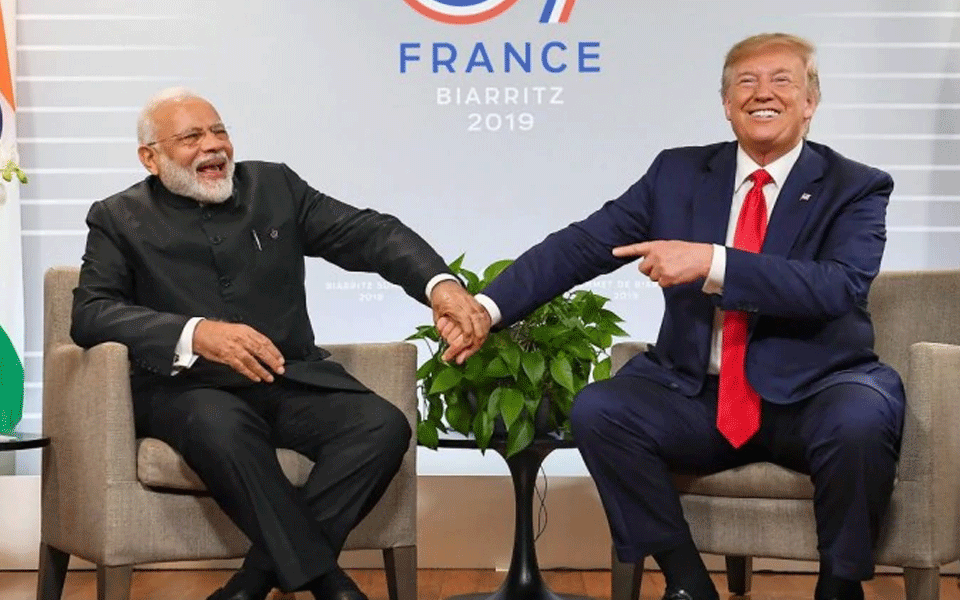
White House officials told PTI that a request for the joint address was made by Prime Minister Modi to President Trump when the two met in France last month on the sidelines of the G7 summit.
While India is not part of the G7 countries, Modi was invited as a special guest by French President Emanuel Macron for the summit. Trump, who enjoys a great chemistry and friendship with Modi, "immediately accepted" the invitation to join him in Houston and directed his officials and secret service to make arrangements, officials said.
This would be the third meeting between the two leaders this year. The previous two were on the sidelines of the G20 Summit in June in Japan and in France in July on the sidelines of the G7 Summit.
In October 2016, Trump, then as Republican presidential nominee, had addressed a strong crowd of some 5,000 Indian-Americans in New Jersey, a few weeks away from his historic win in the November 2016 elections.
So far, Trump is the only presidential candidate to address the Indian-Americans solely during an election year.In his address, Trump had said that if elected, he would be the best friend of India in the White House.
The Houston event will be Modi's third major address to the Indian-American community after he became the prime minister in 2014 and the first after his re-election in May.
The previous two were at the Madison Square Garden in New York in 2014 and the Silicon Valley in 2016. Both the events were attended by more than 20,000 people.The "Howdy, Modi!" event is being organised by non-profit Texas India Forum, a recently-formed representative body of hundreds of Indian-American organisations in Texas and other parts of the US.
"Howdy", short form of 'How do you do?', is a friendly greeting commonly used in southwestern United States. Senior Democratic Congressman Steny Hoyer would also join Prime Minister Modi and President Trump for the "Howdy, Modi!" event.
Let the Truth be known. If you read VB and like VB, please be a VB Supporter and Help us deliver the Truth to one and all.
AIITA welcomes Karnataka’s ban on obscene songs in school events
Bhatkal: The Karnataka unit of the All India Ideal Teachers Association (AIITA) has welcomed the Karnataka government’s decision to strictly ban school children from dancing to obscene songs during educational and cultural programmes in government, aided, and private schools across the state.
AIITA Karnataka State President M. R. Manvi congratulated the government for taking what he termed an important step to preserve the sanctity of education.
“Such decisions to safeguard the dignity of school children and uphold the values of education are the need of the hour. This rule should not be limited to government schools alone but must be strictly implemented in all private educational institutions as well,” he said.
He further urged the government to address other concerns within school programmes.
“The government should not only prohibit obscene dances in the name of school anniversaries, but also ensure that plays and dialogues that incite religious hatred are avoided. Schools should be centres of harmony, not platforms for spreading hatred,” he added.
According to a recent circular issued by the Department of School Education and Literacy, obscene dances are adversely affecting the mental health and moral values of students.
In this regard, schools have been advised to use songs that promote nationalism, positive thinking, the greatness of Kannada culture, and value-based traditions instead of inappropriate content during programmes.
The circular also emphasises that students should be dressed in decent attire.
AIITA also backed the department’s warning that disciplinary action would be taken against head teachers if such guidelines are violated. The association has further demanded that district Deputy Directors of Public Instruction strictly monitor the implementation of these rules.