US lawmakers seek access of foreign journalists, congressmen to Kashmir, writes to Indian envoy
Washington: Seeking free access of foreign journalists and congressmen to Kashmir, six American lawmakers have written to Indian Ambassador to the US Harsh Vardhan Shringla, claiming that the picture portrayed by India in the Valley is different from the one being told to them by their constituents.
The lawmakers' letter to Shringla comes as the US on Thursday sought from India a "roadmap" to political and economic normalcy in Kashmir and immediate release of all political detainees.
Noting that journalists have extensively covered developments in Kashmir, acting Assistant Secretary of State for South and Central Asia Alice G Wells had said the role of some of the international reporters have been particularly important, but journalists continue to face challenges in access while reporting due to the security restrictions.
We believe true transparency can only be achieved when journalists and Members of Congress are allowed free access to the region. We encourage India to open Jammu and Kashmir to both domestic and foreign journalists, and other international visitors, in the interest of open media and increased communication, the congressmen said in the letter.
The lawmakers David N Cicilline, Dina Titus, Chrissy Houlahan, Andy Levin, James P McGovern and Susan Wild in their letter dated October 24 said their questions were a follow up to the briefing given to them by Shringla on October 16 about the situation in Kashmir.
As was discussed during the meeting, many of our constituents have painted a much different picture of the situation than what you shared with us. They have raised concerns about the repeal of Article 370 of the Indian Constitution, as well as suspended internet and telecommunications access, arrests of local politicians and activists, and the imposition of a curfew, the congressmen said.
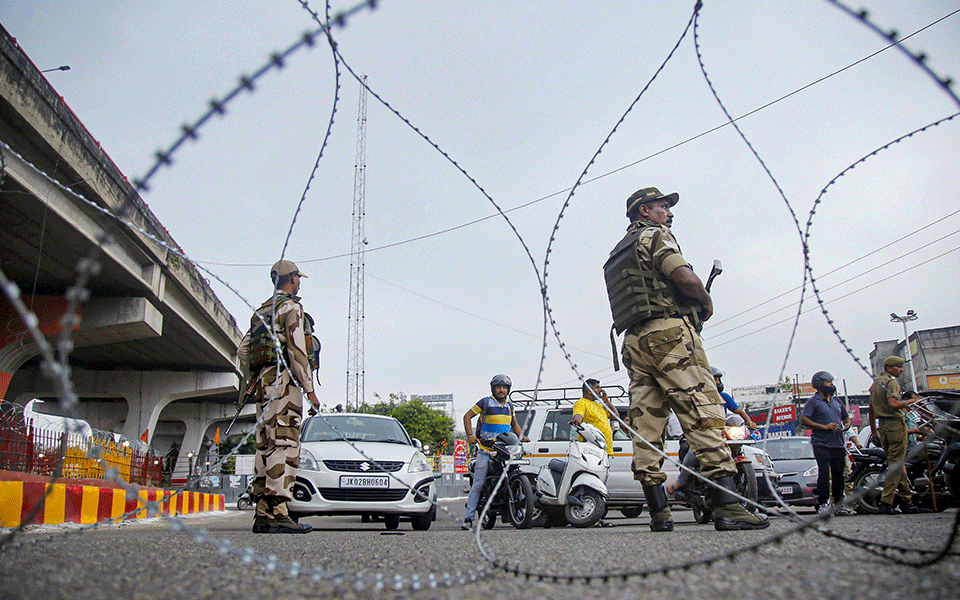
On August 5, India withdrew the special status of Jammu and Kashmir and bifurcated it into two Union Territories. Several security restrictions were imposed in Kashmir as well as Jammu following the decision.
India has defended its decision to abrogate provisions of Article 370 that gave special status to Jammu and Kashmir and the subsequent restrictions in the state with authorities saying the ban on communication services in the Valley has helped save lives. The have also denied there was any shortage of medicines and essential supplies in the region.
The internet services in the Valley were snapped along with mobile and landline telephone services. While the landline services were restored gradually first, the postpaid mobile services were restored only last week. The prepaid services continued to remain barred.
In the letter written two days after a Congressional hearing on human rights situation in South Asia, with focus on Kashmir, the congressmen asked a set of six specific questions to Shringla.
During the briefing, the Ambassador had said that he is available to answer any of their questions on Kashmir.
Has 100 per cent of landline service been restored inside Jammu and Kashmir, or are there any remaining outages? When will all mobile phone service be restored, including for those who use prepaid mobile phones? When will full internet access be restored (not just access at kiosks)? they asked.
The letter also asked about the number of people detained under the Public Safety Act or other legal provisions since August 5 and asked Shringla to be as specific as possible.
Of those, how many are minors? What is the standard judicial procedure for someone detained under the Public Safety Act? they asked.
What is the status of the curfews that have been imposed in Jammu and Kashmir? What are the government's plans to allow residents to return to uninhibited movement? When can we expect that? the congressmen asked Shringla.
They also asked the Indian envoy to lay out the reasons that foreign journalists are still not allowed inside Jammu and Kashmir. When will they be allowed to enter the region?
Will the Indian Government welcome visiting members of the United States Congress or other foreign officials who wish to visit Jammu and Kashmir? the lawmakers asked.
Let the Truth be known. If you read VB and like VB, please be a VB Supporter and Help us deliver the Truth to one and all.
AIITA welcomes Karnataka’s ban on obscene songs in school events
Bhatkal: The Karnataka unit of the All India Ideal Teachers Association (AIITA) has welcomed the Karnataka government’s decision to strictly ban school children from dancing to obscene songs during educational and cultural programmes in government, aided, and private schools across the state.
AIITA Karnataka State President M. R. Manvi congratulated the government for taking what he termed an important step to preserve the sanctity of education.
“Such decisions to safeguard the dignity of school children and uphold the values of education are the need of the hour. This rule should not be limited to government schools alone but must be strictly implemented in all private educational institutions as well,” he said.
He further urged the government to address other concerns within school programmes.
“The government should not only prohibit obscene dances in the name of school anniversaries, but also ensure that plays and dialogues that incite religious hatred are avoided. Schools should be centres of harmony, not platforms for spreading hatred,” he added.
According to a recent circular issued by the Department of School Education and Literacy, obscene dances are adversely affecting the mental health and moral values of students.
In this regard, schools have been advised to use songs that promote nationalism, positive thinking, the greatness of Kannada culture, and value-based traditions instead of inappropriate content during programmes.
The circular also emphasises that students should be dressed in decent attire.
AIITA also backed the department’s warning that disciplinary action would be taken against head teachers if such guidelines are violated. The association has further demanded that district Deputy Directors of Public Instruction strictly monitor the implementation of these rules.