US will take on challenges posed by China directly: Joe Biden
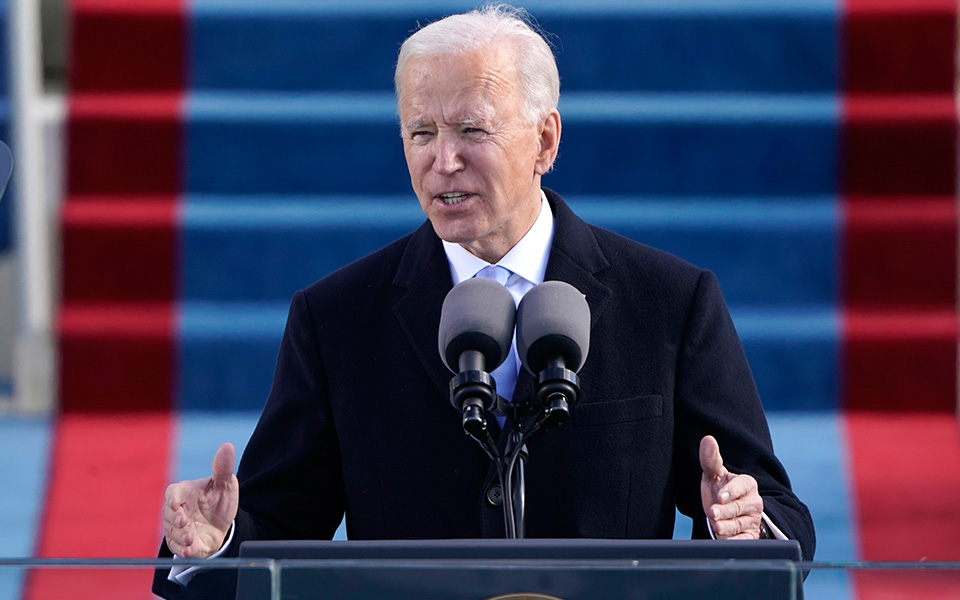
Washington: The United States will take on the challenges being posed by China directly, but will not hesitate to work with Beijing when it is in America's interest to do so, President Joe Biden said on Thursday.
"We will confront China's economic abuses, counter its aggressive, coercive action to push back on China's attack on human rights, intellectual property and global governance," Biden said in his address to State Department employees at its Foggy Bottom headquarters here.
"But we are ready to work with Beijing when it is in America's interest to do so. We will compete from a position of strength by building back better at home, working with our allies and partners, renewing our role in international institutions, and reclaiming our credibility and moral authority, much of which has been lost," he said, giving the glimpse of his administration's policies on China.
"That is why we have moved quickly to begin restoring American engagement internationally and earn back our leadership position to catalyse global action on shared challenges," Biden said.
Earlier in the day, National Security Advisor Jake Sullivan told reporters that their priority is not to get access for Goldman Sachs in China. "Our priority is to make sure that we are dealing with China's trade abuses that are harming American jobs and American workers in the United States," he said.
The Biden administration believes that once the US establishes its position of strength, it will be able to compete more effectively with its competitors across the board and especially with China in every domain, including economic, diplomatic, technological and security.
"We will be able to counter Russia more effectively and we will be better equipped to address threats from climate change, to pandemics, to nuclear proliferation. We will also be able to more effectively pursue a foreign policy for the middle class. This is not just a tagline, it is an organising principle for the work that we will do," Biden said.
In a letter to Defense Secretary Lloyd Austin, Senator Rick Scott underscored that the threat of communist China must be a top priority for Pentagon.
"As the United States faces increasingly frequent and dangerous threats from adversaries across the globe -- namely communist China, Iran, Russia and North Korea -- there has never been a more important time to ensure that our men and women in uniform have every resource they need to stand strong and combat threats to our freedoms and interests," he said.
"Communist China is undoubtedly our greatest enemy and must be treated as such. The Chinese Communist Party's (CCP) policy of genocide against the Uyghurs, theft of American technology and dangerous actions to build its military presence and threaten the security of the United States and its allies cannot be tolerated," Scott wrote to Austin.
Encouraged by the defense secretary's candour regarding the threat communist China poses to nations around the world, Scott urged Austin to take the strongest possible position to ensure that the Biden administration places accountability and strength at the top of its policy agenda.
"We cannot forget, when the reckless actions of communist China adversely impact our allies, especially those in the Indo-Pacific region including Japan, South Korea, Vietnam, Indonesia, the Philippines, Singapore, India or Taiwan, they also threaten the safety and security of the United States," he said.
Meanwhile, Congressman Brad Wenstrup led 45 lawmakers in writing to Secretary of State Antony Blinken and Sullivan regarding the CCP's coercive population control efforts and grave human rights abuses in the Xinjiang Uyghur Autonomous Region.
"There is little doubt that China poses one of the most significant challenges to the United States going forward. As part of the administration's effort to confront this challenge, we urge you to prioritise holding the Chinese government accountable for the ongoing genocide in Xinjiang and stand up for the rights to life, human dignity and religious freedom for all people," the members wrote.
Let the Truth be known. If you read VB and like VB, please be a VB Supporter and Help us deliver the Truth to one and all.
Austrian police detain suspect in case of rat poison found in baby food jars on supermarket shelves

Vienna (AP): Police in eastern Austria say a 39-year-old suspect has been arrested after rat poison turned up in some HiPP baby food jars on supermarket shelves in central Europe.
HiPP, which recalled some of its baby food jars in Austria, Slovakia and the Czech Republic after the case came to light last month, said in a statement Saturday it was “greatly relieved” by the arrest, and would provide further updates as verified details come in.
The Burgenland State Criminal Police Office, under the direction of prosecutors, said a probe was launched after poison turned up in a baby food jar purchased at a supermarket in the city of Eisenstadt on April 18.
It said the suspect was being questioned, and that no further details would be immediately provided. The Burgenland public prosecutor's office has announced an investigation into suspected “intentional endangerment of the public.”
The Austrian Press Agency reported that an expert report on the toxicity of the poison was pending. A total of five tampered baby food jars were seized before they could be consumed, APA reported.
Authorities said previously they believe the tampering occurred in 190-gram (6.7-ounce) jars of baby food made with carrots and potatoes for 5-month-olds that were sold from SPAR supermarkets in Austria.
HiPP responded by recalling all of its baby food jars sold at SPAR supermarkets — which include SPAR, EUROSPAR, INTERSPAR and Maximarkt stores — in Austria as a precaution. Vendors in Slovakia and the Czech Republic also removed all of the brand's baby jars from sale.
The company said the recall was not due to any product or quality defect on its part, and said the jars left its facility in “perfect condition.”
Police said a customer at the time of the discovery had reported that a jar appeared to have been tampered with, but no one had consumed the baby food.