Violent protests in France over Macron's retirement age push
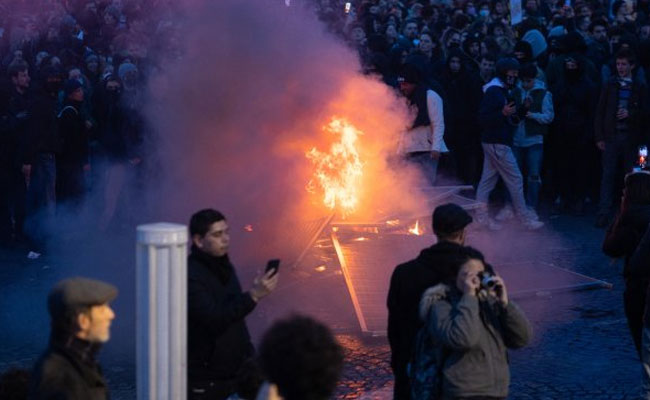
Paris, Mar 18 (AP) Angry protesters took to the streets in Paris and other cities for a second day on Friday, trying to pressure lawmakers to bring down French President Emmanuel Macron's government and doom the unpopular retirement age increase he's trying to impose without a vote in the National Assembly.
A day after Prime Minister Elisabeth Borne invoked a special constitutional power to skirt a vote in the chaotic lower chamber, lawmakers on the right and left filed no-confidence motions to be voted on Monday.
At the elegant Place de Concorde, a festive protest by several thousand, with chants, dancing and a huge bonfire, degenerated into a scene echoing the night before. Riot police charged and threw tear gas to empty the huge square across from the National Assembly after troublemakers climbed scaffolding on a renovation site, arming themselves with wood. They lobbed fireworks and paving stones at police in a standoff.
On Thursday night, security forces charged and used water cannons to evacuate the area, and small groups then set street fires in chic neighbourhoods nearby. French Interior Minister G rald Darmanin told radio station RTL that 310 people were arrested overnight, most of them in Paris.
Mostly small, scattered protests were held in cities around France, from a march in Bordeaux to a rally in Toulouse. Port officers in Calais temporarily stopped ferries from crossing the English Channel to Dover. Some university campuses in Paris were blocked and protesters occupied a high-traffic ring road around the French capital.
Paris garbage collectors extended their strike for a 12th day, with piles of foul-smelling rubbish growing daily in the French capital. Striking sanitation workers continued to block Europe's largest incineration site and two other sites that treat Paris garbage.
Some yellow vest activists, who mounted formidable protests against Macron's economic policies during his first term, were among those who relayed Friday's Paris protest on social media. Police say that "radicalised yellow vests" are among troublemakers at protest marches.
Trade unions organising the opposition urged demonstrators to remain peaceful during more strikes and marches in the days ahead. They have called on people to leave schools, factories, refineries and other workplaces to force Macron to abandon his plan to make the French to work two more years, until 64, before receiving a full pension.
Macron took a calculated risk ordering Borne to invoke a special constitutional power that she had used 10 times before without triggering such an outpouring of anger.
If the no-confidence votes fail, the bill becomes law. If a majority agrees, it would spell the end of the retirement reform plan and force the government to resign, although Macron could always reappoint Borne to name the new Cabinet.
"We are not going to stop," CGT union representative R gis Vieceli told The Associated Press on Friday. He said overwhelming the streets with discontent and refusing to continue working is "the only way that we will get them to back down."
Macron has made the proposed pension changes the key priority of his second term, arguing that reform is needed to make the French economy more competitive and to keep the pension system from diving into deficit. France, like many richer nations, faces lower birth rates and longer life expectancy.
Macron's conservative allies in the Senate passed the bill, but frantic counts of lower-house lawmakers Thursday showed a slight risk it would fall short of a majority, so Macron decided to invoke the constitution's Article 49-3 to bypass a vote.
Getting a no-confidence motion to pass will be challenging none have succeeded since 1962, and Macron's centrist alliance still has the most seats in the National Assembly. A minority of conservatives could stray from the Republican party line, but it remains to be seen whether they're willing to bring down Macron's government.
BREAKING: After French President Emmanuel Macron decided to raise the retirement age from 62 to 64, the French took to the streets rioting and protesting to show their displeasure.
— Ed Krassenstein (@EdKrassen) March 17, 2023
This also happens to be the Republican’s plan in the United States. They want to raise the age… https://t.co/pio5XNDHWH pic.twitter.com/txArOFVVN8
BREAKING: After French President Emmanuel Macron decided to raise the retirement age from 62 to 64, the French took to the streets rioting and protesting to show their displeasure.
— Ed Krassenstein (@EdKrassen) March 17, 2023
This also happens to be the Republican’s plan in the United States. They want to raise the age… https://t.co/pio5XNDHWH pic.twitter.com/txArOFVVN8
Unions blocked the main Paris ring road as they stepped up protests against President Macron’s plan to raise the retirement age.
— The Times and The Sunday Times (@thetimes) March 17, 2023
🔗 Read more: https://t.co/5tKTQjn2so pic.twitter.com/QLXid0jQ90
Let the Truth be known. If you read VB and like VB, please be a VB Supporter and Help us deliver the Truth to one and all.
T'gana RTC strike: Talks between govt, employees successful

Hyderabad (PTI): Talks between employees of Telangana State Road Transport Corporation (RTC) who were on strike and the state government concluded successfully on Friday as the government agreed to the key demands of the workmen.
Following a day-long marathon of talks between the leaders of the employees' Joint Action Committee (JAC) and the cabinet sub-committee, the government announced after midnight that it acceded to the demands, including a merger of RTC with the government, 11 per cent pay revision and elections to the employees' unions.
A committee comprising officials and employee leaders would be appointed over the merger of RTC with the government, it said.
The RTC management has also agreed to address the remaining issues as well, an official release said.
The employees would call off their strike and the RTC buses would hit the roads shortly, it said.
The employees had been on an indefinite strike since April 22 over a series of demands, including the merger of RTC with the government.
Earlier in the day, a driver of the RTC, who attempted suicide on April 23 during the strike, died at a hospital here in the early hours of Friday.
Shankar Goud, a 55-year-old driver, set himself ablaze by pouring petrol at Narsampet in Warangal district when the employees were staging a protest on Thursday in support of their demands.
Goud suffered serious burns, was initially admitted to a state-run hospital in Warangal, and later shifted to a super-speciality hospital in Hyderabad for advanced treatment.
"He succumbed (to injuries) at about 1.30 am on Friday," a senior official said.
The driver’s body was taken to his relative’s village, Muttojipet in Warangal district, for funeral rites.
Tension prevailed in Muttojipet as his family members and RTC employees attempted to take the body to the Narsampet bus station, where he worked, to enable his colleagues to pay their last respects. However, police did not permit this, citing law-and-order concerns.
This led to a deadlock before the funeral could proceed.
Union Minister Bandi Sanjay Kumar criticised the Telangana government for not allowing the body to be taken to the Narsampet bus station.
Kumar, Minister of State (Home), visited Muttojipet village in Warangal district, where the funeral was held, and paid homage to Goud.
“They (family members) want to take the body to the bus depot for five minutes. Is the RTC bus depot in Pakistan or Bangladesh? They are emotionally attached to taking the body there. The government is hurting sentiments and creating fear among RTC employees,” Kumar told reporters.
He also expressed anger at the police for not allowing the body to be taken to the bus station and staged a protest, according to a release from his office.
RTC employees and BJP workers attempted to take the mortal remains in an ambulance to Narsampet, but were stopped by the police.
Later, after discussions with the police, the family members and RTC employees agreed to conduct the funeral in the village.
Sanjay Kumar, stating he would abide by the family’s decision, left the village after the funeral was conducted there.
Transport Minister Ponnam Prabhakar said an ex gratia of Rs 10 lakh, a house, and a government job would be provided to the kin of Goud.
Chief Minister A Revanth Reddy expressed shock over the employee’s death and conveyed deep condolences to the grieving family, according to the release.
The RTC employees’ JAC had earlier announced an agitation programme from April 24 to 29, including silent marches and submission of memorandums to MLAs and other leaders.