Amit Shah calls meeting to discuss future action on Indus Waters Treaty abeyance
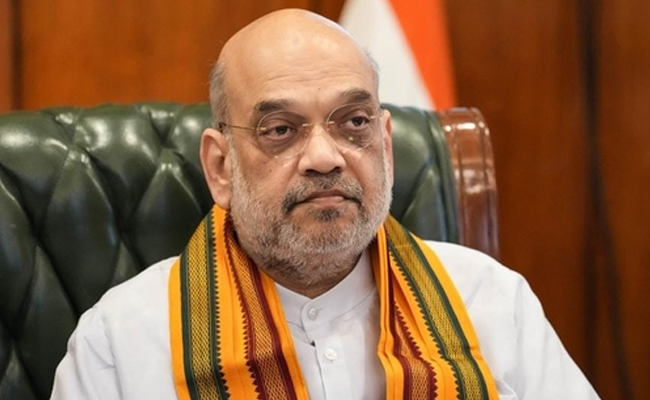
New Delhi (PTI): Union Home Minister Amit Shah will hold a key meeting on Friday to discuss the future course of action on the Indus Waters Treaty of 1960 with Pakistan, which has been kept in abeyance, sources said.
Union Jal Shakti Minister C R Paatil and senior officials of several ministries will take part in the meeting, sources said.
The meeting is expected to discuss the future course of action and how to implement the decision of keeping the treaty in abeyance, they said.
India has already informed Pakistan of its decision to keep the Indus Waters Treaty in abeyance with immediate effect, saying Pakistan has breached its conditions.
India's Water Resources Secretary Debashree Mukherjee said in a letter addressed to her Pakistani counterpart, Syed Ali Murtaza, that sustained cross-border terrorism by Pakistan targeting Jammu and Kashmir impedes India's rights under the Indus Waters Treaty.
"The obligation to honour a treaty in good faith is fundamental to a treaty. However, what we have seen instead is sustained cross-border terrorism by Pakistan targeting the Indian Union Territory of Jammu and Kashmir," the letter read.
India's decision to suspend the decades-old treaty follows the killing of 26 people, mostly tourists, in a terror attack in Jammu and Kashmir's Pahalgam on Tuesday.
"The resulting security uncertainties have directly impeded India's full utilisation of its rights under the treaty," the letter read.
The communication to Pakistan also highlighted "significantly altered population demographics, the need to accelerate the development of clean energy, and other changes" as reasons necessitating a re-assessment of the treaty's obligations.
To give effect to the decision, the government has also formally issued a notification to suspend the Indus Water Treaty.
The treaty brokered by the World Bank has governed the distribution and use of the Indus river and its tributaries between India and Pakistan since 1960.
The Indus river system comprises the main river, the Indus, and its tributaries. The Ravi, Beas, Sutlej, Jhelum and Chenab are its left-bank tributaries, while the Kabul river, a right-bank tributary, does not flow through Indian territory.
The Ravi, Beas and Sutlej are collectively referred to as the eastern rivers, while the Indus, Jhelum and Chenab are known as the western rivers.
The water of this river system are crucial to both India and Pakistan.
At the time of Independence, the boundary demarcation between the two newly-formed nations -- India and Pakistan -- cut through the Indus Basin, leaving India as the upper riparian and Pakistan as the lower riparian state.
Two key irrigation works -- one at Madhopur on the Ravi and another at Ferozepur on the Sutlej -- on which Punjab on Pakistan's side was entirely dependent, ended up within the Indian territory.
This led to a dispute between the two countries over the utilisation of irrigation water from the existing infrastructure.
Following negotiations facilitated by the International Bank for Reconstruction and Development (now part of the World Bank Group), the Indus Waters Treaty was signed in 1960.
Under the treaty, India was granted exclusive rights to the water of the eastern rivers-- the Sutlej, Beas, and Ravi -- amounting to an average annual flow of about 33 million acre-feet (MAF).
The water of the western rivers -- Indus, Jhelum and Chenab -- amounting to an average annual flow of around 135 MAF was largely allocated to Pakistan.
However, the treaty allowed India to utilise the water of the western rivers for domestic needs, non-consumptive uses, agriculture and hydroelectric power generation.
On Wednesday, India announced a barrage of measures against Pakistan, including the suspension of the Indus Waters Treaty, expulsion of Pakistani military attaches and the immediate shutting down of the Attari land-transit post.
Pakistan has rejected India's suspension of the treaty and said any measures to stop the flow of water "belonging to Pakistan" under the pact will be seen as an "act of war".
Let the Truth be known. If you read VB and like VB, please be a VB Supporter and Help us deliver the Truth to one and all.
Samson's unbeaten 87 powers CSK to eight-wicket win over DC

New Delhi (PTI): Sanju Samson bossed the chase with authority, anchoring a modest 156-run target with a fluent 87 not out as Chennai Super Kings outclassed Delhi Capitals by eight wickets in the IPL here on Tuesday.
Samson's knock came off just 52 balls with seven fours and six sixes, batting through the innings as CSK completed the chase in just 17.3 overs giving a huge boost to their net run-rate.
Electing to bat on a tricky surface, Delhi Capitals were restricted to 155/7.
West Indies left-arm spinner Akeal Hosein set the tone with the new ball, returning tidy figures of 1/19, including 14 dot balls.
Reduced to 69/5 in 11 overs, Delhi found some late impetus through Tristan Stubbs (38; 31 balls) and Sameer Rizvi (40 not out; 24 balls), who stitched together a crucial 65-run (off 47 balls) stand to give the innings a respectable total.
Brief Scores:
Delhi Capitals: 155 for 7 in 20 overs (Tristan Stubbs 38, Sameer Rizvi 40 not out; Noor Ahmed 2/22)
Chennai Super Kings 159 for two in 17.3 overs (Sanju Samson 87 not out, Kartik Sharma 41 not out). CSK win by eight wickets.