Cases pertaining to Rs 6.85 lakh crore pending in tax tribunal, says CJI Gavai
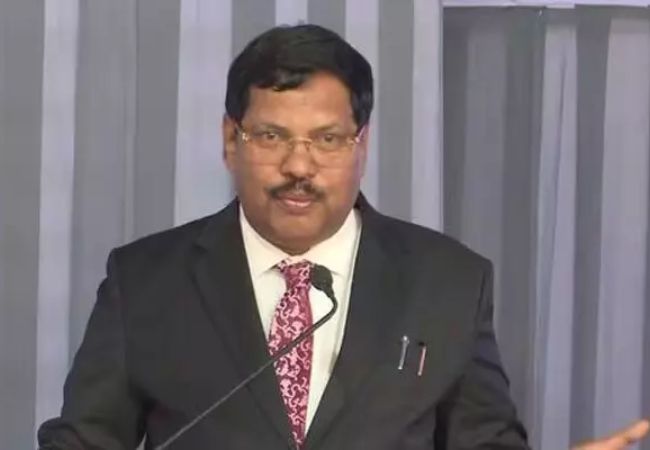
New Delhi (PTI): Terming huge pendency as a "major problem" with the courts and the tribunals, Chief Justice of India B R Gavai on Wednesday said the disputes pertaining to whopping Rs 6.85 lakh crore are still pending considerations before the Income Tax Appellate Tribunal (ITAT).
The CJI was speaking at a symposium titled 'Income Tax Appellate Tribunal (ITAT) -- Role, Challenges and Way Forward' and a felicitation ceremony held here.
Justice Gavai, however, praised ITAT for bringing down the pendency of cases from 85,000 to 24,000 in the last five years.
"A major problem as is with the courts as well as the other tribunals is with regard to huge pendency. I am happy to note that as Shri Bhadang (ITAT head) said that in last five years they have brought down the pendency from 85,000 to 24,000.
"I must congratulate all the members of the ITAT as well as the members of the Bar because without the cooperation of the Bar this could not have been possible for achieving such great achievement. However, still the matters involving disputes that you know is of Rs 6.85 lakh crore which amounts to more than 2 per cent of India's GDP still lie for consideration before the Tribunal," he said.
Justice Gavai praised the Tribunal for its significant contribution to the justice delivery system while urging renewed focus on structural and procedural improvements to meet contemporary challenges.
He underscored the need for comprehensive reforms and modernisation of the ITAT, emphasising transparency in appointments, consistency in decisions and investment in capacity-building to strengthen the institution's credibility and efficiency.
"The way forward, in my view, must be comprehensive. Reform should address the issues of appointments, tenure, training, case management and technology as interconnected components of an institutional ecosystem, rather than treating them as isolated policy measures," he said.
The event was attended by dignitaries including Law Minister Arjun Ram Meghwal and ITAT President Justice C V Bhadang.
"The ITAT continues to navigate the intricate interplay between law and finance while delivering timely and informed decisions," the CJI said, adding that its work provides a vital layer of scrutiny that supports the broader judicial system.
"We must examine the ITAT with gratitude for its achievements and with a critical willingness to address its structural challenges," he said.
The CJI identified conflicting rulings as another significant concern, warning that inconsistencies in judgments could erode public trust and legal certainty.
"When courts and tribunals provide consistent,reasoned and predictable decisions, the law becomes a stable framework within which citizens can exercise their rights and duties confidently. Conversely, inconsistent or contradictory opinions can erode the authority of the legal system and hinder the effective administration of justice, especially in technical and highly specialized fields like the Income Tax," he said.
Referring to the need for a multi-dimensional reform, he said that there should be transparent appointment procedures.
"Appointment procedures at ITAT must remain transparent. The credibility of a tribunal fundamentally relies on public confidence that its members are selected according to objective standards rather than transient administrative convenience. I can only tell the Law Minister that the law has kept the minimum entry at 50 for the ITAT member, I became the high court judge at the age of 42," he said.
He suggested tenure structures that allow members to develop expertise and preserve.
"Eligibility criteria should be adapted to attract senior practitioners at a point in their careers where their experience can be effectively applied, rather than deferring appointments to the very end of their professional lives," he said.
Justice Gavai called for systematic induction and continuing education programmes to enhance adjudicatory skills and reduce inconsistencies.
He proposed early identification of conflicting decisions through special benches and internal reference mechanisms to ensure consistency in rulings.
The CJI emphasised the need for stable secretariat support, adequate registry staff and greater control over infrastructure and staffing to prevent disruptions in judicial work.
Let the Truth be known. If you read VB and like VB, please be a VB Supporter and Help us deliver the Truth to one and all.
KKR defeat LSG via Super Over

Lucknow (PTI): Kolkata Knight Riders edged Lucknow Super Giants via Super Overs in a battle between two bottom-placed teams in the IPL, here on Sunday.
Chasing a modest 156, LSG suffered a batting collapse and managed to tie the contest and take it to Super Over with No. 9 Mohammed Shami striking a last-ball six against a wayward Kartik Tyagi, who leaked 16 runs in the final over.
But Sunil Narine bowled a stunning Super Over conceding just one run and taking two wickets to give KKR an easy target.
Rinku Singh then finished the chase with a boundary off first ball from Prince Yadav.
Earlier the KKR were in deep trouble with 93/7 in 15 overs but Rinku smashed a sensational 83 not out from 51 balls including four sixes in a row in the final over to lift them to 155/7.
Cameron Green (34) was the only other batter to reach double-digit scores as KKR suffered a familiar batting meltdown with Mohsin taking his maiden fifer.
In reply, LSG continued their dismal show with the bat to succumb to their fifth loss in a row.
Brief Scores:
Kolkata Knight Riders 155/7; 20 overs (Rinku Singh 83 not out, Cameron Green 34; Mohsin Khan 5/23). Lucknow Super Giants 155/8; 20 overs (Rishabh Pant 42). KKR won via Super Over.