Dowry death strikes at foundation of dignity but no blanket prohibition on bail: Delhi HC
New Delhi, Apr 25 (PTI): Offence of dowry death strikes at the foundations of dignity, equality and justice in domestic life, but there is no blanket prohibition against the grant of bail in such cases, the Delhi High Court has said.
Justice Sanjeev Narula, while granting the relief of bail to a dowry death accused, said the Court was fully conscious of the societal gravity and enduring prevalence of such incidents but a decision of bail must rest on the individual facts and circumstances of each case.
In the present case, the wife of the accused applicant passed away in November 2023 after she allegedly hung herself from a ceiling fan in the bathroom.
Justice Narula observed that the death of a young woman within a year of marriage under unnatural circumstances inevitably invited serious legal scrutiny, but the material on record, in this case, prima facie revealed significant ambiguities and lacked the specificity that section 304B (dowry death) IPC demanded.
"This Court remains fully conscious of the societal gravity and enduring prevalence of dowry deaths. Such offences strike at the foundations of dignity, equality, and justice in domestic life," said the Court in a judgement dated April 22.
"However, the observations (of the Supreme Court) in (the case of) Shabeen Ahmad cannot be read as laying down a blanket prohibition against the grant of bail in every case under Section 304B IPC. Rather, the (top) Court reaffirmed that bail decisions must rest on the individual facts and circumstances of each case, the nature and weight of the evidence, and the overall context in which the allegations are situated," it stated.
In the present case, the Court asserted that the absence of any "proximate allegation" shortly before the death created a doubt, and the statements of the deceased’s family members were devoid of specific details, particularly with respect to the date, time or frequency of the alleged demands.
It added that the alleged demand for a car was mentioned only in the post-incident statements made by the family of the deceased, and there was no contemporaneous complaint during her lifetime alleging harassment or demand for dowry.
With respect to section 306 (abetment of suicide) IPC, the Court said mere suspicion of an extramarital affair did not per se amount to abetment of suicide and prima facie, there was no allegation that the applicant engaged in any behaviour to trigger the deceased’s suicide.
An extramarital relationship per se may not come within the ambit of Section 498-A (cruelty) IPC, it further stated.
Noting that the chargesheet was filed after the completion of the investigation and the trial was unlikely to conclude shortly, the Court opined that the continued incarceration of the applicant would serve no fruitful purpose.
It also observed that the father-in-law and brother-in-law of the deceased had already been discharged, and the sister-in-law, who faced identical charges as the applicant, was on bail.
The Court released the applicant subject to certain conditions and said, "The object of granting bail is neither punitive nor preventative. The primary aim sought to be achieved by bail is to secure the attendance of the accused person at the trial."
Let the Truth be known. If you read VB and like VB, please be a VB Supporter and Help us deliver the Truth to one and all.
Samson's unbeaten 87 powers CSK to eight-wicket win over DC
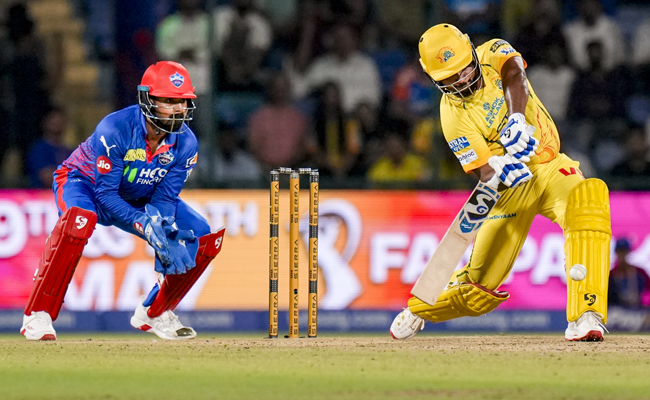
New Delhi (PTI): Sanju Samson bossed the chase with authority, anchoring a modest 156-run target with a fluent 87 not out as Chennai Super Kings outclassed Delhi Capitals by eight wickets in the IPL here on Tuesday.
Samson's knock came off just 52 balls with seven fours and six sixes, batting through the innings as CSK completed the chase in just 17.3 overs giving a huge boost to their net run-rate.
Electing to bat on a tricky surface, Delhi Capitals were restricted to 155/7.
West Indies left-arm spinner Akeal Hosein set the tone with the new ball, returning tidy figures of 1/19, including 14 dot balls.
Reduced to 69/5 in 11 overs, Delhi found some late impetus through Tristan Stubbs (38; 31 balls) and Sameer Rizvi (40 not out; 24 balls), who stitched together a crucial 65-run (off 47 balls) stand to give the innings a respectable total.
Brief Scores:
Delhi Capitals: 155 for 7 in 20 overs (Tristan Stubbs 38, Sameer Rizvi 40 not out; Noor Ahmed 2/22)
Chennai Super Kings 159 for two in 17.3 overs (Sanju Samson 87 not out, Kartik Sharma 41 not out). CSK win by eight wickets.