HC allows felling of around 20,000 mangrove trees for Mumbai-Ahmedabad bullet train project
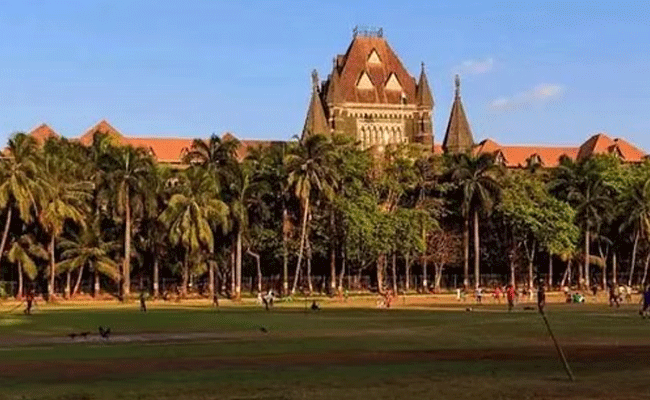
Mumbai (PTI): The Bombay High Court on Friday permitted the National High Speed Rail Corporation (NHSRCL) to cut around 20,000 mangrove trees in the city and neighbouring districts of Palghar and Thane for the Mumbai-Ahmedabad bullet train project.
A division bench of Chief Justice Dipankar Datta and Justice Abhay Ahuja allowed the plea filed by the NHSRCL seeking permission to cut the mangrove trees.
As per a 2018 order of the high court, there exists a "total freeze" on the destruction of mangroves across the state and permission has to be sought from the high court each time an authority wishes to fell mangroves for any public project.
As per the said order, a 50 m buffer zone must be created around the area that hosts the mangroves and no construction activity or dumping of debris can be permitted within this buffer zone.
In its petition filed in 2020, the NHSRCL had assured the court it would plant five times the total mangrove trees that were earlier proposed to be felled and the number would not be reduced for the same.
The plea was opposed by 'Bombay Environmental Action Group', an NGO, on the ground that no study was undertaken about the survival rate of saplings to be planted as a compensatory measure and the Environmental Impact Assessment report for felling trees has not been provided.
The NHSRCL had denied the objections raised by the NGO and claimed that it had availed required approvals for the felling of trees for the project of public importance and would compensate the loss occurring due to the same by planting of saplings as directed.
The 508-km high speed rail corridor between Ahmedabad and Mumbai is expected to cut travel time from six-and-a-half hours to two-and-a-half hours.
The bullet train project received a major push after the Eknath Shinde-Bharatiya Janata Party (BJP) government came to power in June this year. The dispensation has given all approvals for this project, the foundation of which was laid by Prime Minister Narendra Modi in September 2017.
Let the Truth be known. If you read VB and like VB, please be a VB Supporter and Help us deliver the Truth to one and all.
Manipur: Mortal remains of children killed in bomb attack handed over to family
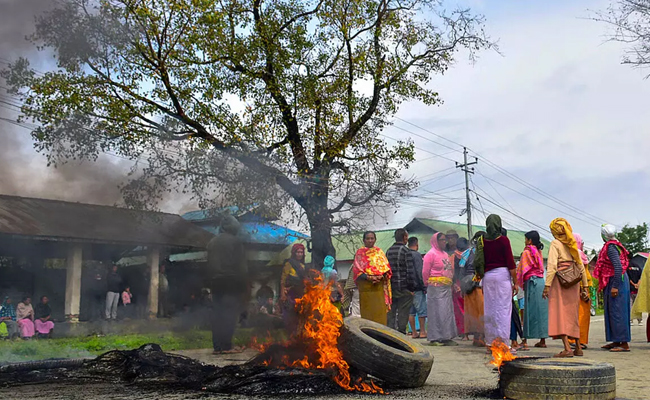
Imphal (PTI): The mortal remains of two children, who were killed in a bomb attack in Manipur's Bishnupur district in April, were handed over to family members on Saturday, officials said.
The bodies of the five-year-old boy and his six-month-old sister were kept in the morgue for 25 days, as the family members had refused to accept the mortal remains, demanding that the perpetrators be brought to book at the earliest.
On April 25, Chief Minister Y Khemchand Singh had appealed to the family members of the children to accept the bodies. Singh had also said that all efforts were underway to find the culprits.
The two children were killed in a bomb attack at Tronglaobi in Bishnupur district on April 7. Their bodies were kept in the morgue at the Regional Institute of Medical Sciences in Imphal.
The incident had triggered widespread violent protests in the five valley districts of Manipur, and the case was subsequently handed over to the NIA.
Hundreds of people lined up along the way to Tronglaobi to offer floral tributes, as the mortal remains were taken for the last rites in an open vehicle earlier in the day.