Husband has to equally participate in household chores as he is not marrying a maid: SC
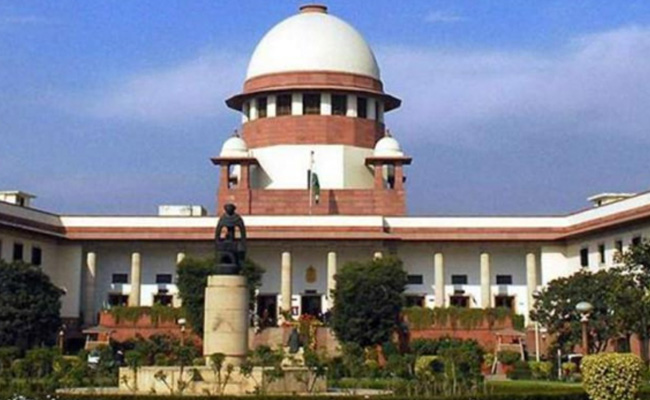
New Delhi (PTI): The Supreme Court on Friday said a husband has to equally participate in household chores like cooking, cleaning and washing as he is not marrying a maid but a life partner.
The observations came from a bench of Justices Vikram Nath and Sandeep Mehta which was hearing a petition filed by a man challenging an order of the Karnataka High Court.
The high court had set aside a trial court order granting divorce to the man on the ground of cruelty.
During the hearing before the apex court, the counsel appearing for the man said the mediation between the parties had failed.
He said the marriage between the parties took place in May 2017 and since 2019, the couple is separated.
ALSO READ: Four held for throwing non-veg food leftovers near temple
"I (man) want a divorce. The trial court granted a divorce on the ground of cruelty," the counsel said.
The bench asked what the cruelty was as alleged in the matter.
The counsel appearing for the man said the woman had indulged in improper behaviour and was not cooking food.
"You have to equally participate in all these. Cooking, cleaning, washing, everything. Today's times are different," Justice Nath observed, adding the high court was right that it might not be a ground for cruelty.
"You are not marrying a maid. You are marrying a life partner," Justice Mehta observed.
The bench was told that both of them were working in a government school.
"Call both parties physically. We would like to speak to them," the bench said.
It posted the matter for hearing on April 27 and asked both parties to remain present before it.
Let the Truth be known. If you read VB and like VB, please be a VB Supporter and Help us deliver the Truth to one and all.
Cabs should accommodate wheelchairs or assistive devices of persons with disabilities: SC
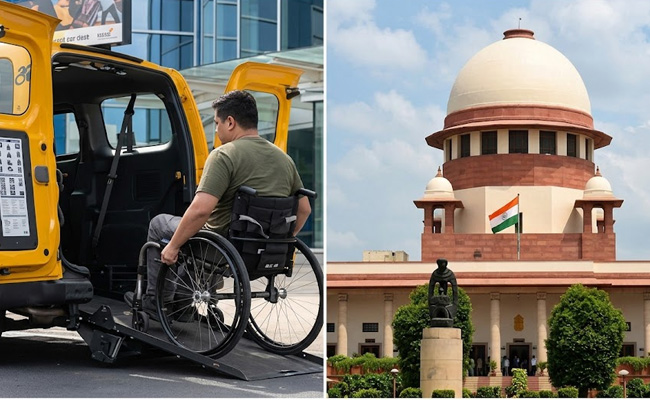
New Delhi (PTI): The Supreme Court on Friday emphasised the need to find ways to assist people with disabilities, and suggested that cab services should be equipped to accommodate wheelchairs and other assistive devices for them.
The observations came from a bench of Justices Vikram Nath and Sandeep Mehta, which was hearing a plea regarding first-mile and last-mile connectivity for people with disabilities.
"Now, in larger metros, there are cabs everywhere. Cabs should also be asked to accommodate wheelchairs or assistive devices of these persons," the bench said, proposing the idea of having specific cabs designated for persons with disabilities.
"The apps can have provision for specified cabs which have been accordingly modified for these individuals," the bench said, adding, "We have to find out the ways and means to help them."
The counsel appearing for the petitioner referred to the difficulties faced by people with disabilities while boarding cabs.
"Most cabs are equipped with CNG, which limits space and does not allow for wheelchairs to be transported in the back," the counsel said.
He proposed implementing a universal design similar to what is available in European markets.
"Take the case of a person whose house is, say, one km away from the highway or the main road. He comes on an automated wheelchair. If he doesn't accommodate it in the cab, where does he leave it?" the bench asked the counsel appearing for the Centre.
In response, the Centre's counsel stated that these issues are currently under review by the relevant department. They also informed the bench that a committee had been appointed by the Supreme Court to address a separate petition that raised similar concerns.
The bench observed that the issue raised in this petition could also be considered by that committee.
The petitioner's counsel said that they had a specific case concerning last-mile connectivity, distinct from broader issues.
"That specific issue can also be taken up by the committee, which is already dealing with larger issues," the bench observed.
The petitioner's counsel reminded the court that cabs are now an integral part of public transport.
The Supreme Court has scheduled further hearings on the plea for March 24.